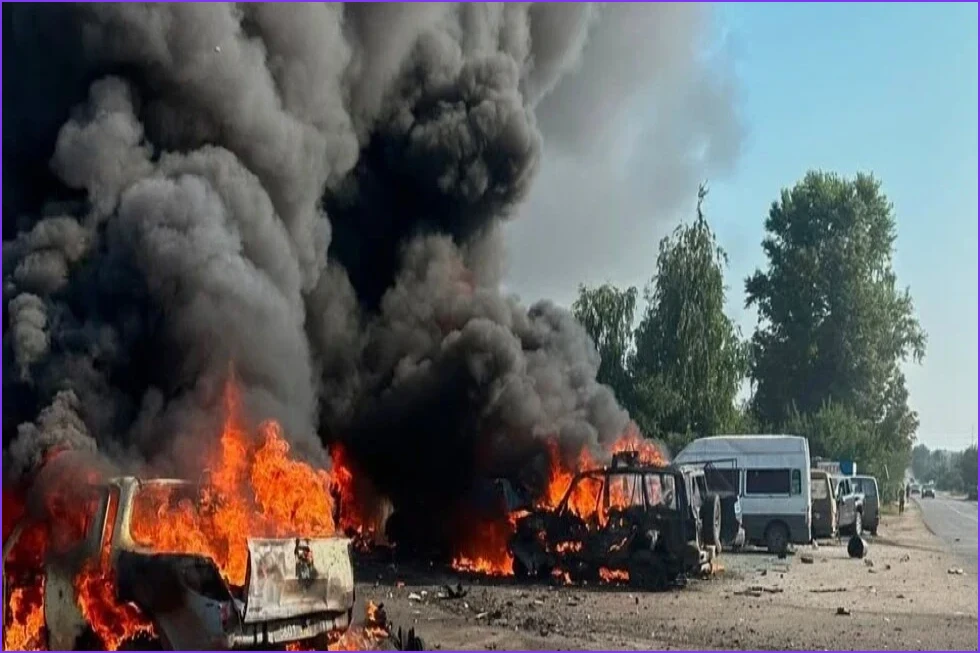
Ukrainian forces have executed one of their largest drone operations against Russia since the invasion began more than four years ago, deploying nearly 800 drones just two days after launching a similar massive barrage. Meanwhile, a devastating Russian missile strike on a village in northeastern Ukraine's Kharkiv region killed at least 10 civilians and wounded 17 others, destroying local homes and infrastructure.
The dual strikes highlight an intensifying long-range aerial duel between the two nations. On the ground, the approximately 1,250-kilometer (780-mile) front line in eastern and southern Ukraine remains largely deadlocked. Analysts note that massive deployments of drones and ground-based robots have severely restricted troop movements, preventing either side from making significant battlefield progress.
Over the past year, Ukraine has increasingly relied on domestically engineered long-range drones to strike targets deep inside Russian territory. This rapidly evolving drone technology has drawn the attention of defense manufacturers and governments worldwide. Officials in Kyiv have openly stated that these operations aim to bring the reality of the war to the Russian public, hoping to pressure Russian President Vladimir Putin into negotiating a peace settlement.
However, Putin has shown no intention of halting the invasion. Ukrainian Foreign Minister Andrii Sybiha criticized the Russian leader on social media, writing that "Putin continues to drag out the war instead of accepting Ukraine’s realistic ceasefire proposals and ending the bloodshed."
According to the Russian Defense Ministry, air defense systems intercepted 791 Ukrainian drones overnight across multiple Russian regions, annexed Crimea, and the Black and Azov seas. This marked the second-largest drone offensive recorded since January 2025. Moscow Mayor Sergei Sobyanin reported that more than 600 of the drones were flying toward the Moscow region, with 180 of them shot down, though he did not provide further specifics.
While no deaths or major structural damages were reported in the capital, Moscow regional Governor Andrei Vorobyov confirmed that three people were wounded. In the neighboring Ryazan region, Governor Pavel Malkov reported three additional injuries and damage to three private homes.
The overnight drone wave also sparked a fire at an industrial zone warehouse belonging to Wildberries, Russia's largest online retailer. Ukrainian officials have targeted the company previously, alleging that it helps supply the Russian military—a claim that Moscow denies. Wildberries stated that the facility sustained only "insignificant damage."
Russian state-controlled media largely muted coverage of the massive drone incursions, which is typical for such incidents. The country's primary state-run television channels, Russia 1 and Channel One, completely omitted the attacks from their morning news bulletins. However, the state news agency RIA Novosti featured the event prominently on its homepage, labeling it "one of the most large-scale attacks on Moscow since the beginning of the summer." The state-run newspaper Rossiyskaya Gazeta also highlighted the incident, using the word "massive" in its headline to describe Governor Vorobyov's updates, while the pro-Kremlin tabloid MK carried a brief report on its main page.
In northeastern Ukraine, the Russian missile strike on the village of Pechenihy in the Kharkiv region caused severe civilian casualties. Oleh Syniehubov, head of the Kharkiv regional military administration, stated that preliminary reports confirmed 10 dead and 17 wounded. Ukrainian President Volodymyr Zelenskyy condemned the action as "a brutal attack." Syniehubov detailed that the barrage damaged 10 private homes, a cafe, a post office, a retail store, and at least seven vehicles.
President Zelenskyy vowed on social media that Ukraine would definitely respond to the strike. Additionally, Ukraine's National Police reported that Russian attacks on the nearby Sumy region over the past day killed three people and wounded three others.
The escalating drone warfare has also triggered a diplomatic row involving the United Kingdom. British Prime Minister Andy Burnham, who took office last month, reaffirmed the U.K.'s unwavering support for Kyiv after Russia warned of unspecified consequences following reports that Ukraine used British-made drones to strike targets inside Russia. Burnham stated, "We are providing support so that Ukraine can defend itself, and that’s been the British position all the way through this conflict by previous prime ministers. It remains the case with me."
This statement followed a report by the British newspaper The Sunday Times, which revealed that two companies based in the United Kingdom manufactured drones utilized by Ukrainian forces to strike Russian territory. In response, the Russian Embassy in the U.K. issued a statement warning that "London’s actions will inevitably carry consequences." Russian Foreign Minister Sergey Lavrov also addressed the issue on state television, asserting that Moscow has every right to interpret British involvement in strikes on Russian soil as direct "participation in the war, with all the ensuing consequences."