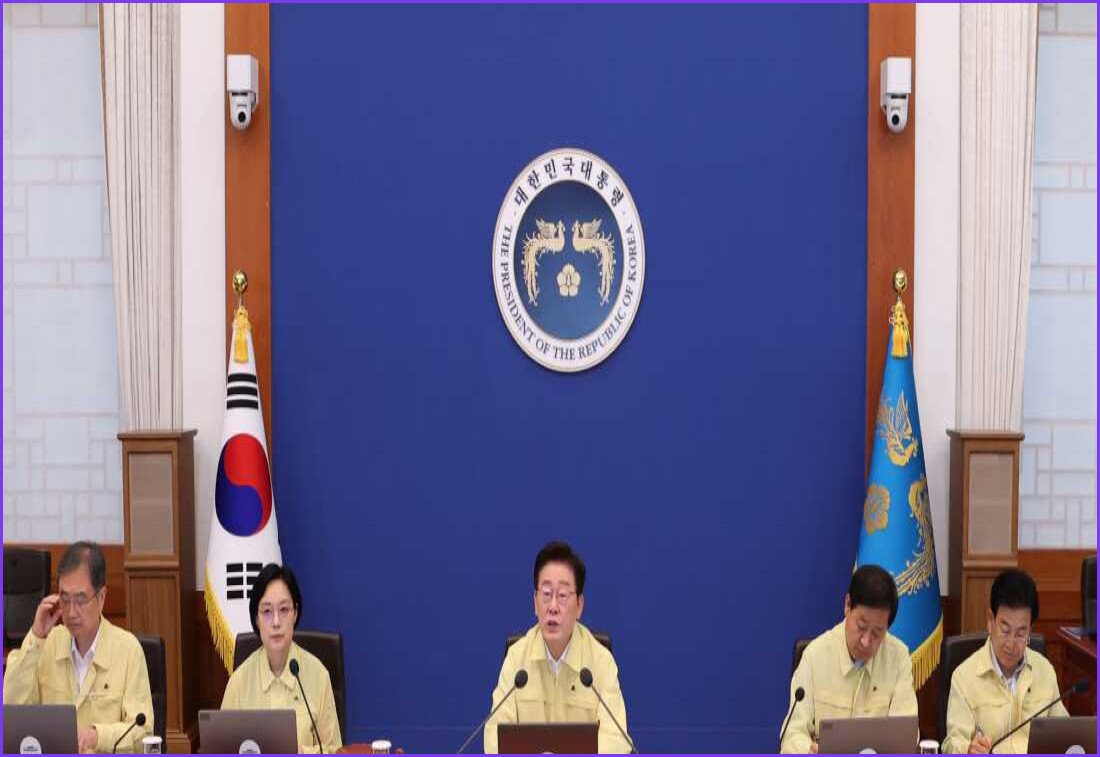
South Korean President Lee Jae Myung sought to reassure his nation on Tuesday, declaring that a solid alliance with the United States remains the foundation of national security following U.S. President Donald Trump's unexpected order to scale back joint military drills.
The surprise announcement from Trump was posted on social media just before American and South Korean forces began their annual 11-day Ulchi Freedom Shield exercises on Monday. These drills are primarily designed to maintain readiness against threats from North Korea. Trump justified his decision by pointing to his positive relationship with North Korean leader Kim Jong Un and expressing frustration over South Korea's refusal to join U.S. military efforts against Iran. According to Trump, when he asked President Lee if South Korea would assist in the denuclearization of Iran, the response was, "No thanks!"
In response to Trump's claims, Lee's office stated that Seoul and Washington are actively discussing practical and military contributions South Korea can provide to help maintain freedom of navigation in the Strait of Hormuz.
Trump's unilateral decision, seemingly made without consulting Seoul, has sparked widespread concern across South Korea. The East Asian nation holds no nuclear weapons of its own and depends heavily on the U.S. "nuclear umbrella" to deter potential attacks from nuclear-armed North Korea. The U.S. currently stations about 28,500 troops in South Korea. Public trust in Washington had already been strained by Trump's tariff policies and a federal immigration raid in Georgia last year that led to the detention of hundreds of South Korean workers.
During a regularly scheduled Cabinet meeting in Seoul, President Lee, a liberal leader who has advocated for a more self-reliant national defense, emphasized the necessity of a stable security partnership. "National security will be further strengthened when the alliance is solid," Lee said. "When we build up our strengths, our value and importance as an ally will further grow."
However, the administration's handling of the situation drew sharp criticism from domestic political opponents. On Monday, Lee's office expressed hope that the personal rapport between Trump and Kim could lead to meaningful peace talks, prompting a swift backlash from conservatives who accused the government of prioritizing diplomatic overtures over concrete security. Park Chung-kwon, a spokesperson for the main conservative opposition People Power Party, warned that "South Korea's security bulwark is being shaken to its very foundations."
The local media also reflected public anxiety. An editorial published Tuesday in the Hankook Ilbo newspaper argued that the incident "reveals the stark reality of a faltering Korea-U.S. alliance, fueling public anxiety," adding that it was "absurd" for the U.S. to appear to treat North Korea with more respect than its treaty ally.
It remains unclear which components of the joint exercises will be downsized. Prior to Trump's post, both militaries had announced that the drills would proceed at a scale similar to previous years, incorporating strategic lessons from modern global conflicts, including North Korea's battlefield support on the Russia-Ukraine front. North Korea's Foreign Ministry had already condemned the drills as highly provocative, promising to counter them with "a new level of a deterrent."
Diplomatic experts doubt that Trump's gesture will easily coax Kim Jong Un back to negotiations. Kim has avoided formal talks with Washington and Seoul since his high-profile summits with Trump collapsed in 2019, choosing instead to expand his nuclear arsenal and align closer with Russia. Leif-Eric Easley, a professor at Ewha University in Seoul, noted that Trump treats alliances like financial investments expected to pay regular dividends. "South Korean leaders understand that relations with the Trump administration will be a constant renegotiation linking economic and security issues," Easley said, noting that Seoul is managing current events cautiously within that framework.
South Korean President Lee Jae Myung, center, speaks during a cabinet meeting at the presidential office in Seoul, South Korea, Tuesday, Aug. 18, 2026. Yonhap/AP hide caption
Trump's move was apparently taken without consultations with South Korea and meant to reach out to Kim, deepening concerns about the reliability of the U.S.-South Korean alliance forged in the turmoil of the 1950-53 Korean War.