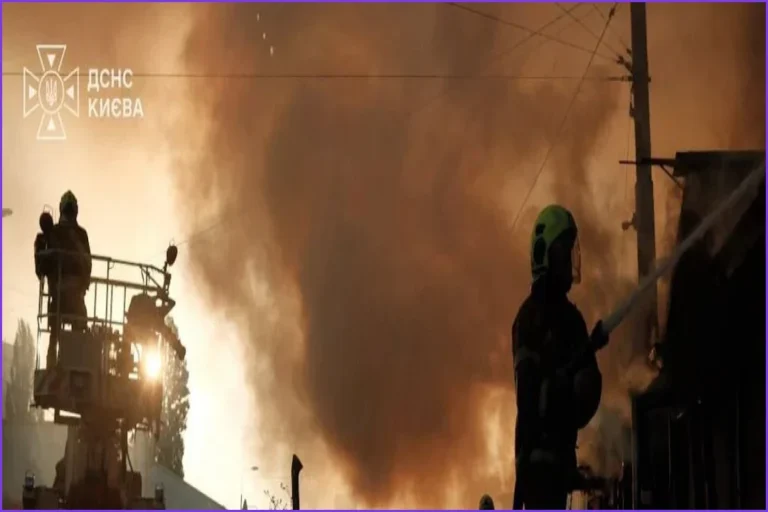
Ukraine’s strategic campaign of long-range drone strikes has expanded beyond military and energy infrastructure to target Wildberries, Russia's largest online retailer. By striking the e-commerce giant’s massive logistics hubs, Kyiv has destroyed billions of dollars in merchandise, disrupted the domestic economy, and brought the daily reality of the war directly to the Russian public.
The drone campaign has targeted approximately 20 Wildberries facilities across the country, presenting a fresh challenge to Russian President Vladimir Putin nearly four and a half years into the full-scale invasion of Ukraine. The strikes have severely impacted the business empire of Tatyana Kim, Russia's wealthiest female entrepreneur, whose fortune is estimated at $8.1 billion. With hundreds of thousands of individual sellers losing their inventory, the economic shockwaves are spreading through Russia's financial systems, particularly as Wildberries faces potential difficulties repaying massive loans drawn from VTB and other financial institutions.
Kim, 50, founded Wildberries in 2004 from her Moscow apartment while working as an English teacher shortly after the birth of her first child. Born in Grozny, the capital of Chechnya, to an ethnic Korean family of an engineer and a teacher, she has since become a mother of seven. What began as a platform selling clothing has evolved into Russia's undisputed e-commerce leader, accounting for roughly half of all online orders across the country's 11 time zones. Often described as Russia's equivalent to Amazon, the platform accommodates between 500,000 and 800,000 sellers. Following the exodus of Western brands after the invasion of Ukraine, Wildberries helped fill the retail void by sourcing merchandise from China, Turkey, the United Arab Emirates, and other nations. The company also acquired a bank, expanded into tourism, and has explored purchasing an airline.
However, the company's rapid expansion relied heavily on a centralized logistics network of about two dozen giant warehouses, which stockpiled goods before distributing them to approximately 100,000 pickup points. This reliance on a small number of massive hubs made Wildberries highly vulnerable to Ukraine's long-range drone strategy. Unlike competitors such as Ozon and Yandex Market, Wildberries concentrated its inventory in unprotected depots, some spanning up to 300,000 square meters (about 3.2 million square feet).
The targeted campaign began on July 18 with strikes in Elektrostal, located just east of Moscow, and in the southwestern Tambov region. The fire at the Elektrostal hub, a critical logistical node for the Moscow region, took three days to extinguish. More recently, another major distribution hub in Podolsk, also near the capital, was set ablaze. According to Ukraine's Defense Ministry, seven of Wildberries' ten largest logistics centers have been knocked out of operation. The reach of these attacks has extended far beyond the border regions, striking as far as Yekaterinburg, more than 2,000 kilometers (1,250 miles) from Ukraine.
While official data remains scarce, some analysts estimate that up to 20 percent of Wildberries' total warehouse capacity has been destroyed, with financial losses estimated to be as high as $6 billion. The company’s outstanding debts were valued at approximately $15 billion at the end of 2025. In response to the ongoing threat, Kim stated that Wildberries facilities have been defensively reinforced, and the company is attempting to restructure its supply chains by establishing smaller "partner hubs."
The economic fallout has heavily burdened Russia's small and medium-sized businesses, which were already grappling with tax increases, regulatory hurdles, and a fuel crisis caused by Ukrainian strikes on oil refineries. To shield itself from mounting liabilities, Wildberries recently updated its seller policy to exempt the company from financial responsibility for inventory destroyed by "force majeure" events, including drone attacks. Although Kim promised to support affected sellers with storage discounts, free transfers of goods, and discounted loans, the partial reimbursements issued so far cover only a fraction of the actual losses. To mitigate the crisis, Russia's Central Bank has requested that commercial lenders restructure loans for small and medium businesses that lost their stock. Meanwhile, independent pickup point operators are facing severe revenue drops due to a plunge in deliveries, with some taking to social media to warn they may go out of business.
Ukrainian officials have justified the targeting of Wildberries by asserting that the platform is used to sell technical components and military gear, including drone parts, flak jackets, and thermal weapon sights, to the Russian military. Although Moscow has denied these allegations, such dual-use items remain readily available for purchase on the website.
The strikes have also carried a significant psychological and political impact. Mark Galeotti, a Russia expert and head of the Mayak Intelligence consultancy, noted that the attacks are designed to bring the war home to ordinary Russian citizens. Rather than just seeing smoke from distant oil refineries, ordinary consumers are finding themselves unable to receive purchases, and local business owners are seeing their entire livelihoods go up in smoke.
However, some analysts warn that the strategy could backfire by intensifying anti-Ukrainian and anti-Western sentiment. Pro-Kremlin political analyst Sergei Markov suggested that the attacks play into the hands of Russian military hawks who are calling for an escalation of the conflict, stating that it strengthens the view that Russia must strike Europe sooner rather than later. Former Russian President Dmitry Medvedev also sought to channel public anger, claiming that Ukraine's actions prove the enemy is targeting ordinary citizens and their daily routines rather than the military.
Kim’s business empire has also faced severe internal turmoil. In 2024, her divorce from her husband, Vladislav Bakalchuk, sparked a violent battle for control of Wildberries. Bakalchuk sought assistance from Chechen leader Ramzan Kadyrov and his paramilitary forces. The dispute culminated in a fatal shootout at a business office near the Kremlin, leaving two people dead and several others injured.