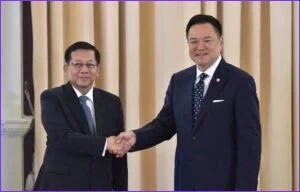
Thailand’s recent diplomatic overtures toward Myanmar have sparked concerns that the kingdom is breaking ranks with the Association of Southeast Asian Nations (ASEAN). On August 6, 2026, Prime Minister Anutin Charnvirakul hosted Myanmar’s military-appointed leader, Min Aung Hlaing, in Bangkok. This two-day visit, which included a stop at the Thai parliament, was framed by the Thai government as a move toward stability. During the trip, the two nations signed three memoranda of understanding covering labor, water, and space cooperation, while Min Aung Hlaing urged Thai business leaders to invest in his country.
The diplomatic red carpet for the junta leader, who has faced significant international isolation since the 2021 coup, was not without domestic friction. The visit drew opposition from Thai civil society groups and activist networks, including a notable protest by a Thai parliamentarian who shouted calls for peace and humanity during the proceedings. Despite this, the Thai government defends its strategy, which it terms “calibrated reengagement,” as a necessary step to address the spillover effects of Myanmar’s civil war, such as migration, cross-border crime, and scam networks.
Professor Thitinan Pongsudhirak of Chulalongkorn University has criticized the move, arguing that it grants legitimacy to the junta without requiring adherence to the ASEAN Five-Point Consensus. This shift complicates the roles of the current ASEAN chair, the Philippines, and Singapore, which is set to lead the bloc in 2027. Prime Minister Anutin justified the outreach by citing reports of progress, including a meeting between detained leader Daw Aung San Suu Kyi and a representative from the International Committee of the Red Cross. Foreign Minister Sihasak Phuangketkeow further suggested that Myanmar might soon allow ASEAN representatives access to Aung San Suu Kyi.
However, this accommodative stance stands in stark contrast to the broader ASEAN policy. The bloc has consistently excluded Myanmar’s military leaders from high-level summits due to the lack of progress on the Five-Point Consensus. Philippine Foreign Secretary Ma. Theresa Lazaro, serving as the ASEAN special envoy on Myanmar, recently stated that the country’s readmission to the bloc remains “far off” without significant implementation of the consensus. By choosing a unilateral path that ignores the junta’s failure to act on these conditions, Thailand is seen by many analysts as directly challenging the unity of the regional organization. While Thailand seeks to manage its own border security, its current strategy risks eroding ASEAN’s collective influence and its role as a key regional mediator in the crisis.