Following the Japan-Philippines Summit Meeting held on May 28, 2026, Tokyo and Manila have initiated negotiations to define their overlapping Exclusive Economic Zones (EEZs) and continental shelves in the waters east of Taiwan. The diplomatic effort aims to clarify resource development scope, bolster maritime security and defense cooperation, and mitigate the risk of unforeseen clashes. While Japan views this as a model for peaceful resolution under the United Nations Convention on the Law of the Sea (UNCLOS) consistent with international law, China has strongly protested the initiative. Beijing claims rights over these waters, asserting that Taiwan is part of its territory and that any boundary negotiations regarding the area should involve China.
China’s strategic interest in the region is underscored by its territorial claims. While the nine-dash line has long been central to its South China Sea assertions, the "2023 edition of China’s standard map," released by the Ministry of Natural Resources on August 28, 2023, includes a tenth dash line extending east of Taiwan. Furthermore, the People’s Liberation Army has frequently deployed carrier groups and conducted military exercises in the area, signaling potential preparation for an invasion from the east.
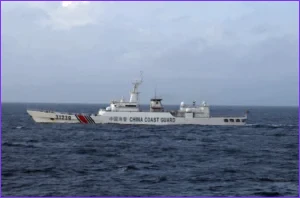
In June 2026, coinciding with its public criticism of the Japan-Philippines talks, the China Coast Guard (CCG) began conducting regular law enforcement patrols off Taiwan’s eastern coast. This maneuver is part of a broader effort to normalize a presence that integrates military, legal, and administrative functions. This approach mirrors previous tactics, such as the February 2024 Kinmen Islands episode. Following the death of two Chinese fishermen during a Taiwanese Coast Guard operation on February 14, 2024, the CCG announced and subsequently enforced patrols in Xiamen-Kinmen waters, effectively altering the status quo. Similarly, in September 2012, Beijing began routine coast guard intrusions into Senkaku territorial waters following the Japanese government’s nationalization of land there.
By treating the Japan-Philippines boundary negotiations as an "incident or accident," Beijing has moved to establish a daily, normalized law enforcement presence east of Taiwan. This strategy is also linked to a broader diplomatic narrative. Since Japanese Prime Minister Takaichi Sanae described the regional situation as one "threatening national survival" during a House of Representatives Budget Committee meeting on November 7, 2025, China has intensified its criticism of Tokyo. Beijing frames Japanese foreign policy as "neo-militarism," using this narrative to justify its own actions as a response to perceived provocations, a pattern that experts suggest is likely to persist across the Western Pacific.
You have reached the limit of 2 free articles this month.