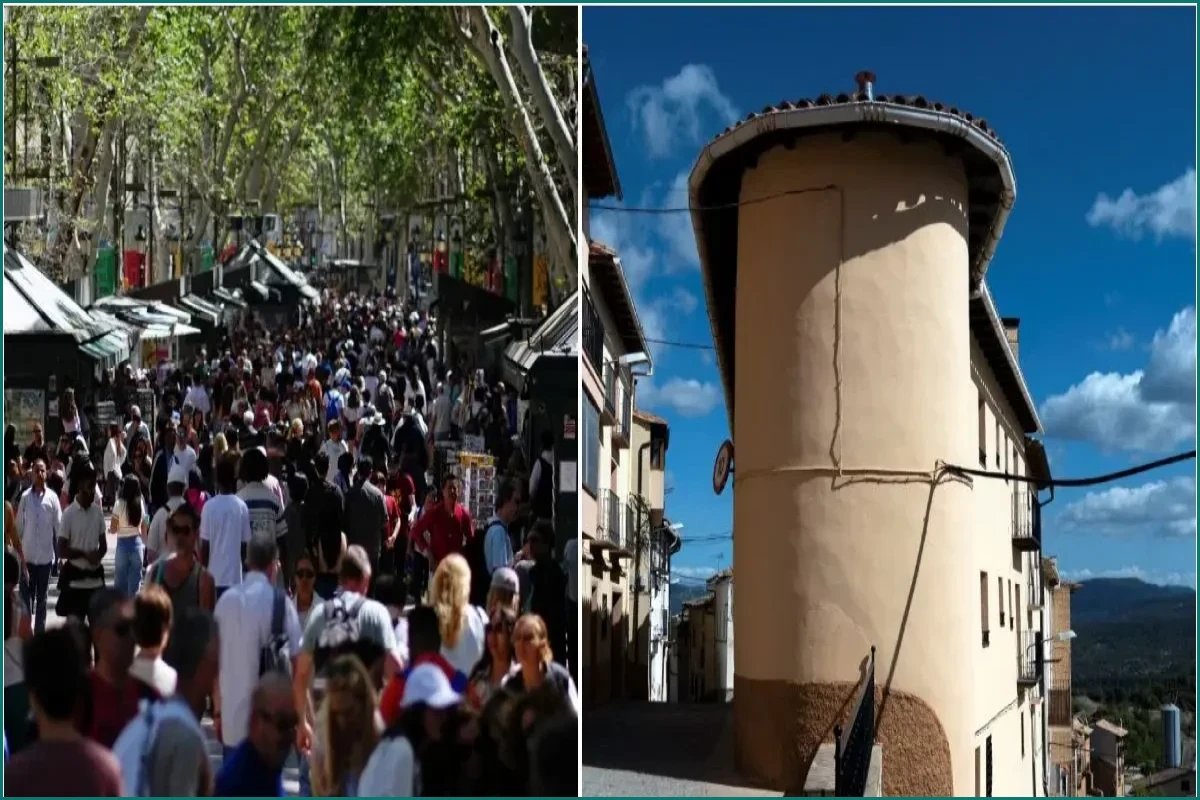
Spain presents a striking demographic anomaly within Europe, characterized by a profound imbalance in how its people are distributed across the land. Currently, approximately 90 percent of the nation's residents are concentrated within just 2.6 percent of its total territory. This creates a sharp, visible contrast between the densely populated urban centers and the vast, sparsely inhabited stretches of the country's interior. While the national average population density stands at about 97 people per square kilometer, this figure obscures the reality on the ground.
For instance, Barcelona maintains a population density of 16,000 people per square kilometer, whereas the province of Soria records a mere 9 people per square kilometer. In total, only around 12.7 percent of Spanish land is inhabited, a statistic comparable to the most inhospitable regions of the Alps or the Scandinavian Peninsula.
This phenomenon of the 'Empty Spain', known locally as La España Vaciada, encompasses a vast swath of the interior, including provinces such as Palencia, Zamora, Salamanca, Cáceres, Ávila, Segovia, Soria, Guadalajara, Cuenca, and Teruel. Large parts of northeastern Spain are even referred to as 'Spanish Lapland' due to their extreme lack of residents.
Despite Spain being on the verge of reaching 50 million inhabitants—driven by a progressive rise in population thanks to an increase in immigration—these new arrivals, who are largely of working age, are heading to the same overcrowded cities where most Spaniards already live.
Meanwhile, in the 'Empty Spain' regions, depopulation continues to worsen, and despite the abundance of cheaper, albeit largely derelict housing, hardly anyone wants to move there.
The roots of this distribution are deep, dating back to the Reconquista, a period of conflict lasting roughly 800 years from 718 at the Battle of Covadonga in Asturias until the creation of a unified Spain when the Catholic Monarchs Isabella I and Ferdinand II took back the last Moorish stronghold in Granada in 1492. During these times of conflict, a scarcity of materials and manpower made it impossible to guarantee the security of new settlements, forcing the population to concentrate in areas that were easier to defend and had ensured resources.
This cemented life in densely populated cities over hundreds of years, and by the 18th century, the current marked population distribution could already be seen.
In the 20th century, the gap widened further, particularly from 1950 to 1991. Historians believe the España Vaciada phenomenon was primarily created by a massive mid-20th-century rural exodus inspired by dictator Francisco Franco. His technocratic stabilization and industrialization plans concentrated state investment, factories, and infrastructure in major urban centers like Madrid, Barcelona, and Valencia, leaving the agrarian interior impoverished, isolated, and largely abandoned.
If people wanted better jobs and greater earning potential, they had to move to the cities or coastal areas.
Environmental factors have also played a decisive role in shaping this landscape. The Meseta Central, Spain’s huge central plateau, acts like a high-altitude semi-desert. It is characterized by scorching summers, freezing winters, and scarce rainfall. These harsh conditions make traditional rain-fed farming a high-risk, low-yield endeavor. Sudden frosts and intense dry spells regularly ruin olive and almond harvests, triggering local job losses.
Therefore, high temperatures, low rainfall, difficult terrain, and poor soil have all played a role in pushing people toward the coast and big cities, though there are exceptions such as Andalusia and Madrid, which sits in the center of the Iberian Peninsula and is the third most populous region in Spain.
Spain's population schism was further exacerbated during the 2008 financial crisis. A study by the Bank of Spain titled 'Recent Population Trends in Rural and Urban Areas of Spain' points out that an uneven spatial distribution of the population leads to an unequal distribution of income.
Cities concentrate the majority of jobs, specifically 65 percent, and in particular the more stable contract positions, whereas in the countryside there is a far higher rate of self-employment. This has led to the ongoing migration of young people to the cities in search of better prospects.
Fewer people has resulted in a vicious circle of fewer services and jobs in 'Empty Spain'. Depopulated areas have increasingly lost access to basic services such as education, healthcare, leisure, and transport, making them less attractive to families and working professionals. For example, many banks have pulled out of rural regions, making it even more difficult for people who cannot access services online or have access to cash.
Data from the National Institute of Statistics (INE) and demographic studies show that the gap between Spain's major urban centers and 'Empty Spain' is likely to keep getting wider. Although the COVID-19 pandemic saw more people moving to rural areas to work remotely, and authorities in many regions are actively trying to encourage young families to move there through financial incentives, it is still not enough.
In truth, this hugely uneven population density is bad for both sides. People in the crowded coastal and urban areas fight for all available services, jobs, and housing, while in the empty interior there are too few people for new or existing population centers to ever stand a chance of blossoming.
READ ALSO: Seven in ten homes empty in Spain's villages in midst of national housing crisis
READ ALSO: How 'Empty Spain' is now a political party