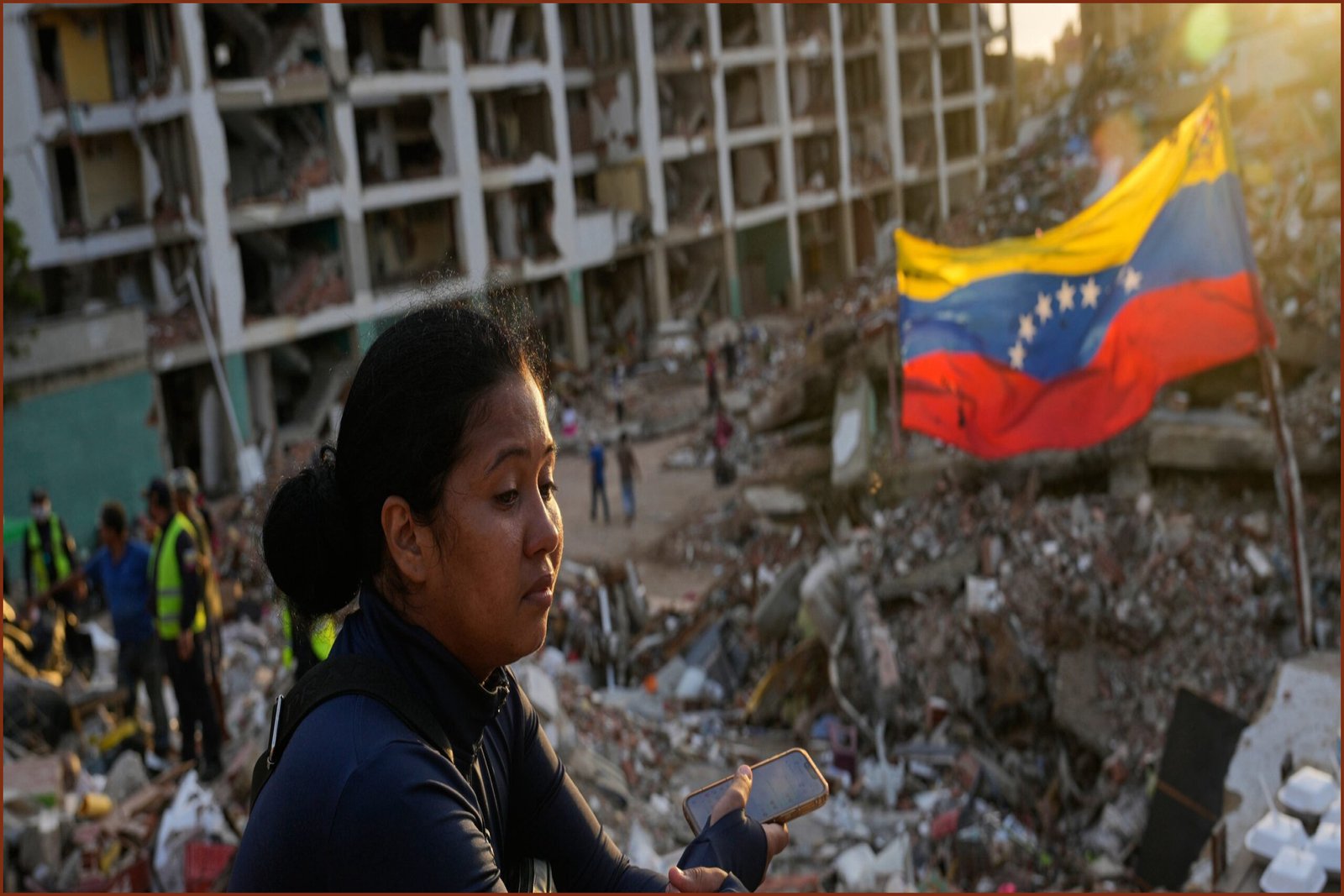
In the wake of twin earthquakes that devastated parts of Venezuela, killing 4,829 people and leaving 16,740 injured according to official government figures, the nation's push for a return to democracy has been pushed to the background. While a group of about 100 protesters recently gathered in Caracas to demand free elections and the release of more than 300 political prisoners, their demonstration was largely ignored by the authorities, save for the presence of shotgun-toting police agents. The protesters, who marched to secret police headquarters, saw their movement dissipate shortly after, as the government prioritized disaster recovery efforts over political demands.
Acting President Delcy Rodríguez, who took over following the seizure of authoritarian leader Nicolás Maduro by U.S. troops in January, is currently working in coordination with the Trump administration. However, U.S. officials appear to be prioritizing the resurrection of the Venezuelan oil industry over the advancement of democratic reforms. Critics of the current government argue that the state of emergency declared in response to the earthquakes has provided Rodríguez—who has retained many pro-Maduro hard-liners in her administration—a pretext to ignore calls for a clear timetable for presidential elections.
The political climate remains fraught with tension. Last month, the government briefly closed the country's airspace to prevent opposition leader María Corina Machado from returning from the United States. In a speech delivered last week, Rodríguez accused her political opponents of exploiting the post-earthquake chaos to conspire against her government. This rhetoric has left opposition activists feeling deeply frustrated. José Rolón, a pro-Machado activist based in La Guaira state, which was the area hardest hit by the earthquakes, stated that the regime consistently invents new excuses to delay progress. He noted that for the current leadership, it will never be the right time to discuss democratic transitions or elections.
Some analysts suggest caution regarding the speed of a potential transition. Vladimir Villegas, a radio show host and former diplomat, argues that Venezuela must first overhaul its highly partisan supreme court and electoral council before holding new elections. These institutions were responsible for ratifying Maduro’s claims of victory in the 2024 presidential election, despite widespread evidence that he lost in a landslide to opposition candidate Edmundo González, who had been endorsed by Machado after she was banned from running. Villegas noted that while Rodríguez is currently unpopular and faces heavy criticism for her government's slow response to the earthquake, she may be less inclined to cling to power indefinitely after witnessing the fate of Maduro, who is now held in a New York prison on drug-trafficking charges.
The opposition movement itself faces significant internal challenges. Machado’s faction previously boycotted legislative elections and remains critical of those who chose to participate in the National Assembly. Furthermore, the infrastructure of many political parties was severely damaged or outlawed under the Maduro regime. Vente Venezuela, Machado's party, is currently working to regroup after its main office in Caracas was looted and many of its activists were forced to flee or were imprisoned. Among the recently released political prisoners is Henry Alviárez, the party's deputy leader. Despite his release, Alviárez faces ongoing charges of terrorism, treason, and conspiracy, and he is required to report to judicial authorities monthly while remaining under a travel ban. He described the party's struggle to regroup after being forced underground. As they await the return of Machado, activists like Rosa Cucunuba are focusing their efforts on providing earthquake relief, including the distribution of medical supplies like antibiotics, face masks, and body bags to health workers in the disaster zone. Cucunuba emphasized that while they are currently dedicated to helping those in need, they remain fully committed to the long-term goal of achieving freedom and pushing for free elections once the recovery efforts subside.
Estefany Landaez sits amid the rubble of a collapsed building in La Guaira, Venezuela, on Sunday as she waits for news about her two children following the earthquakes. Ariana Cubillos/AP hide caption