The United States military has destroyed five Iranian oil tankers in a series of strikes conducted on Tuesday, according to U.S. Central Command. The military action followed two separate attempts by Iran's Revolutionary Guards to target a Navy warship with ballistic missiles over the preceding two days. Officials stated that the American warship successfully evaded the incoming fire and continued its patrol of regional waters, with no injuries reported among U.S. personnel.
The vessels destroyed in the Gulf of Oman were identified as the Kivik, Charminar, Horizon 1, and the Riesco. Additionally, the U.S. military destroyed a fifth vessel, the Derya, which was located near Kharg Island in the Strait of Hormuz. According to the U.S. military, crews on all five ships were instructed to abandon their vessels prior to the strikes. Iranian state television corroborated the reports of the attacks, noting that the vessels were struck near the southern port of Jask and the Kharg Island anchorage area, and confirmed that the crews had been evacuated.
This escalation has had an immediate impact on global energy markets, with the price of international standard Brent crude briefly reaching $99.46 per barrel on Tuesday. The Strait of Hormuz, a vital maritime corridor through which roughly one-fifth of the world's oil passed before the conflict began, remains a focal point of the ongoing struggle for control between Washington and Tehran. Secretary of State Marco Rubio stated that the United States will not allow Iranian attacks to go unanswered.
In response to the U.S. strikes, Iran’s Revolutionary Guard Navy issued a warning to oil tanker crews operating near ports in Kuwait and Bahrain, ordering them to leave their vessels immediately. Tehran accused both nations of hosting U.S. forces and facilitating the attacks on Iranian shipping. Furthermore, Iran announced plans to establish a new "exclusion zone" near the Strait of Hormuz to regulate vessel transit.
Danny Citrinowicz, an expert on Iran at the Institute for National Security Studies, warned that the cycle of retaliatory strikes risks further destabilizing the global economy. He noted that there is no kinetic solution to the challenges in the Strait of Hormuz, cautioning that each attempt to impose one brings the United States and Iran closer to an escalation that may become increasingly difficult to manage. Currently, the U.S. military provides assistance to a limited number of ships transiting the route off Oman, while a U.S. blockade of Iranian ports continues to restrict the country's oil exports. Tehran has expressed a desire for ships to follow a specific route of its choosing through the strait, which was considered an international waterway before the war.
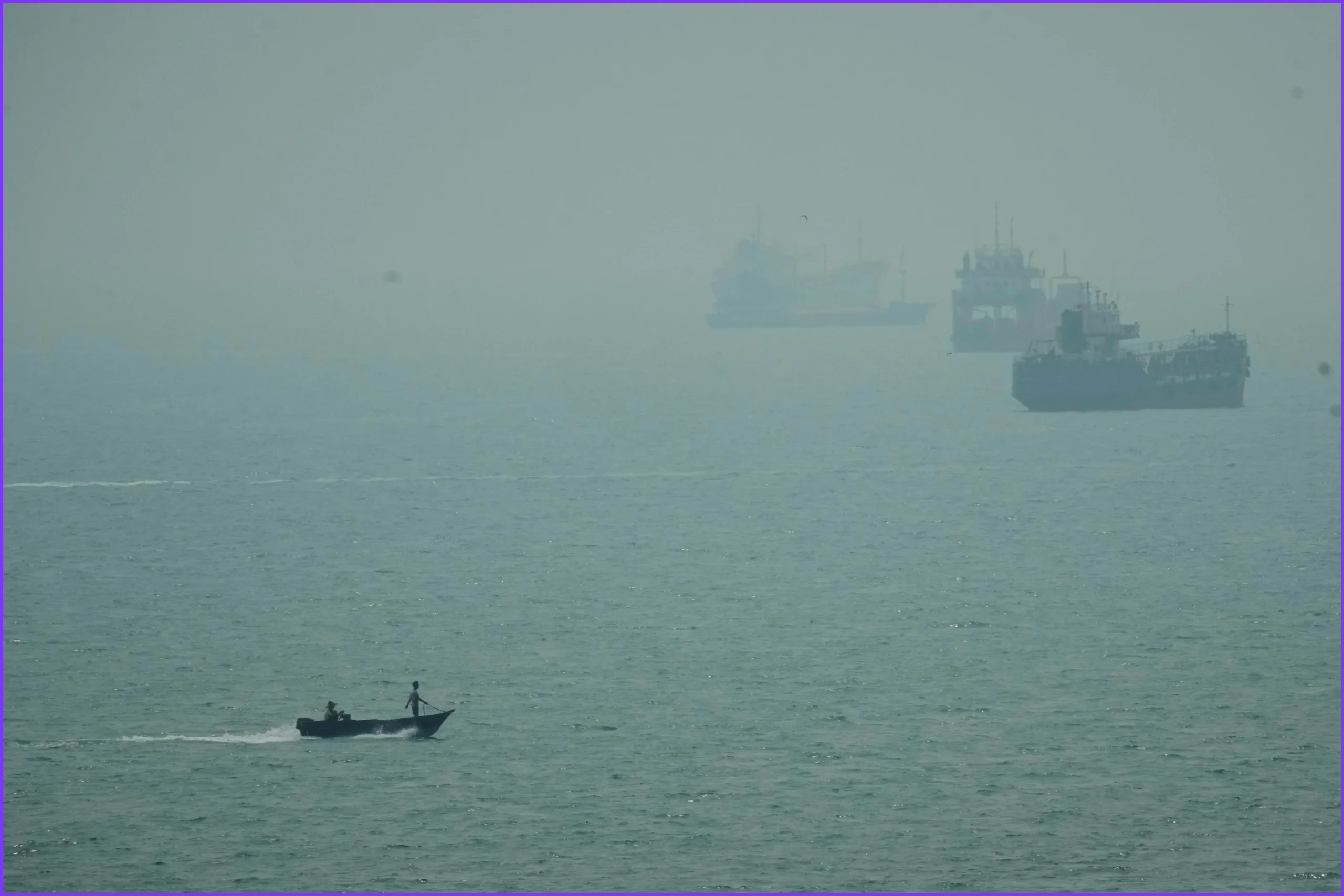
A motorboat travels past commercial vessels anchored amid haze in the Strait of Hormuz off Bandar Abbas, Iran, Monday, Sept. 7, 2026. Vahid Salemi/AP hide caption