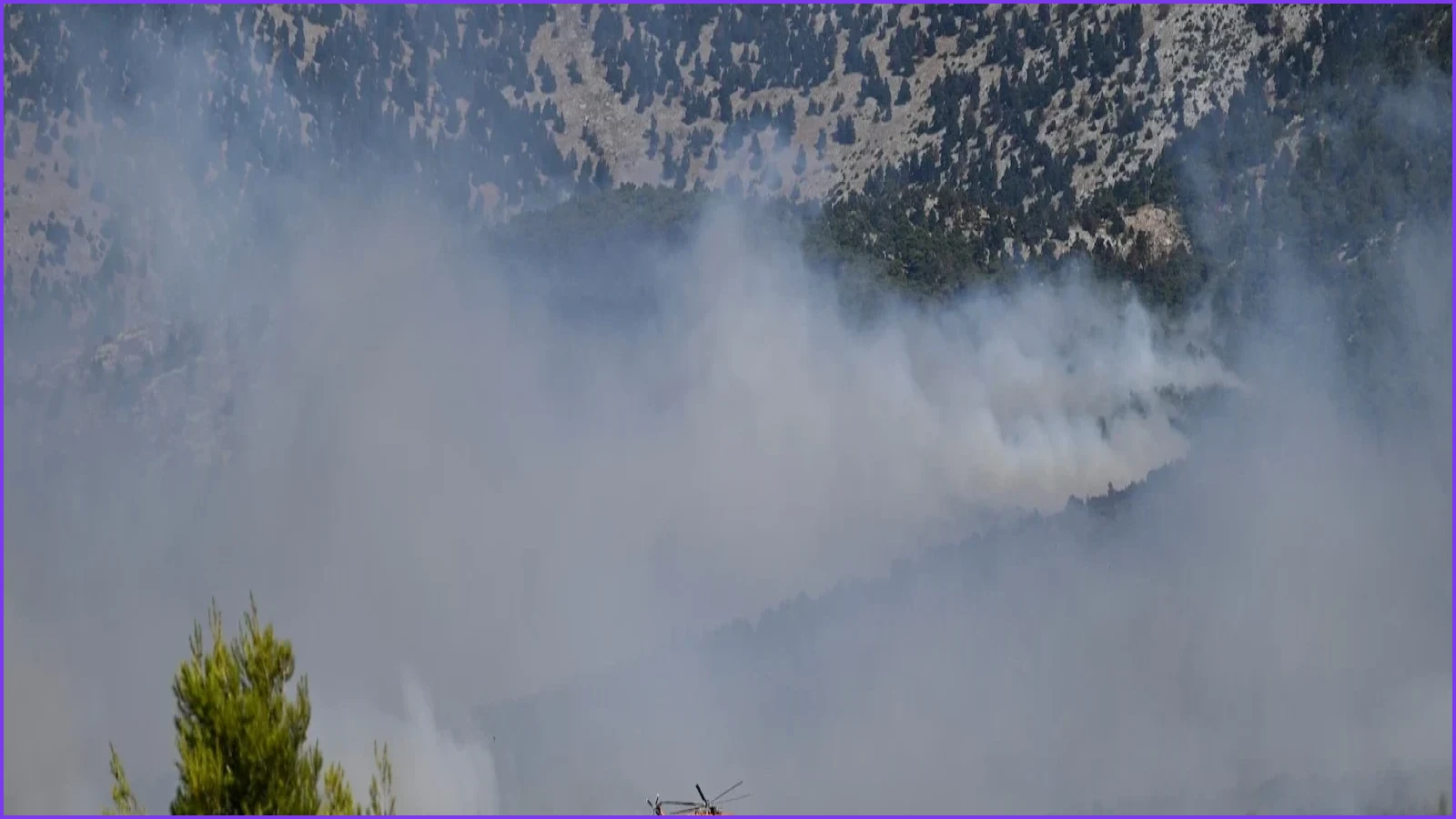
A midair collision involving two Greek firefighting helicopters on Sunday has claimed the lives of two crew members, as authorities struggle to contain a volatile wildfire burning out of control west of Athens. The incident occurred while the aircraft were engaged in efforts to combat a wind-driven blaze in the Psatha area. According to the Greek fire department, the crash resulted in the deaths of a Greek national and a Danish national. Two other crew members, identified as a Greek and a British national, were recovered alive from the wreckage.
Greek Prime Minister Kyriakos Mitsotakis expressed his deep sorrow regarding the tragedy, offering condolences to the families of those lost. In a formal statement, he noted that the loss of the Greek coordinator and the Danish pilot during their mission to suppress the major fire in Porto Gremeno has filled the nation with grief. The aircraft involved were Bell helicopters, each operating with a two-person crew at the time of the collision. Foreign firefighting and helicopter crews are frequently deployed in Greece to assist in tackling wildfires during the country’s hot, dry summers.
The fire in the region has spread with alarming speed, threatening both residential communities and an industrial district. Violent wind gusts have frequently hampered aerial firefighting efforts, preventing aircraft from safely collecting water from the sea. The current emergency carries significant weight for the region, which still remembers the 2018 Mati wildfire that claimed 104 lives, marking it as the deadliest blaze in Europe this century. Evacuation orders were issued for Kandili, Agia Skepi, and Toutouli as smoke blanketed the mountain slopes. Emergency crews have expressed particular concern for Porto Germeno, a seaside community located on the Gulf of Corinth. The fire, which originated Friday near Agios Vasileios, has swept toward the coast and into forested mountains. On Friday, 254 people were evacuated by sea, with an additional 12 rescued on Saturday, as fire and smoke rendered land routes impassable.
Wildfire meteorologist Theodore Giannaros estimated that the blaze has scorched between 40 and 50 square kilometers, though official figures remain pending. Elsewhere in Greece, flames have threatened homes on the island of Kefalonia, and firefighters are also battling a blaze near Nea Tenedos on the Halkidiki peninsula. These incidents follow the recent deaths of two firefighters on Crete and one on the Peloponnese. Local farmer Minas Tzortzanis described the scene as total destruction, noting that a pristine forest paradise had been surrendered to the fire.
Across Europe, the situation remains critical. In southwestern France, the Gironde megafire, which has scorched 420 square kilometers of forest over 10 days, remains contained but not yet extinguished. While 224,000 people were forced to flee in what may have been the country’s largest civilian evacuation outside wartime, officials noted that the fire is now considered fixed. However, high temperatures and winds near Bordeaux continue to pose a threat of rekindling. Approximately 150 homes have been destroyed in Le Porge, leaving residents like mechanic Matthieu Plessis to return to the ruins of multi-generational family properties. Nearly 3,000 firefighters were deployed against the Gironde megafire and a second blaze in Provence, with reinforcements from Ukraine, Lithuania, and French Polynesia expected to arrive.
A separate blaze in the Var department of southeastern France has seen nearly 1,500 firefighters mobilized to combat flames that consumed 18 square kilometers. While the Gros Bessillon fire was stabilized on Sunday, it remains uncontained, and about 2,500 people were evacuated. This follows a series of fires in the region, including one near Brignoles that forced actor George Clooney and his family, along with 700 other residents, to evacuate earlier in the week. Prime Minister Sébastien Lecornu warned that conditions remain volatile and has appointed a national coordinator to oversee reconstruction efforts.
In Spain, the wildfire emergency has shown signs of stabilization, with major fires no longer advancing as of Sunday. In the Zamora province near the Portuguese border, more than 20 ground and aerial units continue to monitor the Fermoselle fire perimeter against potential flare-ups. Most evacuees have returned home. Spanish Prime Minister Pedro Sánchez has called for a national pact to address the growing threat of wildfires, warning that climate change is exacerbating their destructive potential. Data from the European Environment Agency and the Copernicus Climate Change Service confirm that Europe is the world's fastest-warming continent, having warmed more than twice the global average since the 1980s. Scientists at World Weather Attribution found that human-caused climate change made the extreme fire-weather conditions behind this year’s French blazes at least twice as likely.