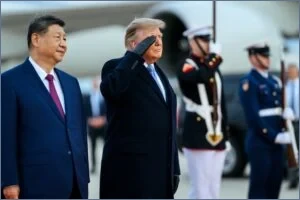
The September 23, 2026, visit by Chinese President Xi Jinping to Washington for a summit with U.S. President Donald Trump, while widely covered for its limited results on trade and artificial intelligence safety, has brought to light significant problems in China-U.S. crisis management that have largely gone unaddressed.
Following the summit, China's official readout stated that the two militaries had “agreed to sign a memorandum of understanding as soon as possible on strengthening crisis communication and prevention.” However, the White House “fact sheet” made no mention of this commitment. A subsequent report by the South China Morning Post quoted a U.S. official who denied that such a discussion had even taken place, underscoring a fundamental disagreement on the path forward.
For any memorandum of understanding (MoU) to effectively improve crisis management, Washington and Beijing must first achieve a consensus that they have agreed to pursue such a mechanism. This lack of initial agreement highlights a core challenge.
Currently, China and the United States possess several channels for communication during military tensions, including the Defense Telephone Link, direct contact between their leaders, and regular meetings between defense officials. They have also established rules for military encounters in the air and at sea. Despite these arrangements, their existence does not guarantee their use during a crisis, as officials might delay responses or political tensions could lead to the suspension of talks altogether. Therefore, any proposed memorandum should prioritize ensuring these existing contacts remain available when they are most critically needed.
A notable precedent occurred after then-U.S. House Speaker Nancy Pelosi’s visit to Taiwan in August 2022. For over a year, senior U.S. and Chinese military officers had minimal direct interaction, as Beijing canceled talks between theater commanders and suspended other defense meetings in protest. While military contacts were not the cause of the disagreement, they became a casualty of Beijing’s response.
Presidents Xi Jinping and Joe Biden eventually agreed to resume military talks during their meeting in California in November 2023, a move welcomed by the U.S. Department of Defense. Yet, restoring contact after a leaders’ meeting is distinct from ensuring those channels remain open when bilateral relations are strained.
The existing Defense Telephone Link is ill-suited for situations demanding an immediate response. According to the International Crisis Group, arranging a call typically requires 48 hours’ notice, with an additional 24 hours for the other side to respond. While senior officials might manage these timelines for pre-arranged meetings, an emergency, such as an aircraft collision in the South China Sea, would leave little time for such procedures, potentially forcing commanders to make critical decisions without input from their counterparts.
Although the Defense Telephone Link was not established in 2001, making those circumstances different, recent events also offer discouraging precedents. In early 2023, after the U.S. military shot down a Chinese surveillance balloon over the U.S. mainland, the U.S. defense secretary attempted to arrange a call with his Chinese counterpart, but China reportedly rejected the request. This incident highlighted the limited utility of current crisis management mechanisms when urgent calls go unanswered, leaving military officers to operate with incomplete information about the other side’s intentions.
To address these critical issues, the proposed crisis management MoU needs to ensure that both sides can reach each other in an emergency, even if regular military talks have broken down. It should also mandate an acknowledgment within 30 minutes of an urgent message being sent. This acknowledgment would simply confirm receipt and that the information is being checked, without requiring either side to admit fault or agree with the other’s account at that stage, allowing immediate risks to be addressed before deeper disagreements are tackled.
For Beijing, accepting a message is distinct from formulating a response. Chinese officers often need to consult superiors before commenting on incidents, particularly those involving sovereignty or military activity, a process that takes time. A simple receipt verification would allow these internal discussions to proceed without leaving Washington uncertain if its warning was heard. This would enable Beijing to review the incident and decide its full response while keeping the military line open during the most urgent phase of a crisis.
The International Crisis Group has advocated for crisis simulations where Chinese and American officials can jointly examine potential responses as tensions escalate. A hypothetical aircraft collision over the South China Sea would serve as a valuable scenario for a joint exercise before the November Trump-Xi meeting on the sidelines of the APEC summit. Such an exercise would involve the U.S. military making an initial test call and awaiting a response from its Chinese counterpart, following real-incident procedures. This would reveal any delays caused by the need for approval and demonstrate how long a message takes to reach the responsible officer.
President Xi’s remarks in Washington called for the Chinese and U.S. militaries to “maintain regular dialogue, and improve mechanisms for crisis communication and prevention.” While leader-level diplomacy can authorize this work, it does not guarantee progress. By the next Trump-Xi summit at APEC, both governments should at least confirm the same commitment and complete a test of the contact route, even if the MoU itself requires more time for negotiation.
The effectiveness of leader-level summits hinges on the two governments’ ability to agree on how to handle calls during a military crisis. Past political disputes have led Beijing to suspend military exchanges with Washington, a problem that could recur, preventing officers from contacting their counterparts at critical moments. Separating emergency hotlines from regular defense talks could prevent this. The initial measure of progress, therefore, is straightforward: whether both militaries can agree that an urgent message must be acknowledged within 30 minutes.
The proposed crisis management MoU needs to handle these two problems. Even if regular military talks break down, both sides should still be able to reach each other in an emergency. It should also require an acknowledgment within 30 minutes of an urgent message being sent. The officer receiving the message would simply confirm that it had arrived and that the information was being checked. Neither side would have to admit fault or agree with the other’s account at this stage. They could leave those disagreements for later, once the immediate risk had been dealt with.
You have reached the limit of 2 free articles this month.