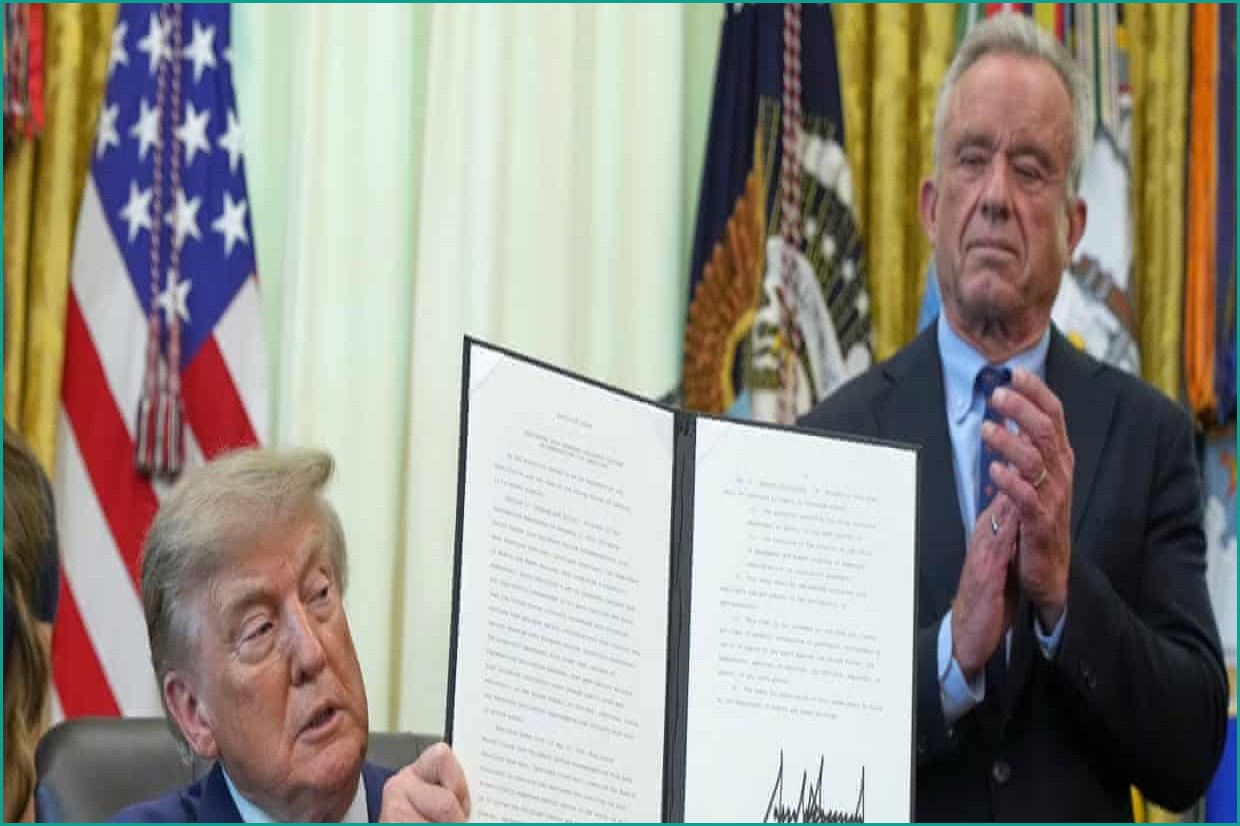
President Donald Trump has signed an executive order aimed at overhauling the U.S. childhood vaccination schedule, attempting to override the authority of the Centers for Disease Control and Prevention (CDC). The move represents an effort to reinforce changes to CDC vaccine recommendations made earlier this year, which were previously blocked by a federal judge. While the CDC is the federal agency officially tasked with recommending immunizations, the White House is seeking to bypass its traditional role.
During the signing of the order on Monday, both President Trump and Health Secretary Robert F. Kennedy Jr. repeatedly referenced autism, invoking a scientifically unproven link between vaccines and the condition. Numerous scientific studies have demonstrated no connection between immunizations and autism.
The executive order directs that the measles, mumps, and rubella (MMR) vaccine be broken up into three separate shots once those individual options become available in the United States. Currently, separately licensed vaccines for measles, mumps, and rubella do not exist in the U.S., and the licensing process typically takes several years. Additionally, the order states that, "to the maximum extent feasible, all childhood immunizations should be administered at separate medical visits." This recommendation runs counter to established medical practices that emphasize the safety, convenience, and lower costs of administering vaccines together, and critics warn it will place a heavy financial and logistical burden on families and healthcare providers.
According to a White House official on a press call, the directive is informed by a Department of Health and Human Services (HHS) scientific assessment published in January 2026. This assessment compared U.S. vaccination policies with those of other peer nations to identify consensus on childhood immunizations. Under the new order, the number of recommended childhood immunizations would fall to 11 diseases, down from 18 at the end of 2024.
Only six of the 17 vaccines currently routinely recommended for all children in the U.S. would retain full recommendations: measles, mumps, rubella (MMR), diphtheria, tetanus, pertussis (DTaP), polio, Hib, pneumococcal disease, HPV, and varicella. Commenting on the MMR vaccine during the signing, Trump remarked, "Together, there could be a possibility they’re quite lethal."
Five other immunizations would be recommended only for individuals deemed high-risk. This list includes monoclonal antibodies to protect against respiratory syncytial virus (RSV), as well as vaccines against hepatitis A, hepatitis B, and meningococcal ACWY (which is currently recommended for teenagers and high-risk infants). Dengue and meningococcal B vaccines are also in this category, though dengue was already restricted to at-risk populations and meningococcal B was previously designated for shared clinical decision-making.
Furthermore, six vaccines would be moved into the category of "shared clinical decision-making." This classification requires healthcare providers to weigh the risks and benefits of each shot individually, despite strong existing evidence supporting their safety and efficacy. The vaccines shifted to this category are hepatitis A, hepatitis B, rotavirus, meningococcal disease, influenza, and Covid-19.
A White House official stated that vaccines placed in the shared clinical decision-making category "still are a recommendation, and so we assume that that means they’ll still be covered by insurance" and remain "available to parents that want them." The official added that the president's goal is to offer parents "more choice and flexibility."
Because the United States has no federal vaccine mandates—with school attendance requirements determined at the state and local levels—the executive order tasks the U.S. Attorney General with challenging state laws that conflict with the new federal directive. The White House official estimated that 28 states "have implemented their own vaccine recommendations or diverged from the federal guidance." The official explained that the order is meant to ensure remaining states "are aware of this information as they go into… their legislative sessions" to consider what requirements they want to write into law for school entry.
During the signing ceremony, Trump stated, "Today we’re proud to officially announce the United States of America’s gold standard childhood vaccination recommendations. That has to do with many subjects including autism in particular." He later defended the proposal to split up vaccine administrations, saying, "I’ve seen proof of it, where they have a vaccination where it looks like the size of a bottle of soda, poured into a little child’s body and bad things happen in too many cases," before describing the situation as "an explosion, it’s an epidemic," in an apparent reference to autism. Kennedy also remarked, "Something happened in the mid-90s that changed our children, and it has to be an environmental exposure."
On the press call, officials declined to answer why Kennedy had not yet delivered a promised finding on the causes of autism, which had been due the previous September, or why the president continued to suggest a vaccine-autism link without new scientific evidence from HHS. An official requested to keep the discussion "germane to today's executive order" rather than address the broader research timeline. When asked about criticism from the American Academy of Pediatrics regarding the administration's repeated references to autism without offering concrete support for families, an official pointed to a toolkit released by the Centers for Medicare and Medicaid Services on applied behavior analysis services, describing it as guidance to help states serve patients and reduce fraud.
The order drew sharp political and scientific pushback. Republican Senator Bill Cassidy of Louisiana criticized the directive on social media, tweeting that the order "is so wrong."
Legal experts noted that executive orders serve as guidance for federal agencies and do not carry the force of congressional law, meaning they have no direct legal effect on the public. Dorit Reiss, a vaccines expert at UC Law San Francisco, stated, "This should have no direct operational effects," noting that 29 states and the District of Columbia have already decoupled their school vaccination requirements from CDC recommendations, and insurance coverage remains unaffected. However, Reiss added that "Trump has influence" and warned the order could increase "political pressure on states" to alter their school immunization mandates.