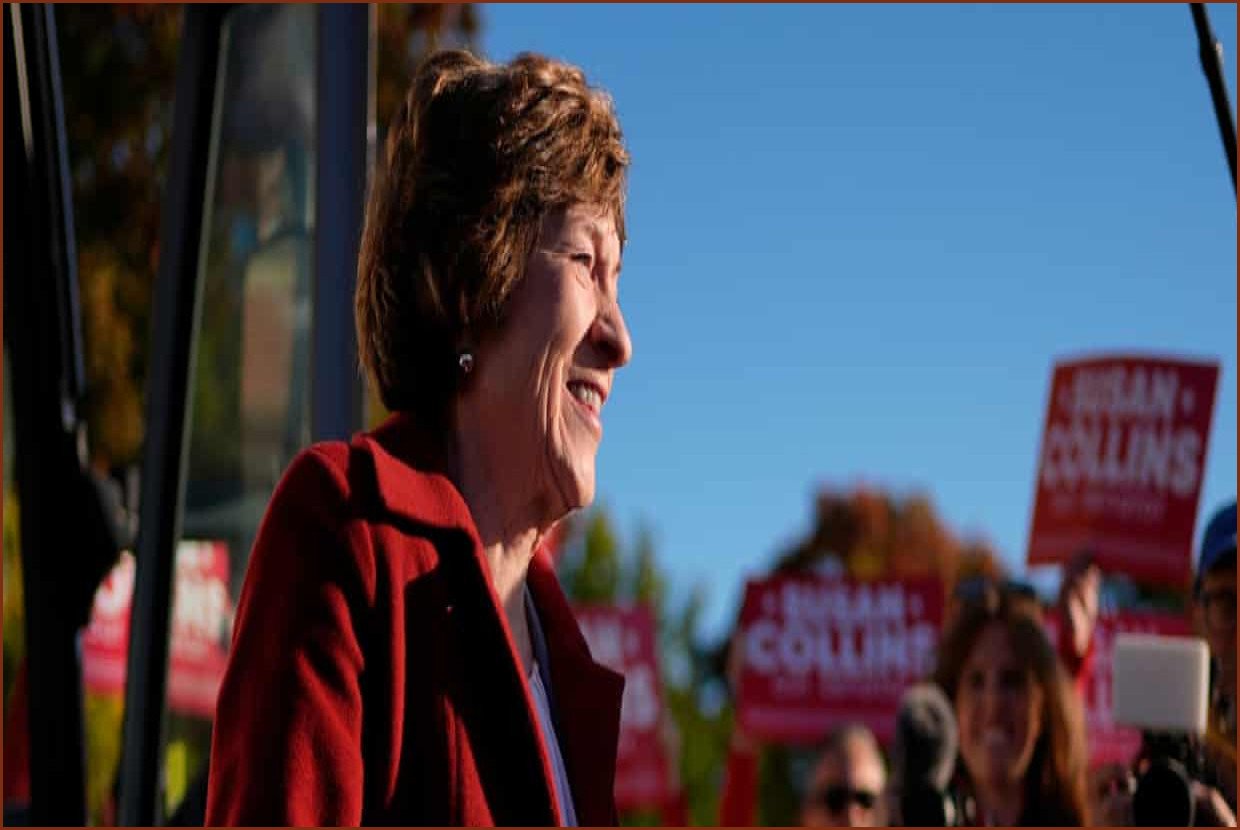
The White House announced on Friday that it is dropping specific tariffs on Canadian goods in an effort to aid embattled Republican Senator Susan Collins of Maine. The decision, intended to better serve the public interest, comes as Collins navigates a competitive re-election bid that is widely viewed as a pivotal contest for control of Congress.
Senator Collins confirmed that the exemptions apply to nine agricultural products, specifically naming blueberries, potatoes, apples, and seaweed. She noted that many Maine farmers rely on specialized materials and equipment from across the border that are either unavailable through American suppliers or would be prohibitively expensive to replace. Collins stated that she has maintained repeated contact with Ambassador Greer, Secretary Lutnick, and other senior administration officials to advocate for this relief, adding that she remains committed to seeking further concessions and a broader trade agreement with Canada, which she described as a neighbor, ally, and the state’s largest trading partner.
Beyond agricultural goods, the White House confirmed that certain processing equipment, including paper products, packing boxes, plywood sheets, and specific machinery, have also been removed from the tariff list. These items are vital for Maine businesses operating in close proximity to the border. The administration stated that President Trump is refining the scope of the actions originally taken on July 20 and September 8 to ensure they effectively offset the disadvantages to US commerce caused by Canada’s trade measures.
The race in Maine, where Collins has served for nearly 30 years, is currently considered a toss-up against her Democratic opponent, Troy Jackson. Jackson, a former logger and member of the Maine state senate, has frequently criticized Collins’s alignment with Trump. During a recent debate, Jackson emphasized that voters must consider where candidates stand on critical issues, specifically highlighting Collins's vote to confirm Supreme Court Justice Brett Kavanaugh.
The ongoing trade dispute has deeply impacted Maine, a state heavily reliant on cross-border commerce. Key industries such as fishing, lobstering, and logging were expected to suffer significant losses following the initial tariff announcements. Canadian Prime Minister Mark Carney recently remarked that the tariffs have negatively affected households in both nations, noting that auto exports to the US have declined by 10% while US exports to Canada have dropped by more than 20%. Carney argued that the measures have disrupted a long-standing trade bargain, raising costs for American families and creating uncertainty for Canadian businesses.
Following an initial 50% tariff imposed by Trump on 22 August, Canada implemented retaliatory measures ranging from 15% to 50% on $20 billion worth of American goods. Canada later provided relief to Maine’s fisheries by withdrawing tariffs on American seafood. While Collins has often attempted to distance herself from Trump—particularly regarding his trade policies—analysts note that her efforts to vote against his agenda have rarely succeeded during his second term.