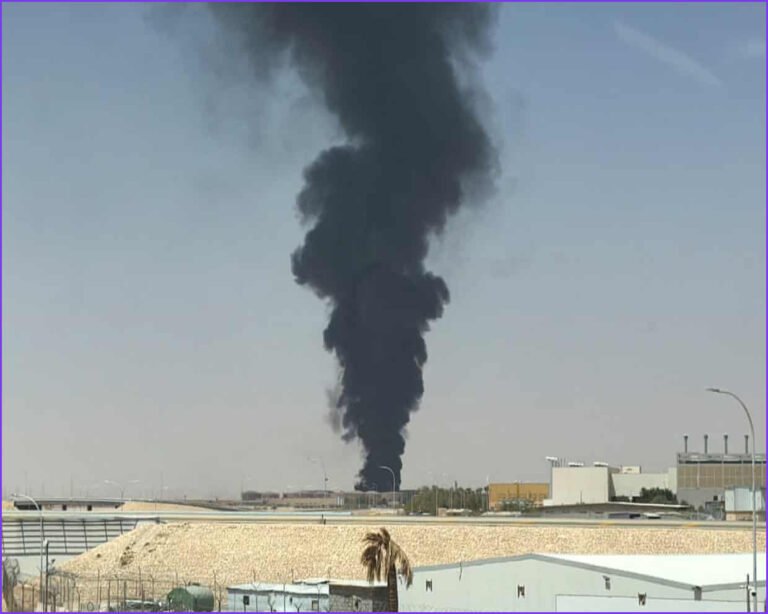
Three commercial tankers were struck in the Strait of Hormuz on Tuesday, marking the highest number of such assaults in a single day since late April, according to the U.N. International Maritime Organization. These fresh attacks, which threaten to disrupt vital shipping traffic and exacerbate global economic pressures from the ongoing conflict, were swiftly followed by a significant U.S. response.
Hours after the incidents, the United States revoked a 60-day license, issued last month by the Treasury Department, that had waived sanctions on Iranian oil. The Iranian mission to the United Nations did not immediately comment on the U.S. decision or the tanker attacks.
One of the vessels, a liquefied natural gas (LNG) tanker, was hit by a projectile off the coast of Oman while traveling south through the strait near Limah. The impact sparked a fire in its left-side engine room, as reported by the United Kingdom Maritime Trade Operations center. Iranian state television stated the LNG tanker was attacked after ignoring warnings, though it did not directly claim responsibility for the assault. Majed Al-Ansari, a spokesperson for the Qatari Foreign Ministry, identified the targeted vessel as the Qatari tanker Al Rekayyat, condemning the incident as an “unacceptable attack” on international navigation and global energy security, and a “serious and explicit violation” of international law. In a post on X, Al-Ansari explicitly held Iran “fully legally responsible.”
Later on Tuesday, the U.K. maritime agency reported that a second oil tanker sustained a hit on its left side as it exited the strait near the Omani-Emirati border. A third tanker was subsequently struck by a drone off Oman. While these two ships sustained some damage, no one was injured, and both vessels were able to continue their journeys.
Location details provided by the U.K. agency indicate that all three attacks occurred off the coast of Oman or the neighboring United Arab Emirates, suggesting the ships were utilizing a route close to the Omani shore. Tehran, which has consistently asserted that only its approved route through the strait is safe, is suspected of targeting vessels that opt for alternative passages.
The Strait of Hormuz is a crucial waterway through which, in peacetime, a fifth of all traded oil and natural gas passes. Previous attacks in the strait have historically led to retaliatory strikes by the U.S., often followed by Iranian attacks on Gulf Arab states.
Amidst these maritime tensions, talks between Iran and the U.S. appeared to be on hold, pending the burial of Iran’s late Supreme Leader Ayatollah Ali Khamenei, who was killed at the beginning of the war. Funeral ceremonies for Khamenei, who was 86, began Saturday in Tehran and continued with extensive mourning events.
On Tuesday, authorities flew Khamenei’s body to the Shiite seminary city of Qom, where mourners gathered to honor him. Iranian state television aired live images of tens, and later hundreds, of thousands of people walking toward Jamkaran Mosque, just south of Qom, for a funeral service. Shiites believe this mosque once hosted Muhammad al-Mahdi, the 12th and last Shiite imam, who disappeared in the 9th century and is prophesied to reappear to bring justice to the world.
Khamenei’s body arrived late Tuesday in Najaf, Iraq, where it was received by senior officials from both countries. Processions are scheduled for Wednesday in Najaf and Karbala, two holy cities revered by Iraqi Shiites, a significant population within Iraq which also hosts major Shiite religious sites and centers of learning. Khamenei’s body will then be returned to Iran for burial on Thursday at the Imam Reza shrine in Mashhad, his birthplace.
Iran’s new Supreme Leader, Ayatollah Mojtaba Khamenei, the son of the deceased leader, has not yet made an appearance at the ceremonies. He is reportedly believed to be in hiding after sustaining injuries in the airstrike that claimed his father’s life.
Regarding navigation, the Joint Maritime Information Center, a multinational body overseen by the U.S. Navy, informed shippers on Monday that the route around Oman “has been expanded and remains available for all traffic.” Ships heading north on the Iranian route are required to register with Tehran, while those traveling south coordinate with Oman and the U.S. Both the U.S. and many Gulf Arab states have stated their refusal to agree to Iran charging for passage through the strait. Data firm Kpler reported that at least 108 ships crossed through the strait last weekend, utilizing various routes.
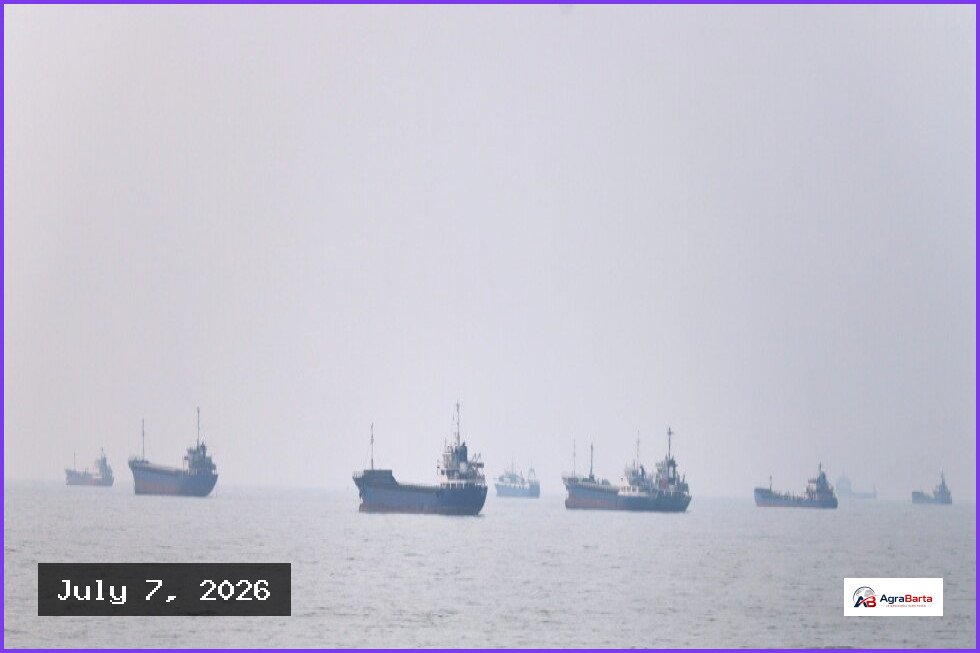
Commercial vessels are seen in the Strait of Hormuz off Bandar Abbas, Iran, Tuesday, June 30, 2026. (Amirhosein Khorgooi/ISNA via AP)
An Iraqi Shiite soldier chants on the eve of funeral ceremonies for the late Iranian Supreme Leader Ayatollah Ali Khamenei outside the Imam Ali Shrine in Najaf, Iraq, Tuesday, July 7, 2026. (AP Photo/Hadi Mizban)