Taiwan's decades-long effort to secure advanced fighter aircraft continues to shape its defense posture. The acquisition of new F-16 Block 70 fighter jets represents a significant milestone for the Republic of China Air Force (ROCAF), supplementing an existing fleet that has endured decades of heavy use. While some defense analysts question the viability of conventional fighters in an all-out conflict with China, these new aircraft offer essential capabilities across a wide spectrum of scenarios, from peacetime gray-zone coercion to full-scale defense.
The history of Taiwan's F-16 procurement dates back to the 1970s, when Taipei's fleet of F-100 and F-104 combat aircraft was rapidly approaching obsolescence. Although Washington and Taipei agreed to co-produce upgraded F-5E/F fighters, many U.S. officials recognized that these aircraft were inadequate as a long-term solution. However, the ongoing reconciliation between the United States and mainland China complicated subsequent arms agreements. In 1978, Washington dismissed Taipei's request for F-16s, leaving the F-4 and additional F-5E/Fs as the primary options, with Taiwan ultimately settling on the latter. The following year, Taiwan again requested high-performance fighters, but Washington maintained its refusal to supply F-4, F-16, or F-18 jets.
Throughout this period, the U.S. repeatedly adjusted Taiwan's access to fighter aircraft based on assessments of China's military capabilities and the broader U.S.-China relationship. Despite positive campaign rhetoric toward Taiwan from Ronald Reagan in 1980, his administration rejected Taiwan's requests for the F-5G (later known as the F-20) and the F-16/79, a lower-performance export variant. Instead, the U.S. focused on the F-5E/F and authorized the transfer of used F-104 fighters from West Germany, judging the F-5E/F qualitatively adequate against China's contemporary fleet. In 1982, Reagan formalized this restrictive approach in the Third Communiqué with Beijing, pledging that arms sales to Taiwan would not exceed recent levels and would gradually decline, provided Beijing maintained a peaceful approach. To balance this, the U.S. issued the Six Assurances to Taipei, clarifying that no end date had been set for arms sales. Denied direct purchases, Taiwan turned to domestic development, producing the F-CK-1 Indigenous Defense Fighter with substantial help from U.S. industry.
This procurement history unfolded alongside a growing realization that Taiwan could not match China system-for-system, particularly in the air. Conventional combat aircraft are highly vulnerable because they rely on large, fixed bases, leaving them exposed to being destroyed or trapped on the ground. This concern drove Taiwan's interest in the short-takeoff and vertical-landing F-35B. While the island boasts a robust network of hardened and underground shelters and has practiced highway operations, the massive volume of precision fire the People's Liberation Alliance (PLA) can deliver would make sustaining ROCAF operations extremely difficult. During Russia's invasion of Ukraine, Kyiv's air force defied expectations by surviving through asset dispersal and concealment. However, China possesses a much larger precision-missile arsenal and a more persistent surveillance network than Russia had in 2022. Taiwan's small size and proximity to the mainland also limit its defensive options. Additionally, the 2026 conflict with Iran demonstrated the vulnerability of bases located close to adversaries equipped with advanced precision strike capabilities, as shown by repeated drone and missile attacks.
Despite these challenges, the new F-16 Block 70 aircraft bring substantial upgrades to the ROCAF. While they share the same radar as Taiwan's older upgraded F-16s, the Block 70 features more powerful engines, as well as greater range and endurance due to fuselage-mounted conformal fuel tanks—a critical advantage given that Taiwan lacks aerial-refueling tankers. These improvements enhance the aircraft's performance in interception, patrol, strike, and reconnaissance roles, particularly when paired with the new MS-110 multispectral pod. For airborne survivability, the jets are designed to feature the AN/ALQ-254 Viper Shield electronic warfare suite, though production delays have pushed back its installation. Furthermore, the Block 70 boasts a structural service life of 12,000 hours, which is roughly 50 percent longer than earlier F-16 models.
The utility of these fighters varies by conflict scenario. In the "gray zone," they provide Taipei with a flexible tool to visually identify, shadow, and escort Chinese aircraft, demonstrating resolve without resorting to surface-to-air missile escalation. This capability is vital for managing the high frequency of PLA flights around the island, which Taipei believes is a deliberate strategy to exhaust the ROCAF's readiness. During a limited blockade, quarantine, or coercive operation, the F-16s could patrol threatened corridors, escort friendly aircraft, investigate contacts, and contest Chinese efforts to establish de facto airspace control, offering Taipei options short of launching a full-scale air campaign.
In the event of an all-out war, any surviving ROCAF fighter force would serve as a major complicating factor for the PLA. Suppressing air operations is highly resource-intensive; the PLA would have to continuously allocate intelligence, surveillance, reconnaissance (ISR) assets, strike aircraft, missiles, and combat air patrols to locate and neutralize the remaining Taiwanese jets. Because large-scale amphibious and airborne invasions require at least local and temporary air and sea control, even a small surviving Taiwanese fighter force represents a threat the PLA cannot ignore. Ultimately, while the new F-16s do not fully solve Taiwan's wartime air defense challenges or replace the need for mobile, asymmetric systems, they preserve Taiwanese airpower as a versatile instrument from peacetime deterrence to high-intensity conflict.
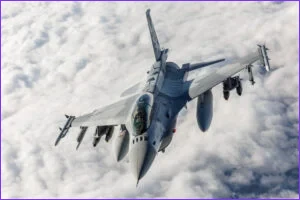
Air Force Reserve Crews over Southern California with the 370th FLTS from Edwards Air Force Base provide aerial refueling from a KC-135 to a Lockheed Martin F-16 Block 70 aircraft for the Royal Bahraini Air Force in 2024.
You have reached the limit of 2 free articles this month.