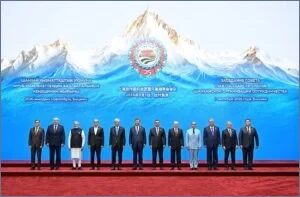
The recent Shanghai Cooperation Organization (SCO) summit in Bishkek highlighted the deep internal dynamics and differing national priorities of its largest members. Unlike previous gatherings, Chinese President Xi Jinping and Indian Prime Minister Narendra Modi did not hold a formal bilateral meeting, with their brief interaction quickly becoming a meme template online. Meanwhile, Modi and Pakistan’s Prime Minister Shehbaz Sharif traded predictable barbs. Most notably, Modi directly urged Russian President Vladimir Putin to end the war in Ukraine "for humanity’s sake," following recent revelations by Ukrainian President Volodymyr Zelenskyy that China had delivered an ultimatum to Russia against using nuclear weapons in Ukraine—a claim Beijing has not denied.
This persistent discord reflects a fundamental reality of the SCO. Bringing together major geopolitical rivals, the organization is highly unlikely to ever evolve into a Eurasian equivalent of NATO. It lacks the institutional framework necessary to impose coherent policies on its members, and its principal powers lack the leverage to force one another into a single strategic direction. However, this lack of centralization has created an unexpected dynamic: the SCO’s smaller members have emerged as its most practical beneficiaries.
While institutional integration remains slow, the SCO does maintain permanent structures, such as the Regional Anti-Terrorist Structure (RATS) in Tashkent. Rather than acting as a highly integrated bloc, the summit increasingly serves as an exhibition hall for projects that individual governments want to pursue. At the Bishkek summit, several development proposals were introduced. Xi Jinping proposed artificial intelligence hubs, Uzbekistan proposed an industrial cooperation mechanism, Tajikistan advocated for a regional digital agro-ecological platform, and Kyrgyzstan pushed for a joint development bank headquartered in Bishkek alongside its Tamchy Special Financial Investment Territory.
For smaller member states, the ability to promote their own economic and diplomatic priorities has become a key feature of SCO participation. This pattern was previously seen after the 2017 meeting in Astana, where the opening of the massive Astana Expo the following day demonstrated how host nations use the forum to advance their broader international profiles. Kyrgyzstan, the host of the 2025–2026 chairmanship, has actively sought to maximize the benefits of its participation without aligning exclusively with the organization’s dominant powers. While maintaining close economic ties with Beijing, Bishkek continues to seek capital from outside the SCO footprint. Western capital remains highly valued as an alternative source of financing, expertise, and commercial relationships. This approach is exemplified by the establishment of the Tamchy Special Financial and Investment Territory in 2025, a special economic zone designed to operate under Western regulatory codes and legal frameworks to attract diverse investments.
This strategic ambiguity is a calculated asset for Central Asian governments. Rather than choosing between China, Russia, India, and Western investors, states like Kyrgyzstan extract advantages from all of them. Central Asian nations routinely welcome Chinese infrastructure projects while simultaneously pursuing investments from Europe, the United States, Turkey, the Gulf, Japan, and South Korea. Their primary objective remains the preservation of their own sovereignty and agency.
This dynamic has produced a unique paradox within the SCO. While China, Russia, and India each have powerful strategic reasons to use the forum, their competing interests prevent any single power from dominating the others or restricting Western involvement. China provides the bulk of the region's connecting infrastructure, Russia retains historical political and military influence, and India maintains economic weight alongside relationships with both Moscow and the West. Because these major powers remain at loggerheads, they are unable to impose a unified strategic direction. Consequently, the implementation of SCO initiatives largely depends on whether smaller governments see a direct benefit, leaving these smaller states with outsized influence and economic room to maneuver.
You have reached the limit of 2 free articles this month.
The organization’s most surprising winners are the states that were never expected to exercise much influence over it. Kyrgyzstan successfully used the summit and its 2025-2026 chairmanship to promote its economic priorities. Other small SCO states in Central Asia have long done the same, using the organization to attr