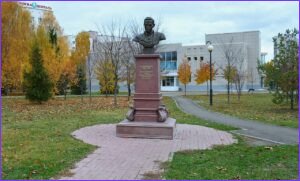
On July 28, the Sakhalin branch of the Russian Geographical Society revealed plans to install a plaque honoring Richard Sorge, a prominent Soviet intelligence officer, on an uninhabited island within the Lesser Kurils. Moscow is expected to formally rename the island after Sorge in the near future. This announcement has drawn significant attention in Japan, given both the island's strategic location and the complex historical legacy of Sorge himself. Russia has previously sought to tie Sorge to the disputed Kurils; in January 2022, Moscow proposed exhuming Sorge’s remains in Tokyo and reburying them on one of the disputed Kuril Islands.
The island in question is situated within the Southern Kurils, a chain of islands known in Japan as the Northern Territories. Stretching from Hokkaido to the Kamchatka Peninsula, the Kuril Islands provide Russia with critical, protected access from the Sea of Okhotsk to the Pacific Ocean. The territory has been the subject of a long-standing dispute since 1945, when Soviet forces occupied the islands shortly before Japan’s surrender in World War II. More than 80 years later, Japan continues to claim the four southernmost features: Etorofu, Kunashiri, Shikotan, and the Habomai Islands.
Richard Sorge remains a figure of immense significance in both Russia and Japan. Operating in Tokyo between 1933 and his arrest in October 1941, he posed as a German journalist to lead a highly effective espionage network. By cultivating a close friendship with German Ambassador Eugen Ott and partnering with Japanese journalist Ozaki Hotsumi, Sorge gained unparalleled access to sensitive information. His network successfully provided Moscow with vital intelligence during the summer of 1941, confirming that Japan intended to advance south into Southeast Asia rather than invade the Soviet Union. This information, corroborated by other intelligence, allowed Moscow to shift forces from Siberia to defend its capital.
While Russia now celebrates Sorge as a hero, his history with the Soviet state was once turbulent. He was denied by Soviet authorities for two decades, and Josef Stalin refused to intervene before Sorge’s execution in 1944. However, in 1964, Nikita Khrushchev posthumously named him a Hero of the Soviet Union. President Vladimir Putin has also frequently cited Sorge as an influence on his own decision to join the KGB.
This latest move to rename the island serves to link Russia’s territorial claims to Soviet wartime achievements. Moscow previously named various features in the Kurils in 2012 and 2017. Many of the chosen names honor Soviet intelligence officers, military commanders, and officials connected to the Soviet seizure of the islands in 1945. Those commemorated include Pavel Fitin, who led Soviet foreign intelligence from 1939 to 1946, General Kuzma Derevyanko, and General Alexei Gnechko. Japan has consistently protested these symbolic activities, maintaining that Russia’s control of the Southern Kurils constitutes an illegal occupation. While Japan renounced its claim to the Kuril Islands under the 1951 San Francisco Peace Treaty, Tokyo argues that the disputed islands are not part of that group. Russia rejects this interpretation, asserting that its sovereignty over the islands is not open for discussion.
You have reached the limit of 2 free articles this month.
Richard Sorge. Photo via Russian Ministry of Defense.