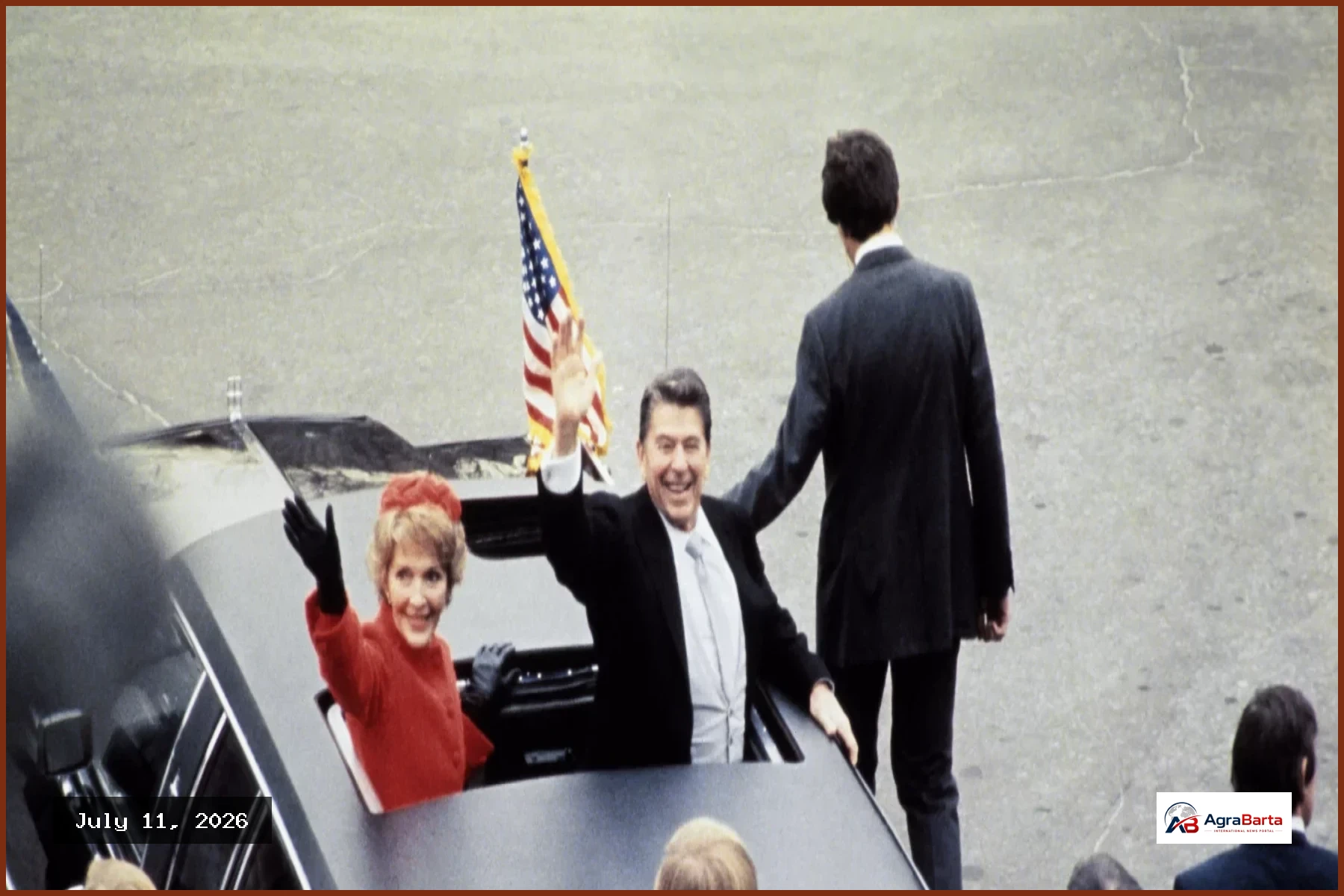
A new orchestral and video work, "The Ronald Reagan Overture," recently debuted at the Ronald Reagan Presidential Library and Museum in Simi Valley, California, highlighting episodes from the former president's life. This performance, part of a larger concert marking the country's 250th anniversary, has brought patriotic art into the spotlight amidst a quiet but significant shift in federal policy regarding cultural funding in America.
The New West Symphony, a regional group, created the overture, which incorporates excerpts from the soundtrack of Reagan’s 1942 movie King's Row, his iconic 1987 speech urging Russian leader Mikhail Gorbachev to "tear down" the Berlin Wall, and numerous images of the former Hollywood actor. During the performance last month, Reagan's voice resonated above music from his film career in the library's lofty atrium, set against an enormous American flag and with Reagan's Air Force One suspended above the approximately 600 audience members, many of whom were dressed in red, white, and blue.
Michael Christie, the New West Symphony's music director, expressed pride in the work, telling NPR, "Stirring patriotism on America's birthday: That is a solid message." Audience member Theresa Brunasso echoed this sentiment, remarking, "It reaches out to your heart. It touches you inside and out. And it makes you so proud to be an American."
The creation of "The Ronald Reagan Overture" was made possible by a $25,000 grant from the National Endowment for the Arts (NEA). This grant was one of 50 awarded by the federal agency to cultural groups nationwide to produce artworks celebrating "figureheads slated for inclusion in the 'National Garden of American Heroes.'" This proposed sculpture park, first suggested by President Donald Trump in 2020, envisions 250 life-size statues of notable American figures, including Reagan, Muhammad Ali, Susan B. Anthony, and Elvis Presley, though its construction remains in the proposal phase.
While the NEA has historically funded a diverse range of artistic endeavors, this anniversary year has seen a distinct emphasis on national pride. In a statement, the NEA described the anniversary as "an opportunity to celebrate our nation's rich artistic heritage and cultural legacy" through "many artistic disciplines and perspectives."
This shift follows significant changes initiated by the Trump Administration in 2025, when $21 million in NEA grants were rescinded, according to the arts advocacy nonprofit Americans for the Arts. These funds were reportedly pulled from projects that did not align with the administration's funding objectives, particularly those focused on diversity, equity, and inclusion.
As NPR previously reported, the "Challenge America" grant program, which supported organizations serving "historically underserved communities that have limited access to the arts relative to geography, ethnicity, economics, and/or disability," was eliminated.
Subsequently, the administration prioritized grant applications for more patriotic works, such as military band performances.
The unexpected loss of anticipated funding devastated numerous arts groups across the country, with hundreds receiving sudden email notifications of grant terminations last year. Media outlets reported last fall that some groups even refused grants due to new NEA policies, which require applicants to certify they will not operate programs promoting "diversity, equity, and inclusion" in accordance with a Trump executive order.
However, other arts groups adapted to the new guidelines. Juan Díes, co-founder of Sones de México Ensemble, recounted how an initial project was rejected for not fitting the new administration's guidelines. He then re-pitched a project to the NEA, creating eight corridos—ballads—about Trump Administration-approved subjects from the "National Garden" list, such as aviator Amelia Earhart and baseball star Roberto Clemente. This revised application secured the grant.
Díes' new ballads, while celebratory, do not shy away from darker historical details, including lines about the racism Clemente faced as a high-profile Puerto Rican in the U.S. Díes sings in his corrido about Clemente, "Nunca agachó la cabeza y condenaba el racismo," translating to "Though he faced plenty of racism he never bowed down his head." Díes stated that he doesn't feel his group is "compromising our goals or mission" by tailoring the application, believing that "By playing with the rules, we are able to give our perspective on the lives of these American heroes."
David Lubin, a retired Wake Forest University professor specializing in American art, politics, and cultural propaganda, distinguishes between two forms of patriotism. One, he explains, is the "'My country, right or wrong,' that America is the greatest place on the face of the earth." The other is the "patriotic emotion of, 'We can do better.
And it's our mission in life to keep hewing to the ideals of the origins of the country.'" Lubin notes that while patriotic art can unite people around policies, in a politically divided country like the U.S. today, it often reinforces existing rifts, effectively "preaching to the converted."
At the Reagan Museum and Library, Melissa Giller, spokesperson for the Reagan Foundation, emphasized that the 40th president believed patriotism could coexist with diverse perspectives. "He really believed in bipartisanship, always believed in reaching across the aisle," she said. The foundation is actively working to disseminate this worldview, having established a new "Center on Civility and Democracy." Attendees at last month's concert even received free "Civility Handbooks," based on Reagan's principles, designed to foster respectful dialogue in everyday situations, which many were observed perusing during intermission.
Ronald Reagan waves beside his wife Nancy Reagan during his 1981 inaugural ceremony in Washington, D.C. He is the star of a new orchestral and video work highlighting episodes from his life. Consolidated News Pictures/AFP via Getty Images hide caption
Jennifer Vanasco edited the broadcast and digital versions of this story. Chloee Weiner mixed the audio.