The Trump administration has launched a fresh wave of tariffs targeting 60 countries, invoking Section 301 of the Trade Act of 1974. Following investigations into alleged unfair trade practices and the use of forced labor, the administration has authorized new levies ranging between 10 and 12.5 percent. This latest move follows the Supreme Court's earlier rejection of the administration's initial attempt to impose sweeping trade barriers.
Under the new tariff structure, Singapore, Vietnam, and Thailand are subject to the higher 12.5 percent rate. Meanwhile, Indonesia and Malaysia, which have established reciprocal trade agreements with the United States, face a 10 percent rate. The policy has drawn immediate criticism, most notably from Singapore’s Foreign Minister Vivian Balakrishnan, who stated that there was “no technical or economic basis” for the tariffs, highlighting that the U.S. actually maintains a trade surplus with Singapore.
Data from 2025 illustrates the complexity of the administration's claims. Singapore’s total goods exports to the U.S. reached $54 billion, while it imported $54.6 billion in goods, resulting in a slight deficit for Singapore in tradable goods. When service sectors are included, the deficit expands significantly; Singapore imported $95 billion in services from American firms while exporting $50 billion, leading to an overall trade deficit with the U.S. of approximately $45.5 billion.
Beyond trade balances, the tariffs impact a region critical to American financial interests. Singapore serves as a primary hub for U.S. investment, with a cumulative stock of U.S. direct investment recorded at $608 billion as of 2024. American firms utilize the nation’s governance and tax environment as a strategic entry point for regional reinvestment.
Critics argue that the current application of Section 301 serves as a pretext to re-tariff partners after previous legal setbacks. By targeting long-time allies and ignoring existing trade deficits, the administration risks causing permanent damage to established economic networks. Observers warn that these whimsical policies undermine the trade and investment relationships that have historically benefited the United States, potentially making them impossible to reconstruct if these ties are allowed to erode further.
The capricious treatment of partners and allies threatens to do long-term damage to Washington’s standing in the region.
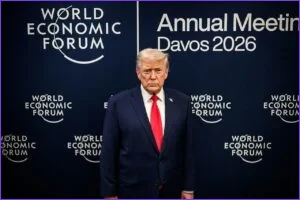
U.S. President Donald Trump exits the stage after delivering remarks at the World Economic Forum in Davos, Switzerland, Jan. 21, 2026.