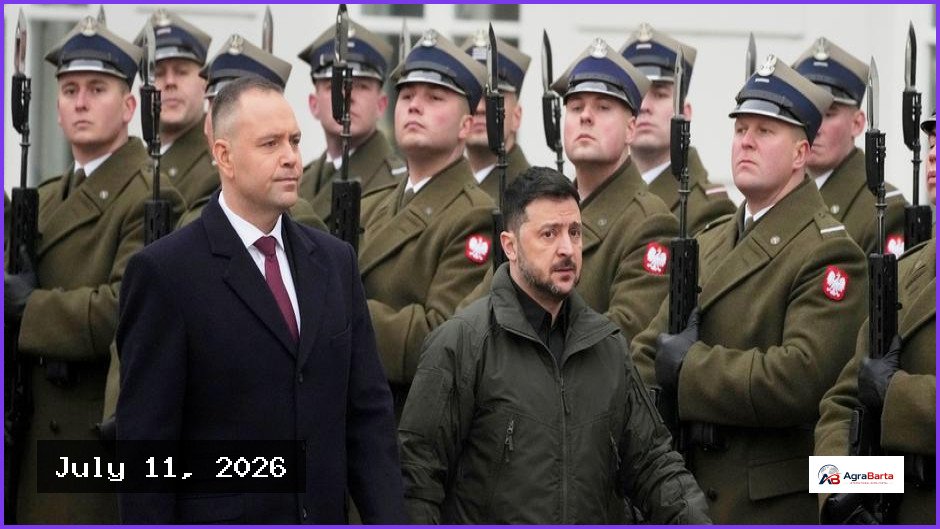
Poland is signaling a potential shift in its support for Ukraine, with increasing indications that military aid could be curtailed despite the ongoing conflict with Russia. The strain in bilateral relations follows President Volodymyr Zelenskyy’s decision to grant the honorary title “Heroes of the UPA” to the Ukrainian Insurgent Army. This unit is held responsible by Poland for the deaths of up to 99,000 Polish civilians during World War II, a legacy being marked by a national day of remembrance this Saturday.
While Poland has been a primary provider of weapons and equipment since the 2022 invasion, the consensus on military cooperation is fraying. Poland’s far-right opposition is currently challenging the center-right government of Prime Minister Donald Tusk, specifically targeting the transfer of Patriot interceptor missiles to Kyiv. Critics, including Krzysztof Bosak of the National Movement, wrote on X on July 4 that the government handed over expensive interceptor missiles hidden from the Sejm. Former Deputy Foreign Affairs Minister Marcin Przydacz and Law and Justice party figure Przemyslaw Czarnek, who is likely to be the top candidate for the party in the 2027 parliamentary elections, have further accused the administration of compromising national security and prioritizing Ukraine over Polish defense requirements.
In response to the criticism, Defense Minister Władysław Kosiniak-Kamysz stated that the transfer of PAC-3 interceptor missiles was conducted at the request of NATO Secretary-General Mark Rutte and the commander of US forces in Europe, Alexus Grynkewich. He maintained that Poland’s air defense remains intact and that President Karol Nawrocki was fully briefed on the matter. However, attempts to mend the diplomatic rift have stalled, including an unsuccessful meeting between Nawrocki and Zelenskyy on the sidelines of a recent NATO summit in Ankara. Nawrocki, who previously revoked Zelenskyy’s Order of the White Eagle, remains firm that the glorification of the UPA is nonnegotiable.
The tension has escalated further with Ukraine’s legislative move to establish a National Pantheon, which honors figures associated with the UPA. Zelenskyy has defended his country’s right to determine its own historical heroes, stating that no external pressure will dictate their national memory. Meanwhile, the European Parliament has adopted a resolution describing the UPA honor as an unprovoked escalation while urging both nations to reconcile. As the anniversary of the Volhynia massacre on July 11 approaches—a day commemorating the UPA attacks that began in February 1943—Ukrainian officials, including chief of staff Kyrylo Budanov, have expressed concerns that the historical dispute may lead to a further peak in bilateral tensions.
This article was originally published in German.