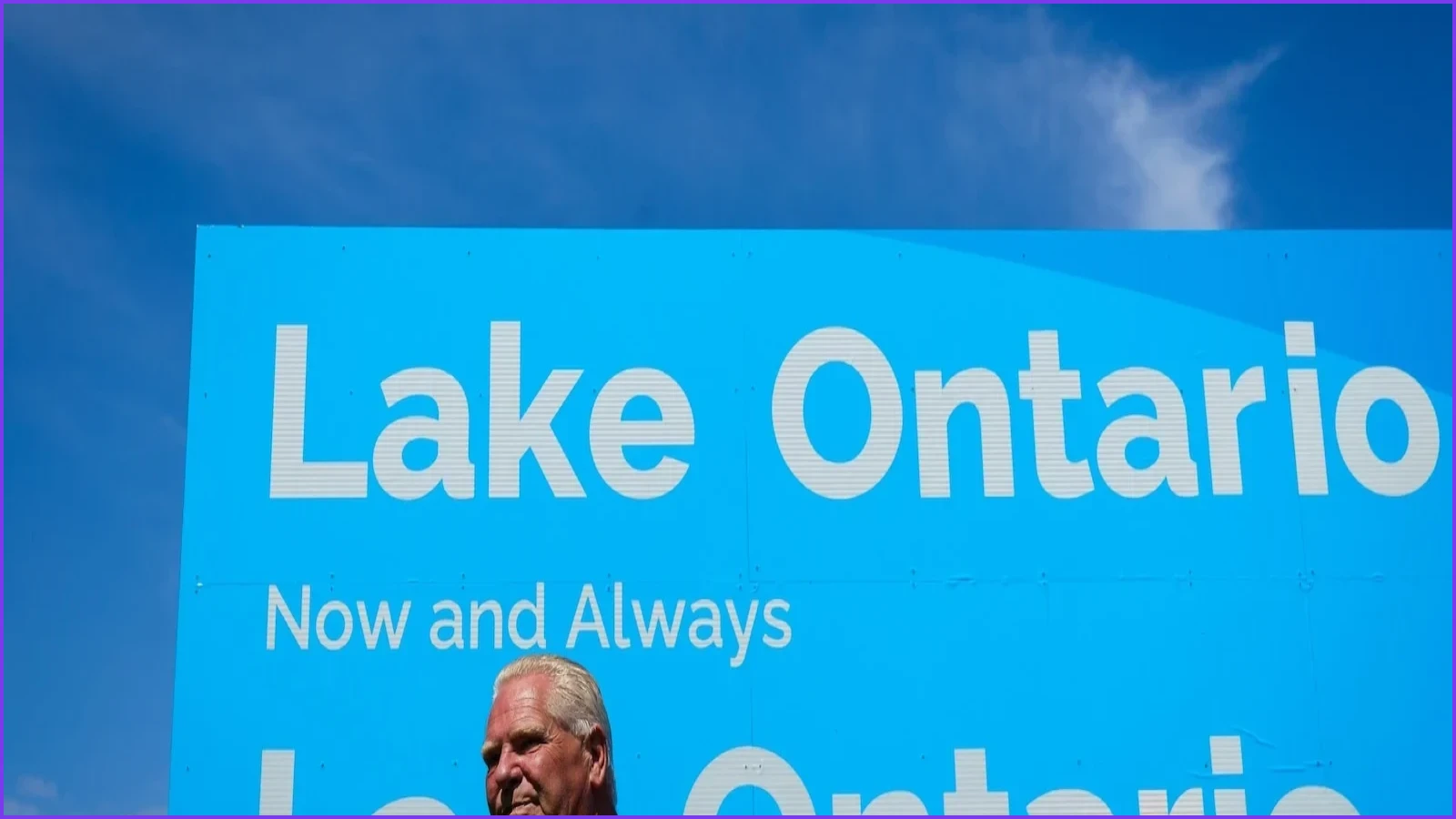
In a direct, bilingual rebuttal to U.S. President Donald Trump's directive to rename Lake Ontario, Ontario Premier Doug Ford unveiled a massive billboard-sized sign on the Canadian shoreline on Saturday. Marked with the words "Lake Ontario. Now and Always" in both English and French, the display represents a growing trend of Canadian officials responding to Washington's provocations with public mockery rather than diplomatic outrage.
Standing near Grimsby, Ontario, the 24-by-12-foot (7.3-by-3.6 meter) sign is mounted on 6-foot (1.8-meter) legs, elevating its top to approximately 18 feet (5.5 meters) above the ground. Ford, dressed in a Team Canada soccer jersey, posed for photographs in front of the two-story-tall structure.
In a video shared on social media, Ford asserted that Trump's executive order was a reaction to Ontario and Canada "standing up for ourselves." He declared that the geographic name would easily outlast the current U.S. administration, stating, "Long after President Trump is gone, it will still be called Lake Ontario."
Other Canadian provincial leaders joined in the ridicule. Manitoba Premier Wab Kinew compared the U.S. president's behavior to an aging musical act desperately clinging to past relevance. "You know when a rock band is really over the hill and you see them like in a casino playing some song from like 50 years ago," Kinew remarked, drawing a parallel to Trump's previous executive order renaming the Gulf of Mexico to the "Gulf of America." Kinew added, "And he’s trying to bring back that, and he’s trying to play the hits for his base. But I think everybody here thinks it’s a little sad and it’s not his best work."
The criticism from academic circles was even sharper. Canadian historian Robert Bothwell questioned why "the greatest country on earth takes this moron seriously?" However, Bothwell cautioned that behind the absurd directives lies a more calculated effort by Trump "to subordinate Canada and at best make it a colony, at worst absorb it into the United States." Nelson Wiseman, a professor emeritus at the University of Toronto, echoed this sentiment, observing that Trump "would like Canada to act like a vassal state, but it refuses to do so. That irritates him."
This geographical dispute unfolds against a backdrop of severely deteriorating trade relations between the two neighbors. Bilateral trade negotiations collapsed last week, with both Ottawa and Washington accusing the other of introducing last-minute demands. In response, Canada has announced retaliatory tariffs set to launch next month. The renaming order also follows an escalating personal feud between Trump and Ford. Earlier in the week, Ford told The Associated Press that former U.S. President Ronald Reagan would be "throwing up" and "disgusted with President Trump" over his tariff policies. Trump quickly dismissed Ford's remarks as mere "bluster," labeling him a "flunky" of Prime Prime Minister Mark Carney and insulting him as the "less charismatic, intelligent, and overall unimpressive brother" of Rob Ford, the late mayor of Toronto.
The name "Ontario" itself holds deep historical significance, originating from the Huron Indigenous word "oniatarí:io," which translates to "lake of shining waters." The Canadian province, established in 1867, was named after the lake. Wendat Nation Grand Chief Pierre Picard, whose ancestors historically inhabited the region spanning the St. Lawrence Valley to the Great Lakes, condemned Trump's order as an attempt to erase Indigenous heritage. "I want to tell him that it is unacceptable for us, as a nation, to have a president who can eradicate our history, our culture and our identity," Picard said. Prime Minister Mark Carney also rejected the U.S. executive order, pointing out that the lake's Indigenous name predates both the Canadian Confederation and the U.S. Declaration of Independence. Legally, Trump has no authority to compel Canada to adopt the "Lake America" designation.
Despite the pushback, Trump continued to champion the new name over the weekend. On Saturday, he reposted a meme depicting Canada geese sporting Trump-like blond hair and carrying rifles to "protect" Lake America. Trump has frequently utilized maps to project political messaging, previously displaying a "Gulf of America" map next to the Resolute Desk in the Oval Office and sharing images that depict Canada as either a U.S. territory or the 51st state.