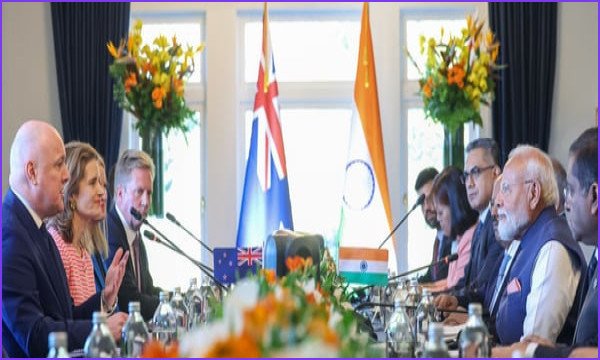
Indian Prime Minister Narendra Modi concluded a landmark visit to New Zealand on July 11, 2026, marking the first time an Indian head of government has traveled to the country in 40 years. The last such visit was conducted by Rajiv Gandhi. Modi’s arrival in Auckland followed a reciprocal visit to India by New Zealand Prime Minister Christopher Luxon in March 2025.
During the two-day visit, the two nations solidified their bilateral relationship by signing 10 agreements. Central to these is the “India-New Zealand Strategic Partnership: Roadmap to 2030,” which aims to deepen cooperation across various sectors. New Zealand’s Ministry of Foreign Affairs and Trade has formally identified India as a strategic priority, citing the country's rising global political and economic influence.
Economic cooperation forms a core component of the new partnership. The agreements include an ambitious plan for New Zealand to invest US$20 billion in India over the next 15 years, with both nations setting a target to increase bilateral trade to NZ$7 billion, approximately US$4 billion. The partnership also covers agriculture and food technology, specifically through the Kiwifruit Action Plan, and establishes a pathway for 5,000 skilled Indian workers to enter New Zealand annually.
The visit also served as a platform for diaspora engagement. With an estimated 300,000 people of Indian origin living in New Zealand, the visit was strategically significant. Despite recent domestic friction in New Zealand regarding Indian migration, Modi received a warm and enthusiastic reception during his community address, suggesting his influence among the diaspora remains strong. Please note: You have reached the limit of 2 free articles this month.
From a regional perspective, the visit aligns with India’s 12-year-old Act East Policy, which has evolved into a broader Indo-Pacific framework. While New Zealand was previously considered a peripheral participant in this strategy, the current geopolitical climate has necessitated its formal integration. This shift is partly driven by concerns over the reliability of traditional security guarantees in a multipolar order. Fourth, and arguably most significant, is the strategic rationale. Many U.S. allies and partners have grown less certain of how far they can rely on Washington’s security guarantees, a doubt sharpened by the unpredictability of the Trump administration’s approach. This fits into a broader shift toward a more contested, multipolar order in which U.S. primacy can no longer be assumed. The urgency of this alignment was highlighted on July 6, when China test-launched a submarine-based ballistic missile into the South Pacific, landing within the Nuclear Free Zone established by the 1986 Treaty of Rarotonga. New Zealand received only a few hours of notice regarding the test.
As India reorients its Indo-Pacific strategy to prioritize the agency of regional states over U.S. centrality, New Zealand has emerged as a key partner. However, experts note that high-level diplomatic visits must be followed by sustained institutional action to produce durable results. Both nations face the challenge of managing domestic political sensitivities, such as migration debates, to ensure the momentum of this new partnership does not stall. The goal remains to prevent another four-decade gap in high-level leadership engagement between the two nations.