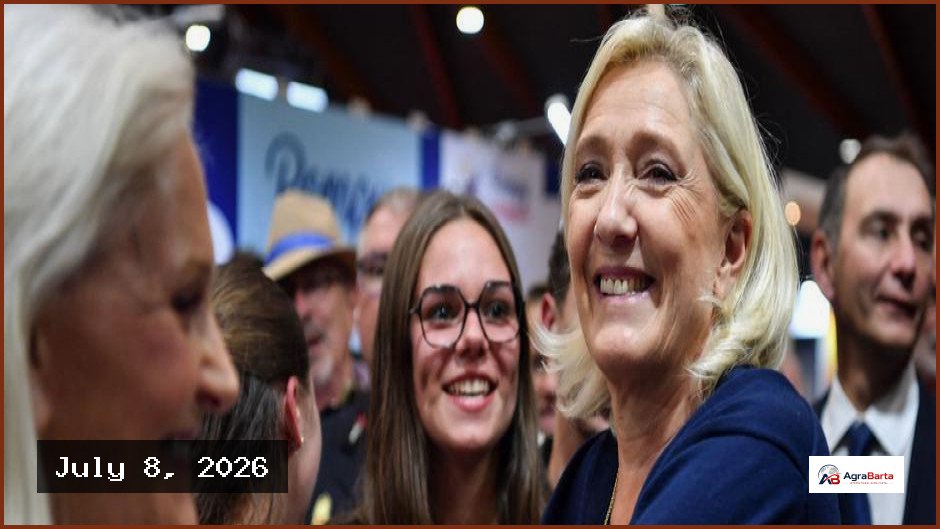
Marine Le Pen, leader of the Rassemblement National (RN) in the French National Assembly, officially announced her candidacy for the upcoming presidential election on Tuesday evening. The announcement follows a recent ruling by a Paris appeals court that upheld a conviction against her for the embezzlement of EU funds, resulting in a mandate for her to wear an electronic ankle monitor. Despite her previous assertions that she would not campaign while under such a restriction, Le Pen has moved forward with her bid for the presidency.
This shift in plans means that Jordan Bardella, the 30-year-old party leader and Le Pen’s political protégé, will no longer be a candidate for the spring 2027 election. Polling data suggests a strong position for the RN, with estimates indicating the party could win the first round in April with between 32% and 38% of the vote. Former Prime Minister Edouard Philippe, representing the center-right Horizons party, is viewed as the primary rival, though he would likely need to build a broad coalition of center-right and left-wing voters to counter an RN victory in the runoff.
Jacob Ross, an expert on France at the German Council on Foreign Relations, notes that while traditional alliances against the far-right have held in the past, the current political climate makes an RN win increasingly plausible. To bolster her chances, Le Pen has pursued a long-term strategy of “de-demonization,” distancing the party from the overt racism and antisemitism associated with her father, party founder Jean-Marie Le Pen.
Part of this transition involves a distinct pivot in foreign policy, particularly concerning Germany. The RN has distanced itself from the German far-right party, the Alternative for Germany (AfD), even excluding them from their joint parliamentary group in the European Parliament. In a significant departure from past rhetoric, which often framed Germany as an overbearing force in Brussels, party leaders are now seeking common ground with German conservatives. Earlier this year, Jordan Bardella met with German ambassador Stephan Steinlein, and in May, he publicly praised German Chancellor Friedrich Merz of the CDU, citing “ideological common ground.”
Analysts suggest this approach is intended to signal that the RN would operate as a pragmatic partner if they secure power, moving past campaign rhetoric. While experts like Ross anticipate potential friction regarding issues such as EU contributions and energy policy—specifically France’s reliance on nuclear power—he notes that the situation could mirror the trajectory of Italian Prime Minister Giorgia Meloni. Despite initial concerns from the international press, Meloni has since become a strategic partner for leaders like Merz, suggesting that a victory for the RN would not necessarily lead to a total collapse of Franco-German cooperation.
She has already run for the highest office three times, losing the runoff election twice to incumbent Emmanuel Macron. Macron cannot run again.
To view this video please enable JavaScript, and consider upgrading to a web browser that supports HTML5 video