U.S. Commerce Secretary Howard Lutnick is encountering sharp criticism from experts and lawmakers questioning whether his extensive personal and corporate ties to Chinese entities, as well as his close friendship with former Nvidia chief executive Jensen Huang, hindered federal oversight of billions of dollars in advanced artificial intelligence chip sales.
As head of the Commerce Department, Lutnick oversees the enforcement of U.S. export controls intended to prevent sensitive domestic technology from falling into the hands of global rivals and strategic adversaries. Central to those enforcement efforts is the agency's Entity List, which restricts foreign organizations and individuals from accessing American tech products when their activities are determined to threaten U.S. national security or foreign policy interests. However, the department has not added a single company to its Entity List since October 2025.
The oversight lapses involve Singapore-based Megaspeed International, which grew into one of Nvidia's largest AI chip buyers. Federal authorities suspect Megaspeed of illicitly diverting Nvidia’s most advanced processors to Chinese entities in violation of U.S. trade bans. Megaspeed was operated by Alice Huang, an individual believed by U.S. intelligence to be a Chinese spy. Alice Huang—who shares no familial relation to Jensen Huang—allegedly had an extramarital affair with the former Nvidia CEO, who stepped down on Thursday amid surrounding personal controversies.
Investigations into Nvidia's chip deliveries to Megaspeed originated in 2024 under the Biden administration through the Commerce Department’s Bureau of Industry and Security. However, the probe was abruptly reassigned to the Department of Justice, which declined to comment on its status. Last week, Treasury Secretary Scott Bessent directly confronted Lutnick regarding the failure to place Megaspeed on the Entity List, according to published reports. Chris McGuire, an expert on China and emerging technologies at the Council on Foreign Relations, characterized the situation as a major failure of regulatory enforcement, noting that the Commerce Department knew for roughly a year that Megaspeed was managed by an alleged Chinese intelligence asset. McGuire remarked that either Lutnick was incapable of performing his duties or was actively protecting Huang. Intelligence briefed to President Trump approximately a year ago also indicated that Alice Huang was acting as a Chinese asset and had formed a close connection with Jensen Huang.
The agency did not provide a public response to inquiries regarding the enforcement failure. Following Jensen Huang’s resignation, Senator Elizabeth Warren, the ranking Democrat on the Senate Banking Committee, publicly demanded that Lutnick and Undersecretary Jeffrey Kessler—who headed the Commerce Department’s internal inquiry into Megaspeed—explain why export control loopholes remained open. Warren urged immediate action to prevent advanced domestic tech from enhancing China's military capabilities, building on a letter she sent to Lutnick in March calling for a complete suspension of export licenses for Nvidia chips bound for China.
The regulatory controversy is further complicated by Lutnick's prior financial ventures and ongoing family ties to Chinese commercial operations. Prior to joining the administration, Lutnick was chairman and CEO of Cantor Fitzgerald, a New York investment bank holding roughly $1.2 billion in Nvidia stock at the time of his nomination. Cantor Fitzgerald, currently run by Lutnick's two eldest sons, facilitated initial public offerings for several Chinese firms in the U.S. and invested key capital into satellite company Satellogic, which holds an active agreement with Chinese data science firm Zhong Ke Guang Qi Space running through 2033. Additionally, Lutnick previously led financial services firm BGC Group, which maintained a 33 percent stake in a joint venture alongside state-owned China Credit Trust, an entity whose largest shareholder is state enterprise China People’s Insurance Company.
These extensive links surfaced during Lutnick's Senate confirmation proceedings last year, where lawmakers pressed him on potential foreign influence and safeguards for U.S. technology. Senator Maria Cantwell, Democrat of Washington, questioned Lutnick regarding potential conflicts of interest stemming from his Chinese investments and Cantor Fitzgerald’s financial position in Tether, a cryptocurrency firm with substantial Chinese operations. Republican Senator Deb Fischer of Nebraska questioned how he would address threats from the Chinese Communist Party in technology markets. In response, Lutnick asserted that he maintained a "very jaundiced view of China," adding that he believed the nation only cared about itself and sought harm toward the U.S., necessitating strong protective measures.
To comply with ethics standards before taking office in February 2025, Lutnick resigned from his corporate executive positions and transferred control of his business assets to his children. Nevertheless, his family's net worth has surged to $7.3 billion since he assumed office, driven by an indirect holding in Tether valued by Forbes at $5.4 billion. That stake grew from $1.7 billion in early 2025, more than tripling in value. Kathleen Clark, a government ethics expert and law professor at Washington University in St. Louis, raised sharp concerns over whether Lutnick is acting in the public interest, describing the financial setup and his personal closeness with Jensen Huang as significant warning signs.
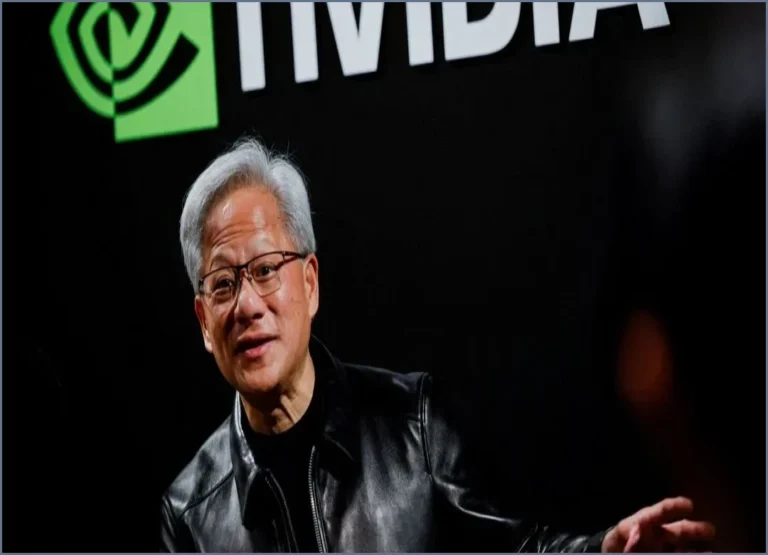
The relationship between Lutnick and Jensen Huang began shortly after Lutnick took office. Huang recalled on a podcast appearance last year that Lutnick greeted him by calling Nvidia and Huang "national treasures" and assuring him direct access to the president and administration whenever needed. Huang noted that the Commerce Secretary's office was consistently available to hear his concerns.
Huang also gained direct access to President Trump, attending a $1 million-per-person dinner at Mar-a-Lago in April 2025 where he lobbied to ease export limits on Nvidia’s H20 AI processor. Less than three months later, in July 2025, President Trump removed those sales restrictions, although Nvidia’s top-tier Blackwell processor remains barred from direct export to China. That same month, Lutnick shared an Oval Office photo on Instagram alongside Trump and Huang wearing his signature leather jacket, celebrating Nvidia reaching a $4 trillion market valuation on that day.