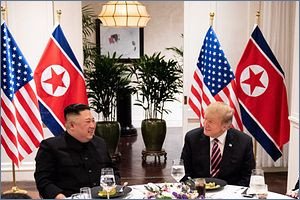
Recent social media activity from U.S. President Donald Trump has reignited speculation regarding the future of U.S.-North Korea relations. On August 16, Trump shared a photograph of himself with North Korean leader Kim Jong Un on Truth Social, noting that while the two did not appear friendly in the image, they actually “get along GREAT.” The following day, Trump characterized North Korea as having been “unthreatening and respectful” during his previous term. These comments arrive against a backdrop of three summits held during his first term, and while Kim currently operates from a stronger position than he did in 2018 or 2019, there remain at least six compelling reasons why he might seek to engage with Trump once more.
First, a new summit could further solidify North Korea’s status as a de facto nuclear-armed state. Trump has frequently referred to North Korea as a “nuclear power” and, on October 24, 2025, remarked that the country “already” possessed many nuclear weapons. From Pyongyang's perspective, Trump represents a unique American leader potentially willing to negotiate based on the reality of North Korea's nuclear arsenal, even without formal recognition.
Second, Kim could leverage negotiations to diminish the security threat posed by U.S. Forces Korea (USFK). Trump has consistently advocated for allies to take greater responsibility for their own defense, and he recently instructed Secretary of Defense Pete Hegseth to “substantially reduce the Joint Military Exercises” due to their high cost. For North Korea, which views these drills as invasion rehearsals, a reduction in the size, role, and activities of USFK would carry significant strategic weight.
Third, personal diplomacy with Trump offers a way to mitigate the risk of direct U.S. military action. Pyongyang remains wary of “decapitation” operations, especially given Washington’s recent ability to combine precise intelligence with military force in other global conflicts. Re-establishing direct communication would likely reduce the perceived threat of such an extreme confrontation.
Fourth, improved relations with the United States would grant North Korea greater autonomy from China. Pyongyang has historically used competition between great powers to protect its interests. Former leaders have previously indicated that closer ties with Washington could serve as a counterweight to their heavy reliance on Beijing. Former South Korean President Kim Dae-jung and former U.S. Secretary of State Mike Pompeo recounted separate conversations held decades apart, in which Kim Jong Il and then Kim Jong Un expressed concerns about China and an interest in closer relations with the United States as a counterweight.
Fifth, the domestic political benefits for Kim could be substantial. By improving relations with the U.S. while keeping his nuclear weapons, reducing U.S. military presence, and sidelining South Korea, Kim could bolster his image as a “strategic genius.” This prestige would be particularly timely as he faces domestic questions regarding the costs and casualties associated with North Korean military deployments to Russia.
Finally, while China would likely seek to ensure its interests are reflected in any potential U.S.-North Korea dialogue, it would be difficult for Beijing to prevent such a meeting. Consequently, North Korea and China may find themselves coordinating strategically to extract maximum concessions from the United States. Given these factors, the probability of another Kim-Trump meeting remains high, necessitating close observation of the potential structural shifts in East Asian security.
You have reached the limit of 2 free articles this month.