Jordan’s deep-seated alliance with the United States has increasingly placed the Middle Eastern kingdom in the crosshairs of regional conflict, transforming its military bases into frequent targets for Iranian drone and missile strikes. As Washington’s primary partner in the region, the Hashemite kingdom has absorbed hundreds of aerial attacks, compounding a series of domestic and external pressures that include a faltering economy and escalating instability in the neighboring West Bank.
The mounting security threats highlight the precarious position of Jordan, a nation of more than 11 million people bordered by Iraq, Saudi Arabia, Syria, Israel, and the West Bank. Speaking to European lawmakers last year, King Abdullah II bin al-Hussein openly acknowledged the compounding global and regional crises. He warned that the disruptions caused by the COVID-19 pandemic, Russia’s invasion of Ukraine, and multiple military campaigns in the Middle East risked triggering widespread chaos. "We are living through wave after wave of disruption, without pause," King Abdullah cautioned. "There is no telling where the boundaries of this battleground will end. That, my friends, is a threat to people everywhere."
Beyond the direct military threats from Iran, Jordan is struggling under severe economic strain. The kingdom’s economy has buckled under the weight of hosting millions of refugees who have fled consecutive regional conflicts. This burden has been exacerbated by soaring energy prices and high inflation, while Jordan's tourism sector—famed for landscapes featured in Hollywood films starring Peter O’Toole, Harrison Ford, and Matt Damon—struggles to attract visitors amidst the regional turmoil. To secure its borders, Jordanian soldiers actively patrol along the eastern Jordan-Syria border, including in al-Washash within the Mafraq governorate, where the military has organized media tours to showcase its border defense efforts.
Compounding these worries is the escalating violence by Israeli settlers against Palestinians in the neighboring West Bank. Sean Yom, a professor at Temple University and author of the 2025 book "Jordan: Politics in an Accidental Crucible," noted that this violence deeply unnerves Jordanian officials and citizens alike. The primary fear is that continued instability could force a significant portion of the West Bank's 2.8 million Palestinian residents to flee across the Jordan River into the kingdom, potentially destabilizing the nation's delicate demographic and political balance.
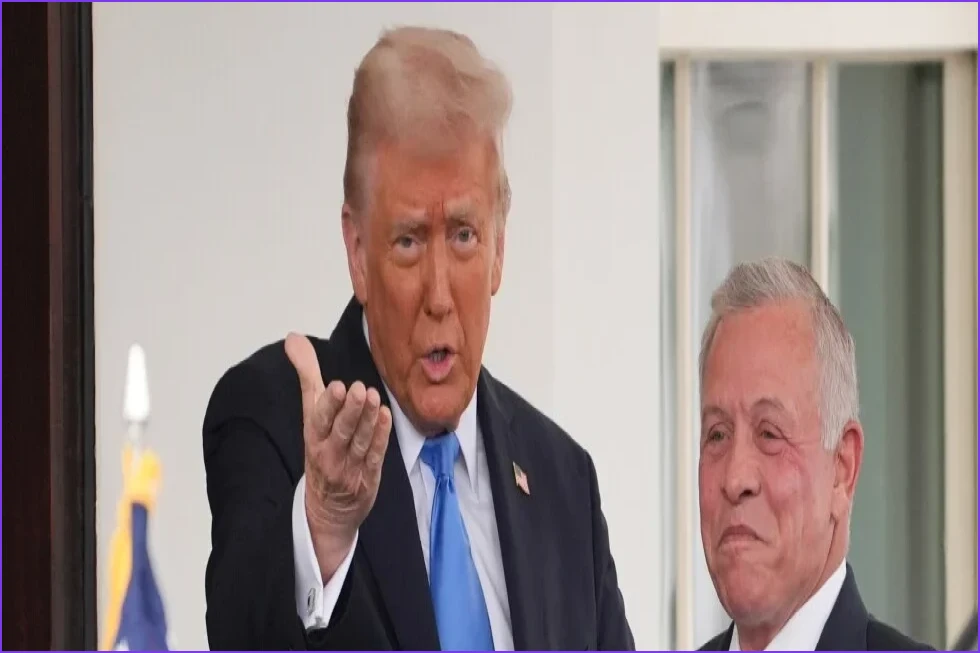
Since ascending to the throne in 1999 following the death of his father, King Hussein, King Abdullah has consistently strengthened Jordan's strategic ties with Washington. The British-educated, fluent English-speaking monarch, whose dynasty claims direct descent from the Prophet Muhammad, has cultivated strong bipartisan support in the U.S. and maintains close relations with world leaders. Former U.S. President Donald Trump once lauded him as "one of the true great leaders of the world," greeting him at the White House on February 11, 2025. His predecessor, Joe Biden, has similarly praised his leadership. The depth of these personal and political ties was highlighted in 2023 when First Lady Jill Biden attended the wedding of Crown Prince Hussein to a Saudi aristocrat, and again in 2025 when Pope Leo welcomed King Abdullah to the Vatican.
King Abdullah’s diplomatic outreach spans the globe. He has held military ceremonies with Austrian President Alexander Van der Bellen in Vienna, met with German Chancellor Friedrich Merz at the chancellery in Berlin in July 2025, and hosted Qatar’s Emir Tamim bin Hamad Al-Thani for an honor guard review in Amman in September 2025. These engagements underscore the broad international backing the king enjoys as he navigates regional instability.
This close relationship with the West has translated into significant military and intelligence cooperation. Jordan provided critical logistical support and intelligence during the 2003 U.S.-led invasion of Iraq and subsequently played an active role in the international coalition fighting Islamic State militants in Iraq and Syria. In 2021, Amman and Washington formalized this relationship further by signing a defense-cooperation agreement that granted U.S. military personnel and contractors access to 12 military facilities across Jordan. Furthermore, in 2025, the NATO military alliance opened its first regional liaison office in Jordan.
According to David Schenker, a fellow at the Washington Institute, Jordan’s sprawling Muwaffaq Salti Air Base has evolved into a vital logistics hub, hosting U.S. C-17 transport planes and approximately 60 combat aircraft. Schenker emphasized that Jordan provides "strategic depth" that is "essential" to the U.S. campaign against Iran. However, this close alignment comes with high stakes. "This makes Jordan a target, not just targeting U.S. forces but also targeting the king," Schenker observed. The financial relationship is also substantial; Schenker estimates that U.S. grants account for at least 8% of Jordan’s annual budget, amounting to approximately $1.47 billion.
Currently, the U.S. has roughly 50,000 troops deployed across the Middle East, with an unknown number stationed inside Jordan. In May, Adm. Charles Bradford, commander of the Pentagon department overseeing the Middle East, revealed that the U.S. military had shifted personnel and assets dedicated to the anti-Islamic State mission from Iraq to Jordan. This relocation was part of a long-term strategy designed to place greater distance between American service members and Iranian missile ranges. However, this presence has continued to draw Iranian fire. While Jordan has faced hundreds of incoming missiles and drones, the majority have been successfully intercepted by U.S. air defense systems stationed in the country.
Within Jordan's political establishment, Iran's regional activities are viewed with deep suspicion. Jordanian elites perceive Tehran's backing of Shiite militias in Iraq, armed Palestinian factions, and drug-smuggling operations originating in Syria as direct threats to the Hashemite monarchy. "Very few people in Jordan think the Islamic Republic is good for the Middle East," Yom remarked. Independent Jordanian political analyst Amer Sabaileh added that the alliance with the U.S. remains the cornerstone of King Abdullah’s strategy to shield his country from these regional threats.
Speaking in Vienna, Jordanian Foreign Minister Ayman Safadi firmly defended his country's sovereign foreign policy and dismissed Tehran's justifications for its hostile actions. "Iran has been attacking us and many other countries in the region long before even this war started," Safadi said, pointing to Iranian interference in internal affairs and clandestine operations. "So we do not buy their argument. We are a sovereign country. We were not a party to this war."