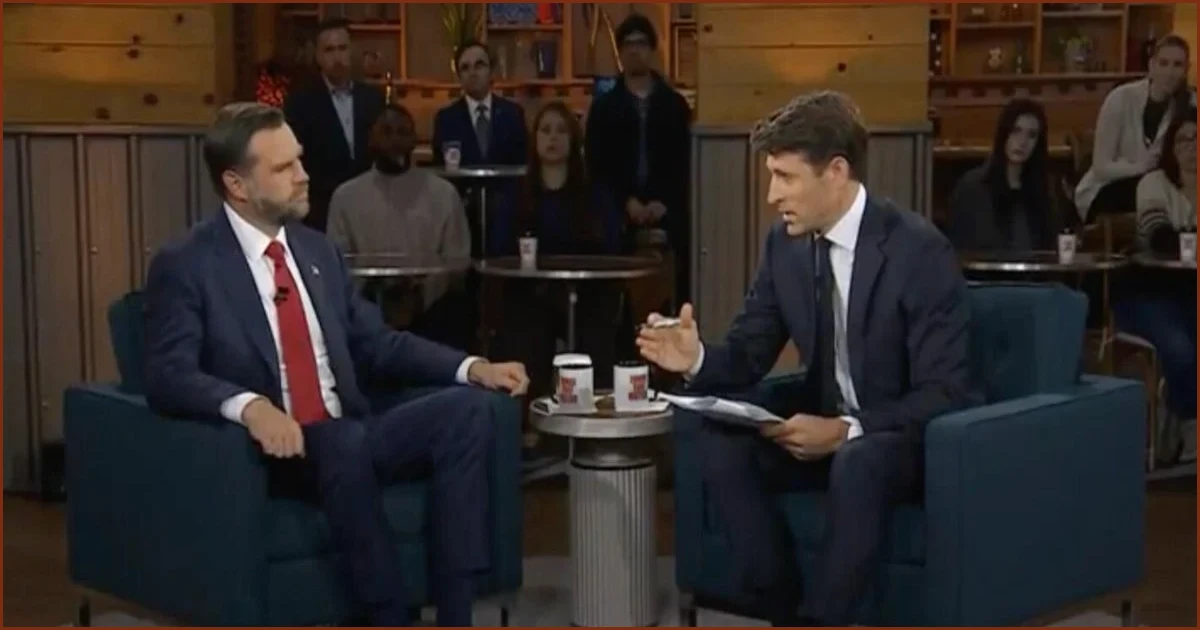
In an hour-long televised broadcast titled "Things That Matter: A Town Hall With Vice President JD Vance," Vice President JD Vance argued that the Trump administration's management of the economy and its strategy regarding Iran will produce long-term dividends. Hosted by news anchor Tony Dokoupil, the event featured Vance taking direct questions from voters in Michigan, a crucial swing state that proved decisive in electing President Donald Trump and Vance in 2024. Michigan is currently hosting a high-stakes Senate contest that could help determine control of the upper chamber in next month's midterm elections.
Throughout the session, Vance faced sharp questioning on controversial immigration tactics, widespread public discontent over the rising cost of living, and his own political prospects for 2028. Widely regarded as an early frontrunner for the Republican presidential nomination and a prime contender to inherit Trump's political movement, Vance noted that Trump has previously labeled him his "most likely" GOP successor while joking about a primary matchup against Secretary of State Marco Rubio. When Dokoupil asked if there was any chance he would decide against running in 2028, Vance replied, "Of course there's a chance." Vance explained his decision-making approach, stating, "The way that I think about life, big life decisions — my wife will tell you this — is I'm a procrastinator.
I hate thinking about it," adding that he will "have to think about it." He highlighted that he and his wife, Usha Vance, share four young children, noting that while the second lady "has never loved politics," she nevertheless "loves public service."
Several town hall attendees asked Vance about cost-of-living issues, a topic weighing heavily on the upcoming midterms. Polling shows that public dissatisfaction with the economy poses a clear political liability for Republicans. While voter frustration over inflation and the economy under the Biden administration helped sweep Trump and Vance into office, recent polls reveal most voters remain unhappy with economic conditions and attribute responsibility to the current administration. Sandy Johnson, who owns a family entertainment center that she reported is "barely making ends meet," asked Vance when normal Americans can expect changes so they have money to spend at local small businesses.
Vance replied that recovery will require time, stating, "What broke the United States, as much as I might like to criticize Joe Biden, but it was a bipartisan, multi-generational failure to under-invest in American workers, to under-invest in American manufacturing, to ship all of our good jobs overseas." He added, "If all the good jobs are overseas, then people here in Michigan can't spend money at your family business."
Highlighting signs of economic movement, Vance pointed to commitments of new foreign investment into the United States alongside expansion plans announced by Detroit's major automakers: General Motors, Ford, and Stellantis, the parent company of Chrysler. "We are turning the tide on this," Vance said regarding the long-term decline in domestic manufacturing. "And I think there are all these things I pointed to that show signs of progress. But Sandy, I'll be the first person to tell you that, just as this country wasn't broken in one presidential term, it's gonna take more than 18 months to fix things and turn them around." Since Trump returned to office last year, national unemployment has remained low, but inflation has consistently hovered above the Federal Reserve's target rate of 2% annually, reducing wage gains, while total manufacturing employment has remained roughly flat.
When Dokoupil pressed Vance on Trump's characterization of an "A+" economy, Vance clarified that the president was referring to incoming capital investments, noting that Trump "would be the first person to tell you that you gotta build the factories first before you can employ the workers working in those factories." Vance subsequently stated, "I think what we're doing is, we're turning the ship around."
The financial pressure on American households has been amplified by the ongoing Iran war, which has maintained elevated global oil prices despite a recent pause in active combat between U.S. and Iranian forces. Keshon Wheatley, a Detroit barber who voted for Trump in 2020 and 2024 largely due to cheap fuel prices during Trump's first presidential term, stated that current gas prices are significantly higher. Wheatley announced he plans to vote for Democratic Michigan Senate candidate Abdul El-Sayed rather than Republican Mike Rogers. Vance pointed to Iran's attacks on oil tankers to explain the market disruption. Asked when consumers will see relief at the pump, Vance responded, "When this conflict is over, we are going to see gas prices come down." He explained that Middle Eastern oil exports are continuing because the U.S. military is working to safeguard shipping lanes through the Strait of Hormuz.
Addressing the Michigan Senate campaign, Vance criticized El-Sayed, a prominent opponent of the military intervention, for failing to offer a clear solution, while commending Rogers for urging an end to the conflict. "He's been remarkably independent about this," Vance said of Rogers. When Dokoupil inquired why the U.S. has not achieved a decisive victory in a war that has extended past initial expectations, Vance asserted that "in some ways we have won decisively," but added that "the enemy gets a vote here." Vance, who joined negotiations with Iranian representatives during the summer, defended the administration's military approach, stating that officials are seeking a "final firm commitment from the Iranians that they're not going to rebuild their nuclear program."
The ongoing war has taken a significant human toll, causing 21 U.S. military deaths and hundreds of injuries since fighting erupted in late February. During the opening hours of the conflict, six U.S. Army Reserve members were killed in an Iranian strike on a military location in Kuwait, including Master Sgt. Nicole Amor. Her husband, Joey Amor, asked Vance about reports indicating the facility lacked adequate defensive security. "Though the Iranian drone was the weapon that killed my wife, there were a lot of mistakes and a lot of fundamental failures that led up to that," Amor told Vance, asking how the administration plans to hold responsible leaders accountable.
Vance acknowledged that operational breakdowns occurred, remarking that "sometimes information doesn't filter up to me," while pledging to "take every single failure extremely seriously." He explained that low-cost drone technology has transformed modern warfare, leading the military to adapt tactics to suppress drone attacks and protect military personnel. Vance conceded, "I know that there are some issues with, for example … where troops were located that we realized was a huge mistake and that we could do better on. And we have changed that."
On the topic of immigration enforcement, Sister Nancy Sylvester of the Sister Servants of the Immaculate Heart of Mary asked Vance, a fellow Catholic, how he would justify U.S. Immigration and Customs Enforcement (ICE) enforcement tactics to people of faith, requesting details on policies that would foster a more compassionate and respectful approach toward immigrants. Vance responded, "We're trying to strike a balance between: How do we do law enforcement, but how do we also do it humanely, and how do we not do so little law enforcement that you actually empower some of the worst people in the world." Vance described the vast majority of ICE officers as "amazing people who are patriots," while acknowledging that some "make mistakes" or "really screw up." He asserted that the administration bears a responsibility to investigate and prosecute officers when severe errors occur.
Asked whether specific major mistakes by ICE stood out, Vance replied that "there are a number of cases where we've investigated and either provided further training, or sometimes even provided disciplinary situations within ICE."
Vance was also questioned about administration rhetoric on immigration, including his own past statements comparing certain employment-based H-1B visa holders to "foreign indentured servants." Vance stated, "To the extent that my rhetoric has been imperfect here, that's on me," clarifying that his criticism was not aimed at individual visa recipients. "That's a criticism of a company who brings a person in, who sometimes will literally lay off an American worker, bring somebody else in, and knows that person, if they complain, if they get too uppity at work, if they have a disagreement with their boss, they couldn't just lose their job, … they can be shipped back to their country of origin," Vance argued, saying that dynamic grants employers excessive leverage.
He emphasized, "My goal here is not to dehumanize any immigrant." However, Vance added that he wants to establish a framework for national stability, stating he seeks "to make it so that we can have a country with some baseline of social cohesion and sense of community, because what happens when too many people come to the United States, even if they're very good people, … [is] it changes the country in very profound ways."
When Dokoupil raised survey data indicating public alarm over political corruption and perceptions that Trump is using his presidency to advance private business interests, Vance rejected the premise, stating, "I've never seen anything like that from the president." While acknowledging that "D.C. is a corrupt town," Vance insisted, "I have not seen a single shred of evidence that he participates or sanctions in that corruption." Pressed on reports regarding Trump's cryptocurrency income and the removal of U.S. Ambassador to Greece Kimberly Guilfoyle over allegations that she requested $100,000 to assist a party seeking administration help—allegations Guilfoyle denies, alongside Trump's denial of conflict-of-interest claims—Vance declared, "If somebody's selling access to the White House, that's disgusting and despicable and they should suffer consequences." Vance added that the administration will "follow the law" if a Democratic-led Congress issues subpoenas or initiates official investigations.
The town hall concluded with a discussion on local friction surrounding rapid data center construction driven by high demand for artificial intelligence computing capacity. While Trump has championed AI development to drive economic growth and maintain technological dominance over China, local residents have increasingly voiced concerns regarding industrial noise, community disruption, and strain on power grids. A Michigan resident residing opposite a data center described how endless mechanical noise transformed "opening our windows to let in a breeze … a luxury that we could no longer enjoy." Vance acknowledged that while data centers offer advantages, they can also cause genuine community hardship.
He argued that data centers must act as responsible local partners by providing increased tax revenues to municipalities without driving up residential electric bills, concluding, "Some of the economic benefits they're generating, they can't just go to a few tech billionaires. It has to go to the community writ large."