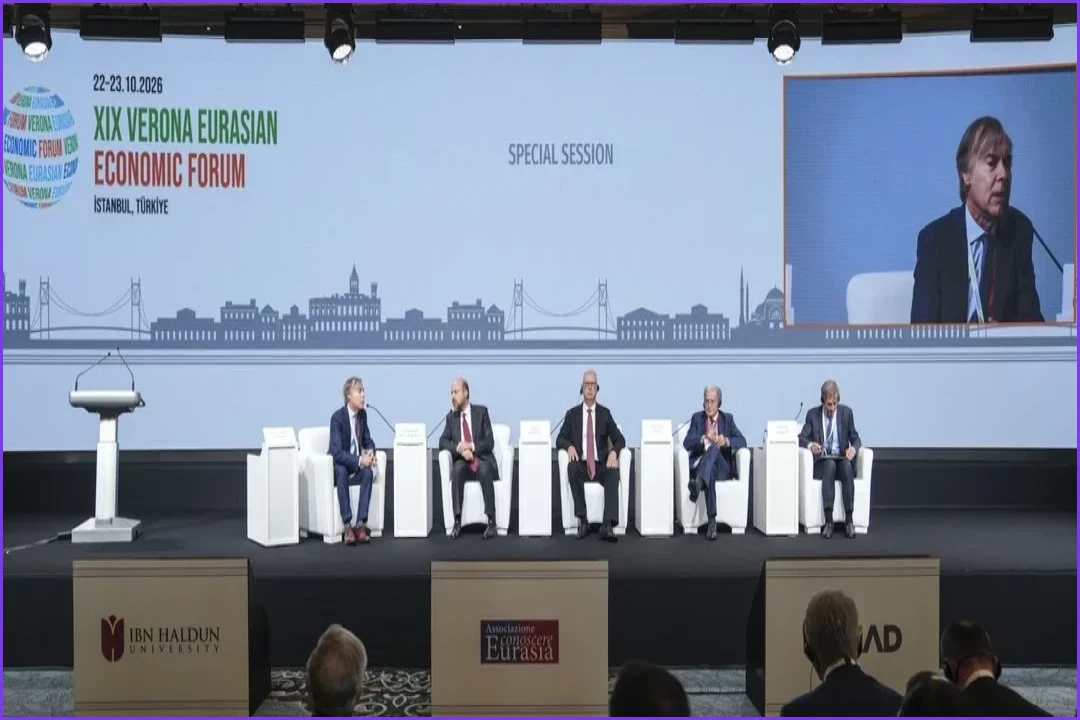
Istanbul's Ciragan Palace hosted political, corporate, and academic delegates from more than 30 nations on Thursday for the opening day of the 19th Verona Eurasian Economic Forum. The discussions centered heavily on the transition toward a multipolar international system, the future positioning of Europe, and strategies to end the ongoing war in Ukraine. Throughout the sessions, participants repeatedly stressed the imperative of sustained diplomatic dialogue and the establishment of a restructured balance of power involving the United States, Russia, Europe, and key global and regional actors.
Addressing the forum's opening session, Turkish Treasury and Finance Minister Mehmet Simsek pointed to the mounting economic pressures driven by armed conflicts, supply chain bottlenecks, and volatile commodity prices across the globe. Simsek stated that Türkiye is addressing these headwinds by prioritizing macro-financial stability and reinforcing its national resilience against external market shocks. He explained that Ankara will adhere to a data-driven, restrictive monetary stance, reconstruct its fiscal buffers, and accelerate a transition to green energy in order to curb reliance on primary energy imports. Highlighting Türkiye's regional role, Simsek noted that his country benefits directly from peace and stability in adjacent territories and will continue to invest heavily in diplomatic mediation.
During a special session, Thomas Graham, a fellow at the Council on Foreign Relations and former senior American official specializing in Russia policy, analyzed the changing global environment and its impact on Washington. "For the first time in history, the United States faces a multipolar order from which it cannot withdraw," Graham stated, observing that Washington can no longer dominate international affairs as it once did. He asserted that the United States must adapt to a period of "permanent rivalry" with competing powers, requiring policymakers to prevent direct military clashes—especially given the catastrophic potential of modern weaponry—while preserving sufficient international cooperation to tackle transnational threats. Graham noted that the ultimate goal should be establishing regional balances in Europe, the Middle East, and East Asia to support a stable broader Eurasian equilibrium, emphasizing that Europe remains essential and rejecting the notion that Washington, Moscow, and Beijing can dictate global affairs alone.
Deliberations regarding the conflict in Ukraine highlighted contrasting perspectives on achieving peace. Kirill Dmitriev, Russian President Vladimir Putin's special representative for investment and economic cooperation with foreign countries and chief executive of the Russian Direct Investment Fund, stated that Moscow is seeking a permanent resolution and a stable European security arrangement rather than short-term pauses. "It's not about temporary ceasefires. It's not about temporary solutions," Dmitriev said, warning that interim deals could simply lead to a resurgence of hostilities. He characterized recent discussions between the United States and Russia as positive and praised efforts by the Trump administration to weigh the interests of Russia, Ukraine, and Europe. Conversely, Graham cautioned that lasting peace cannot realistically emerge from a single treaty, arguing, "To demand permanent peace as a condition for a ceasefire actually is a call for continued warfare." Graham proposed a phased approach where parties first negotiate settlement principles, followed by a ceasefire to enable detailed talks in a calmer setting, requiring mutual concessions and active European participation.
Necmeddin Bilal Erdogan, chairman of the Ilim Yayma Foundation, situated Türkiye's expanding regional influence within the broader transition to a multipolar world. He argued that regional stakeholders must take greater responsibility for their own security and governance, as local populations endure the primary consequences of regional instability. Highlighting Ankara's diplomatic engagement in Syria, Iraq, and the Caucasus, Erdogan cited Türkiye's capacity to maintain communication with rival factions as a crucial asset. He called for keeping dialogue channels open despite ongoing conflicts, warning that deep-seated prejudices and international double standards are eroding global trust. Furthermore, Erdogan stated that both Türkiye and Russia belong to the broader European geographic and historical landscape, warning that ignoring these realities undermines peace efforts. He also linked security to wider technological advances, questioning the purpose of developments in areas like artificial intelligence if they fail to foster peace, human welfare, and social equality.
Former European Commission President and former Italian Prime Minister Romano Prodi reflected on how dramatically relations between Russia and Europe have deteriorated compared to two decades ago when extensive cooperation seemed attainable. Prodi noted that the war in Ukraine, along with a cascade of conflicts extending to Sudan, Gaza, and Iran, has created an exceedingly hazardous global environment. Declaring that "it is time to change," Prodi argued that Europe has been marginalized during high-level contacts between Russia and the United States due to its own internal divisions and vulnerabilities. However, he warned against excluding the continent, stating, "Without Europe there can be no peace," and pointing to Europe's substantial economic power, technological assets, and history of overcoming deep conflict. Drawing a comparison to a potential "little Yalta," Prodi suggested the world may be heading toward major-power bargaining to set new rules, but cautioned that a narrow US-Russia energy agreement would not solve global instability without comprehensive European involvement.
Addressing future economic relations, Dmitriev expressed confidence in the eventual restoration of commercial ties between Moscow and Western Europe, asserting there was "no question" Russia intends to cooperate with the continent. He pushed back against European initiatives to raise defense spending and denied that Moscow poses a threat to Europe. Dmitriev called on European corporate leaders to challenge their governments over restrictions on entering the Russian market and the economic fallout caused by reduced Russian energy imports, arguing that the restoration of widespread Russian energy deliveries to Europe remains "economically inevitable." Additionally, he suggested that economic partnership between Russia and the US could expand beyond energy markets into sectors such as fertilizer production.