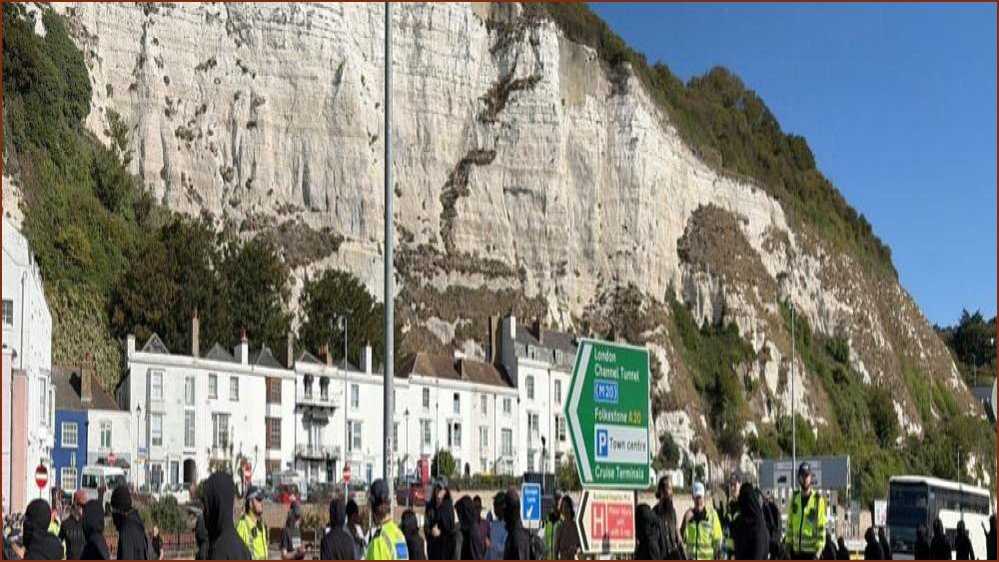
Home Secretary Shabana Mahmood has demanded that police chiefs use all necessary powers to tackle anti-migrant demonstrations, warning that lessons must be learned from recent unrest in Dover and Portsmouth. During a meeting on Thursday, Mahmood sought firm assurances that law enforcement has robust plans in place to respond swiftly and effectively to far-right groups attempting to intimidate local communities.
The Home Secretary's intervention follows a weekend of significant disruption. On Saturday, masked activists brought Dover to a complete standstill. The following day, approximately 200 demonstrators in Portsmouth attempted to block vehicles transporting intercepted migrants for processing. The Home Office characterized these incidents as "unacceptable disorder" in a summary of Thursday's high-level meeting.
Mahmood highlighted the intimidating nature of the demonstrations, pointing out that participants dressed in black and wore balaclavas. "These scenes have caused disruption for people and, given that people are dressed in black wearing balaclavas, there is a fear factor and obvious malign intent being communicated to our residents," she stated. She emphasized that this distinct visual styling sets these demonstrations apart, adding, "This makes it different from other protests, so we need to make sure we are learning lessons."
In response to these tactics, police chiefs are actively considering invoking recently enacted legislation that allows them to completely ban face coverings within designated areas. Under major changes made to protest laws over the last three years, officers have been granted expanded authority to intervene more rapidly. This includes the power to halt demonstrations that block critical national infrastructure, such as major port access roads, as well as declaring specific zones face-mask-free for the duration of an event.
Saturday's protest was followed 24 hours later by another demonstration on Sunday, which escalated after volunteers from the Royal National Lifeboat Institution (RNLI) brought 120 migrants ashore at Langstone Harbour, near Portsmouth. In the aftermath, men blocked the only road leading out of the harbour, and an RNLI volunteer was subsequently targeted online and branded a "traitor."
While it remains uncertain if similar demonstrations will occur in the coming days, local groups linked to the "Patriot Platform" umbrella organization have issued calls for further action in several parts of England. Government ministers believe the emerging Patriot Platform group is specifically designed to intimidate communities, a topic that was actively debated during Thursday's meeting.
To prevent a repeat of last weekend's disruptions, Mahmood instructed police leaders to improve their use of intelligence to ensure better preparation ahead of the upcoming weekend. This directive follows an admission by Kent Police that they had received advance warning of a potential protest in Dover but had failed to "fully assess" the intelligence before the town's critical port road was blocked.
Deputy Chief Constable Andy Mariner, speaking on behalf of the National Police Chiefs' Council as its lead for public order, confirmed that forces have initiated an "enhanced and co-ordinated" strategy to gather intelligence. He stated that police are "continually assessing and preparing for protests and any potential impact on public safety" by working alongside local forces, specialist units, partners, and communities.
"Our priority is to keep people safe, maintain public order and support the right to peaceful and lawful protest," Mariner said. "While people are entitled to express their views, anyone committing criminal offences can and should expect police action."
What we know about anti-migrant protests and organiser Danny Thomas
Small boat protest explained: How a Channel crossing sparked unrest