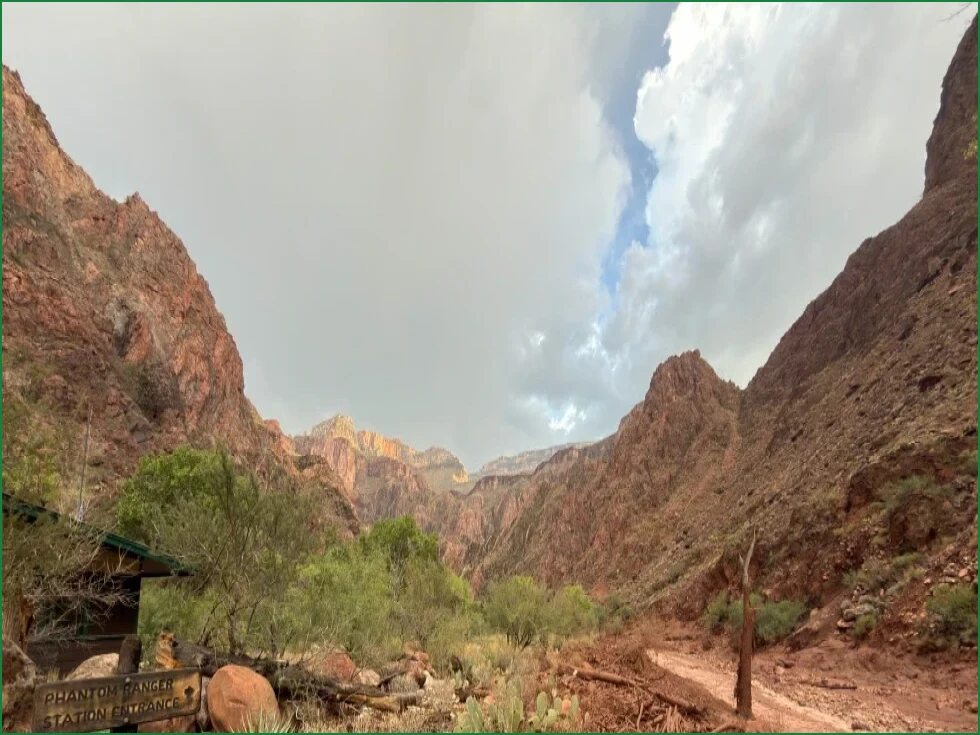
A destructive flash flood at the Grand Canyon has claimed at least one life, left approximately 15 people missing, and forced the suspension of overnight tourist stays after destroying the park's primary water pipeline. The disaster occurred on Saturday, August 29, 2026, following torrential monsoon rains that rapidly transformed the park's rugged landscape.
On Sunday evening, search and rescue teams recovered the body of a 46-year-old man near Crystal Rapids along the Colorado River. Officials from an Arizona coroner's office were on the scene, though authorities did not immediately release further details about the victim. Meanwhile, search efforts continue for about 15 other individuals who remain missing or unaccounted for in the wake of the sudden deluge.
The flood dealt a severe blow to the park's infrastructure by knocking out the sole pipeline that supplies potable water to both residents and tourists. Because of the severely limited water supply, park officials announced that visitors will be unable to stay overnight at lodges and hotels within the park starting Monday. The park's year-round residents, including roughly 1,600 people living in Grand Canyon Village, have been urged to conserve water immediately. In a statement, the National Park Service emphasized that these conservation measures are crucial for ensuring the safety and sustainability of the area's water resources.
While the Grand Canyon maintains large storage tanks for drinking water on the South Rim, these reservoirs cannot be replenished while the pipeline is out of service. Pipeline failures have been a frequent issue over the years. To address this, a massive $208 million rehabilitation and upgrade project was launched in 2023 to secure the water supply for the park's 1,600 residents and 6 million annual visitors. The upgrades were scheduled for completion next year. Expressing concern over the extensive damage, Jack Schmidt, director of the Center for Colorado River Studies at Utah State University, remarked, "Heaven help us if the whole thing down there at the bottom has to be reconstructed. Where are they going to get the money?"
The disaster was triggered by a rapid, intense storm system. Darren McCollum, a National Weather Service meteorologist based in Flagstaff, reported that between half an inch and an inch (1 to 2.5 centimeters) of rain fell within a brief 20-minute window on a rocky slope characterized by a steep drop in elevation. This sudden downpour was preceded by two smaller weather systems that had already saturated the ground hours earlier. McCollum explained that when the main storm arrived, the torrential rain fell on an already soaked landscape, triggering widespread and severe runoff.
The flooding was concentrated on the north side of the canyon, where Bright Angel Creek flows down from the North Rim to the Colorado River, dropping approximately 6,000 feet (1,828 meters). The resulting torrents of water completely wiped out footbridges over the creek, pushed massive boulders into the Colorado River, widened the creek bed, and significantly altered the surrounding landscape by extending an existing river rapid or creating a new one.
The sudden rise of the water caught many hikers by surprise. Parth Desai, a physician, was hiking through a narrow passage in Bright Angel Canyon with a park ranger and fellow doctors when the heavy rains began on Saturday. Desai described seeing the creek flood and waterfalls appearing out of nowhere, accompanied by widespread mud, boulders, and landslides. As they made their way toward Phantom Ranch, a colleague shouted a warning as a 4-foot (1-meter) wall of debris rushed toward them. The group scrambled up into a patch of cacti to escape the flow and was eventually rescued by helicopter late Saturday night.
Another visitor, Erica Viola, was at a nearby campground with about 50 other hikers when they watched the creek swell and debris, including what appeared to be a bunkhouse, float past. Viola and the other campers were airlifted out by helicopter, cutting her outdoor trip short by two days. In total, approximately 50 hikers were safely evacuated from the inner canyon by air, and several trails have been closed as a safety precaution. The National Weather Service warned that additional rain and thunderstorms remain possible for the area through Monday.
Visiting the Grand Canyon — a crown jewel of the national park system — can be particularly dangerous in the summer because of the risk of flash flooding that accompanies the monsoon, or rainy season. Clear days can give way quickly to thunderstorms and downpours.
Stengle reported from Dallas. Jeffrey Collins in Columbia, South Carolina, Holly Ramer in Concord, New Hampshire, and Christopher Weber in Los Angeles also contributed.