Ahead of a highly competitive midterm election, Republican leaders have launched a concerted effort to frame their progressive opponents as extremists. The attacks intensified after democratic socialists won recent Democratic congressional primaries in both New York and Colorado, prompting the GOP to invoke Cold War-era rhetoric to warn voters of a radical left-wing threat.
Prominent Republicans are increasingly labeling progressive Democrats as “communists,” a messaging strategy that mirrors the historical rhetoric of figures like former President Richard Nixon and Wisconsin Senator Joseph McCarthy. On a July 5 appearance on “Fox News Sunday,” House Speaker Mike Johnson, a Louisiana Republican, referenced late President Ronald Reagan’s warnings about the Soviet Union. Johnson declared that “the barbarians are inside the gate” and asserted that the upcoming election “is for all the marbles.”
Former President Donald Trump has also amplified these characterizations. Speaking at the conservative Faith & Freedom Coalition conference on June 26, Trump called progressive Democrats “hardcore, godless communists” and described their movement as “the most serious threat to our country since its existence.” Trump continued this line of attack during his July 4 speech marking the 250th anniversary of American independence.
However, academic experts and democratic socialists argue that this rhetoric mischaracterizes their actual political ideology. They define democratic socialism not as communism, but as the belief that the economy should be managed for the public good through democratic processes. They advocate for an active government role in expanding vital public services to meet basic human needs, such as healthcare and housing.
Susan Kang, an associate professor of political science at the City University of New York’s John Jay College of Criminal Justice and a member of the New York City Democratic Socialists of America (DSA), explained that the movement seeks to challenge capitalist distribution methods through peaceful, democratic means. Kang noted that their goals are achieved by gaining majoritarian support. “We want to push these ideas within the existing political institutions of the United States,” Kang said.
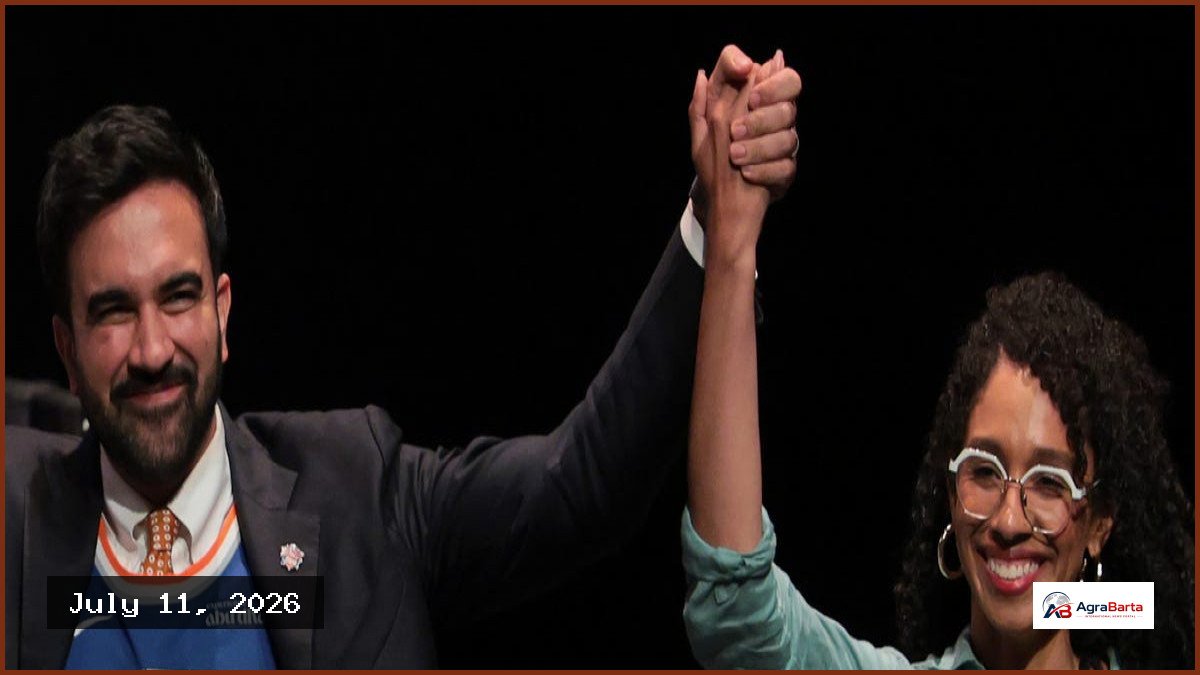
The movement has built significant momentum in heavily Democratic urban areas, where winning a primary is often equivalent to winning the general election. In 2025, Zohran Mamdani won the New York City mayoral election, and Katie Wilson was elected mayor of Seattle. More recently, in June, Claire Valdez and Darializa Avila Chevalier won congressional primaries in New York City, Janeese Lewis-George won the Democratic mayoral primary in Washington, D.C., and Melat Kiros won a congressional primary in Denver by unseating Democratic Representative Diana DeGette, who had held the seat for nearly 30 years. Additionally, Chris Rabb won an open congressional seat in Philadelphia.
Candidates running under the democratic socialist banner have focused heavily on affordability issues, advocating for programs like “Medicare for All” to guarantee universal health coverage. Their platform also includes controversial foreign and domestic policies, such as calling for the abolition of the Immigration and Customs Enforcement (ICE) agency and demanding an end to U.S. military support for Israel due to civilian casualties in Gaza and Iran.
According to the national DSA website, the organization seeks to replace capitalism with a system where ordinary citizens have a voice in their workplaces and neighborhoods, explicitly rejecting authoritarian interpretations of socialism. Communism, as advocated by Karl Marx and Friedrich Engels in “The Communist Manifesto,” envisions a classless, stateless society where there is one-party ruled by the working class. When Americans think of communism, they look to totalitarian, undemocratic governments of the former Soviet Union and North Korea. Although some DSA chapters contain Marxist-Leninist or Maoist factions, such as the Red Star Caucus, Virginia-based economist and DSA member Max Sawicky described these groups as a fringe element with very little electoral influence.
Nonetheless, some of the national organization’s foreign policy stances have drawn criticism. The national DSA opposed American military assistance to Ukraine following the Russian invasion, and a delegation previously met with now-imprisoned Venezuelan President Nicolás Maduro, who has been widely accused of establishing a dictatorship. Despite these controversies, the DSA has experienced rapid growth, expanding from 5,000 members in 2017 to more than 100,000 in 2026, largely driven by highly organized local campaign operations like those in New York City.
A clear generational divide exists regarding these political terms. Younger voters, who did not grow up during the Cold War, are far more open to socialism than older generations who associate the word with the former Soviet bloc. Democratic socialists often point to Western European and Scandinavian nations as models, where robust social safety nets exist within democratic frameworks. A July 4 poll by Morning Consult and the Cato Institute revealed that 53% of Gen Z respondents view socialism favorably, compared to only 27% of Baby Boomers. Meanwhile, a 2025 Gallup poll showed that while 54% of Americans view capitalism favorably, that support has fallen from 60% in 2021, driven in part by rising costs of living, housing, and higher education.
The modern wave of American democratic socialism traces its roots to Senator Bernie Sanders of Vermont, whose 2016 presidential campaign brought the ideology into the mainstream. In 2018, Representative Alexandria Ocasio-Cortez of New York solidified the movement’s electoral strategy by defeating high-ranking House Democrat Joe Crowley. Other prominent allies include Representative Rashida Tlaib of Michigan, though former Representatives Jamaal Bowman of New York and Cori Bush of Missouri both lost their seats to moderate challengers in 2024 Democratic primaries.
Despite recent primary victories, democratic socialists will hold only a small fraction of seats in the 435-member House of Representatives, and the movement has yet to find success in competitive swing districts. This limited reach has caused concern among moderate and centrist Democrats, who worry that the rise of left-wing candidates could damage the party’s prospects in crucial swing states.
Jim Kessler, co-founder and executive vice president of policy at the centrist think tank Third Way, warned that if democratic socialists become the public face of the Democratic Party, it could lead to severe defeats in presidential elections. Kessler noted that mainstream voters view policies like abolishing ICE as extreme. Republicans intend to capitalize on this concern, with White House spokeswoman Olivia Wales stating that Donald Trump will continue to highlight this radicalism to contrast it with his own agenda.
In response, some mainstream Democratic leaders have sought to project unity. House Minority Leader Hakeem Jeffries of New York emphasized the ideological diversity of his caucus, stating on NPR that the vast majority of his members are focused on stopping MAGA extremism and improving daily life for average Americans. Meanwhile, progressive organizers argue that the GOP’s relentless labeling of all opponents as socialists may ultimately backfire. As Sawicky noted, the constant overuse of the term to describe any policy Republicans dislike risks making the word lose its meaning entirely.
Contributing: Phillip Bailey and Marc Ramirez, USA TODAY
Eduardo Cuevas is based in New York City. Reach him by email at emcuevas1@usatoday.com or on Signal at emcuevas.01.