On Tuesday, Tobias Rausch of the far-right Alternative for Germany (AfD) was elected president of the Saxony-Anhalt state parliament. While the victory itself was anticipated by Germany's political establishment, the manner in which it was achieved has sent shockwaves across the country's political landscape, raising urgent questions about the stability of the long-standing "firewall" against the far-right.
At 35 years old, Rausch has made history as the first AfD politician, and the first leader of any far-right party in post-war German history, to be elected president of a state parliament. However, the immediate political fallout has focused less on Rausch's milestone and more on the source of the unexpected votes that secured his position, prompting deep concern among mainstream political parties.
The office of state parliament president is largely ceremonial, but it holds significant organizational power. The president is responsible for chairing parliamentary debates, enforcing rules of procedure, issuing disciplinary measures against lawmakers, and overseeing the administration of the parliament. Additionally, the president controls access to the legislative building and exercises substantial influence over staffing and organizational decisions. While Rausch cannot draft laws or govern the state of Saxony-Anhalt from this position, he now possesses considerable authority over the daily operations of its parliament.
This authority is particularly controversial because the Saxony-Anhalt branch of the AfD is officially classified as a confirmed far-right extremist group by the state's domestic intelligence service. Critics have argued that the parliamentary presidency requires a strictly neutral figure. Although Rausch has sought to reassure his opponents by calling himself a pragmatist and promising to treat all political factions fairly, his detractors have pointed to previous disciplinary warnings he received as a lawmaker, questioning his ability to act as an impartial referee.
The controversy surrounding Rausch's election stems from the final vote tally. The AfD holds 39 seats in the newly elected Saxony-Anhalt parliament, and the Bündnis Sahra Wagenknecht (BSW), which holds five seats, had publicly indicated it would support Rausch. This alliance was expected to yield 44 votes, which would have been sufficient for victory because abstentions from other parties lowered the required threshold. Instead, Rausch received 48 votes.
These four additional votes have ignited a major political storm. The Social Democratic Party (SPD), the Greens, and the Left Party had all publicly ruled out voting for Rausch. Meanwhile, Sven Schulze, the parliamentary leader of the Christian Democratic Union (CDU) and state opposition leader, had announced that his party's lawmakers would abstain. The extra votes suggest that some CDU deputies may have broken ranks to support the far-right candidate.
Suspicions of a breach in the political firewall deepened later in the day during subsequent leadership votes. Another AfD candidate, the controversial hardliner Hans-Thomas Tillschneider, was elected vice-president of the parliament, also receiving more votes than the AfD and BSW could provide on their own. Conversely, while the CDU comfortably secured the election of its own candidate, Carsten Borchert, as vice-president, the SPD candidate, Armin Willingmann, was defeated. Willingmann is a former state minister and was the SPD's lead candidate in the recent election. His defeat was widely interpreted as a humiliation for the Social Democrats, especially given that the SPD and CDU had governed the state together in a coalition until last month's election. The voting patterns have fueled speculation that some CDU lawmakers actively helped AfD candidates while refusing to support their former coalition partners.
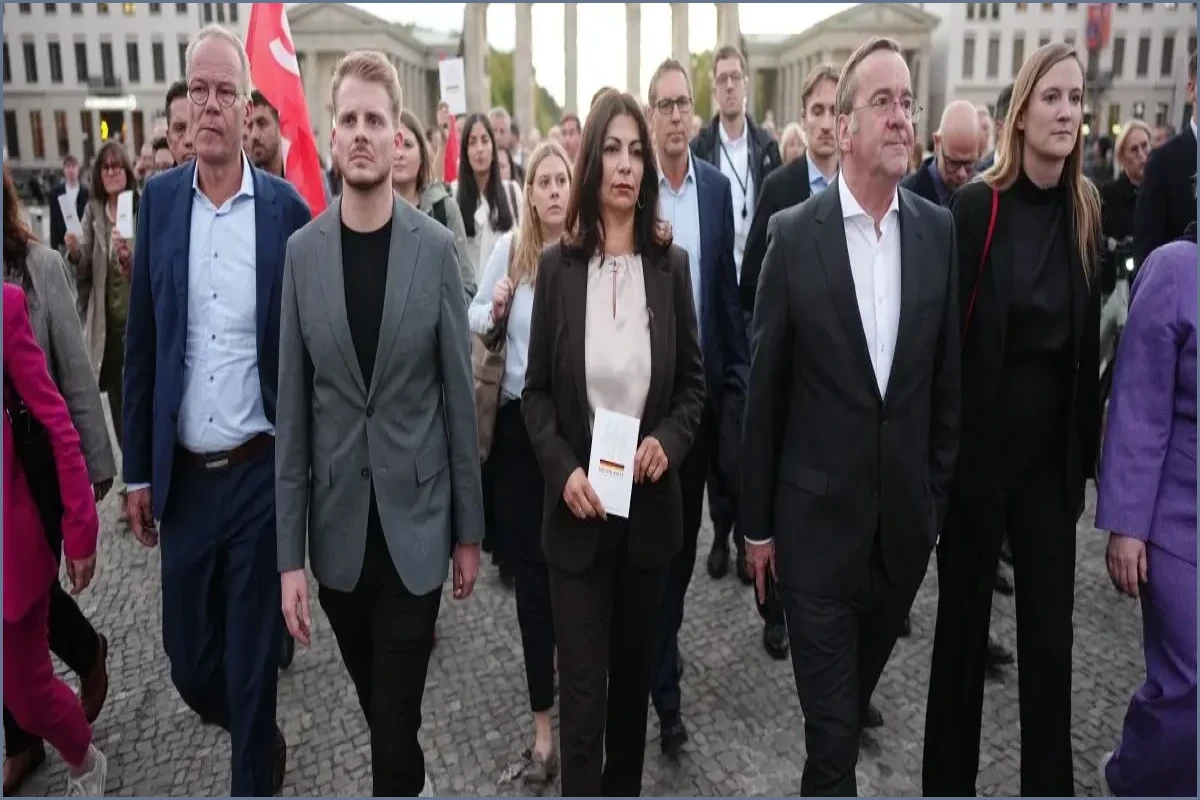
The reaction from the SPD was swift and highly symbolic. On Tuesday evening, members of the SPD's parliamentary group in the federal Bundestag staged an impromptu march through central Berlin. Carrying copies of Germany's Basic Law, the lawmakers gathered at Bebelplatz, the historic site of the 1933 Nazi book burnings. German Defence Minister Boris Pistorius strongly condemned the vote, calling it "a day of anger" and accusing those who enabled Rausch's election of having "betrayed the democracy of our great country." By linking the regional vote to national historical symbolism, the SPD sought to frame the event as a warning sign for the entire nation.
The incident has also escalated tensions within Germany's national political landscape. As SPD politicians expressed outrage over the suspected cross-party support for the AfD, the Christian Social Union (CSU)—the Bavarian sister party of the CDU—accused the SPD of hypocrisy. The CSU pointed to the SPD's ongoing coalition negotiations with the Greens and the Left Party in Berlin, noting that the CDU/CSU also maintains a strict political firewall against the far-left Left Party (Die Linke).
For years, Germany's mainstream political parties have adhered to the "Brandmauer," or firewall, which dictates a policy of no cooperation and no joint political initiatives with the AfD. Officially, leadership figures in both Berlin and Saxony-Anhalt insist this policy remains intact. However, the vote in Saxony-Anhalt has cast doubt on whether party leaders can actually enforce this discipline among their rank-and-file members. A commentary broadcast by public media outlet Tagesschau summarized the growing unease, stating, "Nothing is certain anymore."
This uncertainty is set to loom large over upcoming political decisions. In December, the Saxony-Anhalt parliament is scheduled to elect a new minister-president. AfD leader Ulrich Siegmund has repeatedly claimed he can assemble a parliamentary majority to claim the post. While political analysts previously dismissed Siegmund's assertions as mere posturing, the unexpected voting patterns on Tuesday have thrown all prior political calculations into question.
READ ALSO: Is German Chancellor Merz taking a harder line against the far-right after AfD win?
Before Tuesday's vote, most political observers already believed Rausch would win.