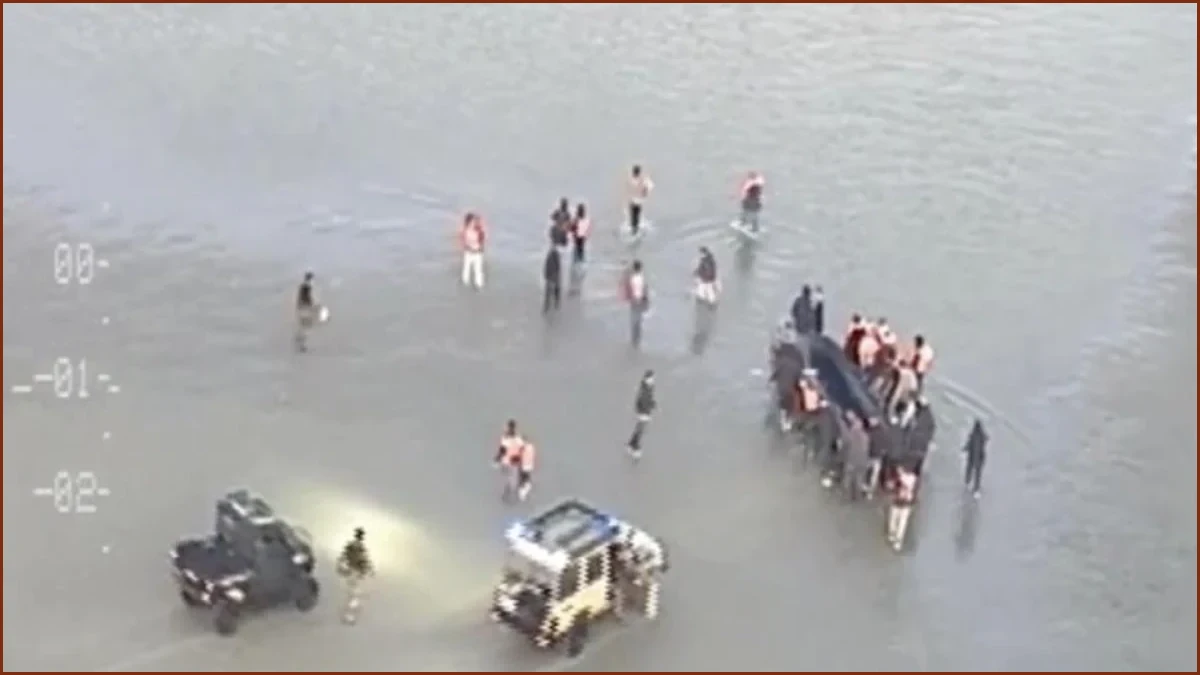
French police tactics are growing more effective at preventing small boats in the English Channel from reaching Britain, according to the Home Office. British officials have credited French authorities with intercepting 185 potential crossings involving 4,300 migrants over four separate weeks this summer, alongside stopping 12 boats at sea using new techniques. However, the specific techniques being used have not been disclosed by the UK or France.
Previously, the French authorities allowed most dinghies to head towards the UK once they had launched, because of the risk of intercepting them in deep water while loaded with people. Out of the 12 dinghies stopped at sea so far, three of those interceptions occurred within the last two weeks.
Footage released by French police shows officers racing across a beach in jeeps to intercept a launch. Once the boat is abandoned, an officer slashes it lengthways with a knife. During these beach operations, migrants can be seen throwing objects at the officers, with one officer appearing to respond by using pepper spray.
Charlie Eastaugh, the director of maritime and small boats at the Border Security Command, stated that on a single recent Thursday, French forces successfully prevented all three of the boats that tried to cross. Speaking at the Western Jetfoil facility in Dover, which is used to process migrants, Eastaugh explained that two of those were prevented at sea, and one was prevented on land.
Addressing claims that bad weather was the primary factor behind the reduction in crossings this year, Eastaugh argued that the data demonstrates that the French are being effective in preventing a number of these small boats. He added: "Clearly, every single day that one slips through the net and crosses, it's one too many, and that's why it's absolutely critical to us to not take our foot off the gas and to keep working hard with our French partners and stop this from happening."
Despite these efforts, the Conservative Party described the announcement as a "joke," claiming that Channel crossing preventions are actually down by half over the past year. Shadow Home Secretary Chris Philp argued that the only way to stop the crossings is by having a proper deterrent, stating that if people know they can stay in the UK, get put up in a hotel, and claim benefits, they will keep risking these dangerous journeys.
Meanwhile, Reform UK stated earlier this month that if it were in power, it would intercept boats crossing the English Channel and return migrants to French ports, even if France disagreed. The French interior ministry responded by warning that such an action would constitute a violation of French sovereignty.
While Channel crossings are down by about 40% compared to last year, thousands of illegal migrants are still getting through. On a single Monday, 250 migrants arrived. Over a recent three-day period of good weather, 425 migrants made it across the Channel on five boats.
Between January 1 and August 8, 2026, a total of 14,819 people crossed the English Channel by small boat from France, representing a 43% decrease compared to the same period the previous year. These crossings have been the most common way for people to be detected entering the UK illegally since 2020.
Nearly all those who arrive by small boat claim asylum, allowing them to remain in the country under international law while their applications are considered. Small boat arrivals made up 42% of all asylum applications between April 2025 and March 2026. People from Eritrea accounted for 18% of all arrivals during that same period.
The physical risk of these journeys has escalated. Boats arriving in the UK from August 9, 2025, to August 8, 2026, carried an average of 67 people, which has more than doubled since 2021. Experts warn that overcrowding makes crossings far riskier. According to the United Nations, at least 84 people died while attempting to cross the Channel in 2024.
To counter enforcement, people smugglers have turned to larger vessels. In late July, a record 165 migrants reached the UK in a single boat. The Border Security Command was pictured towing a 13-meter (42ft) "mega dinghy"—estimated to be the size of a standard bus—when it arrived in Dover on July 23. Earlier this month, another "mega-dinghy" carrying 230 people was intercepted in the Channel.
The government has pledged to "smash the gangs" behind these crossings to reduce the numbers. The overall scale of small boat crossings represents about 5% of the total immigration into the UK from January 2025 to December 2025.
Other illegal entry methods are also declining. Between April 2025 and March 2026, some 4,535 people were detected entering the UK without permission via other methods, including hiding in vehicles, travelling on ferries, or through airports. This was a 22% decrease compared to the previous year. Additionally, some individuals arrive legally, such as on work or study visas, and overstay their limit, though the total number of people living in the UK illegally after arriving legally remains unknown.
The strategy to stop these crossings involves multiple layers. The first layer is stopping the trade in equipment. German police have seized dinghies, outboard engines, and life preservers. Nearer the coast, boats have been discovered buried on beaches and in cars heading for the coast. The second layer is stopping migrants from launching from beaches, which includes tactics like slashing inflatable boats with knives—a technique witnessed by reporters in July last year and now used more frequently.
The final and most difficult layer is interception at sea. The UK government knows that if it can prevent migrant boats from entering British waters, where the Border Force is legally obliged to pick them up, the incentive to cross will be reduced. Smuggling gangs continue to adapt, but Eastaugh noted that changes to their methods demonstrate how hard they are finding it to operate. "That's why the numbers we're seeing are so successful, and we're absolutely not complacent, and we must keep working this way to keep the numbers down," he said.
Burnham pledges to be 'relentless' in curbing small boat crossings