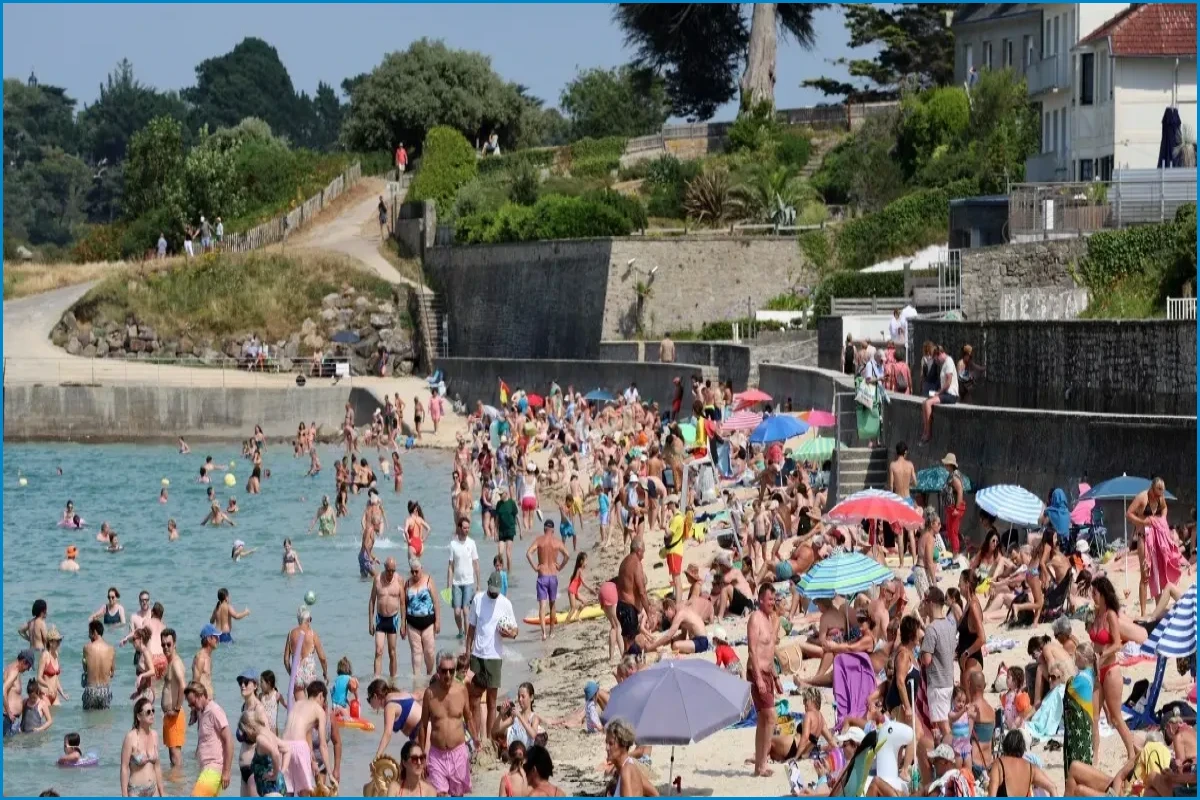
France boasts a spectacular coastline stretching over 5,500 kilometers, spanning the English Channel, the Atlantic Ocean, and the Mediterranean Sea. This makes the seaside a premier destination for travelers. In fact, a survey published by Le Figaro revealed that one in five American tourists visiting France in 2022 intended to spend their time relaxing au bord de la mer, or by the sea. However, those planning a seaside getaway must understand that French beaches are not lawless zones. Local and national authorities enforce a strict set of regulations governing everything from clothing and behavior to environmental preservation and drone usage.
When it comes to clothing, France has a reputation for a relaxed attitude toward nudity, but public order must still be respected. While there is no blanket national law outlawing public nudity, individuals can be fined for disturbing the public order. Naturists have previously faced fines after startling clothed walkers in countryside areas. To accommodate those who prefer to bathe without clothes, French beaches offer numerous designated nudist areas and resorts, which are clearly marked with signs. Within these specific zones, visitors are expected to either remain naked or, if they feel uncomfortable doing so, relocate to the non-nudist sections of the beach.
For female sunbathers, going topless is generally permitted on French beaches, though local municipalities retain the right to implement their own restrictions. For instance, the artificial Paris plages along the Seine do not allow women to sunbathe topless. Any beach with specific local bylaws restricting toplessness must display warning signs at the entrance, and failure to comply can result in a fine of approximately €38. For men, going shirtless is perfectly acceptable on the sand, but local etiquette and municipal signs often request that they put on a shirt or T-shirt when leaving the beach to enter nearby towns or restaurants.
Public displays of intimacy are subject to much harsher penalties. Under Article 222-32 of the French Penal Code, any public sexual exhibition on a public beach is a criminal offense. Violators can face up to one year of imprisonment and a substantial fine of €15,000. This makes it clear that while sex on the beach is a popular cocktail, it is absolutely not a suggested activity on the sand.
Swimwear rules also extend to the controversial topic of the burkini, a modest full-body swimsuit favored by some Muslim women. While municipal public pools in France frequently ban the burkini under the guise of hygiene regulations—a policy that remains highly contentious—the rules on public beaches are different. The Conseil d'État, France's highest administrative court, has repeatedly overturned attempts by local mayors to ban the burkini on public beaches, meaning the garment is legally permitted on the coast.
Visitors should also be aware of the nationwide smoking ban on French public beaches, which went into effect on July 1, 2025. This regulation extended the country's existing indoor smoking ban to various outdoor spaces, including coastal shores. While several local authorities had already implemented their own smoking bans prior to this date, the new legislation established a uniform national rule. Anyone caught smoking on a public beach faces a €135 fine, though the rigorousness of local enforcement remains to be seen.
In contrast, drinking alcohol on the beach is generally permitted, and carrying wine or beer onto the sand is a common practice. However, local municipal decrees can still restrict alcohol consumption in specific areas, and being drunk in public remains illegal across the country. Additionally, environmental challenges have forced some changes to beach amenities. As France experiences hotter, drier summers driven by climate change, several municipalities, particularly along the drought-prone Mediterranean coast, have shut off the water supply to beach-side showers. Travelers visiting these regions during the summer months should verify local water usage restrictions.
Protecting the natural coastal environment is another major focus of French law. Taking sand from the beach as a souvenir is strictly prohibited, with the sole exception of windblown sand that has been naturally carried away from the beach by the wind to another location. While authorities typically tolerate tourists taking a tiny amount of sand as a holiday keepsake, taking significant quantities is prosecuted. This prevents individuals from hauling away sacks of sand to construct private urban beaches or mix mortar. Similar restrictions apply to shingle beaches; taking a couple of pebbles is tolerated, but removing large quantities can result in a maximum fine of €1,500. Similarly, collecting seashells is allowed for personal souvenirs, but taking unreasonable amounts is banned.
Even stricter penalties exist for disturbing local flora. Certain species of seaside plants are protected under robust environmental laws. Anyone caught taking a protected marine coastal plant can face an enormous fine of up to €150,000 for the alteration, degradation or destruction of the environment of a plant species in a protected site. While there are no specific laws governing the collection of driftwood or sea glass, both are legally considered part of the seaside landscape. Collecting a few pieces for personal use is fine, but anyone wishing to gather large quantities to start a business making furniture or ornaments must seek prior permission from local authorities.
Foraging for seafood on the beach, known locally as pèche a pied, is a popular pastime but is also heavily regulated. Whether gathering oysters or razor clams, foragers are usually restricted to a limit of a couple of kilograms to prevent commercial exploitation. These limits are clearly displayed on information boards along the seafront. Furthermore, coastal départements publish specific rules on their websites; for example, Charente-Maritime specifies that oysters and clams cannot be harvested from areas designated as natural reserves. Local authorities may also restrict foraging to certain times of the year to allow marine life populations to recover.
Overnight stays on the beach are also restricted, as wild camping on sea shores or beaches is illegal in France, carrying a fine of up to €1,500. Bringing pets to the beach is another area with tight restrictions. Most public beaches ban dogs, though a few designated spots do allow them. Dog owners can verify which beaches are dog-friendly by contacting local town halls or tourist offices, or by consulting the website of the animal rights organization 30 millions d'amis. Some locations permit dogs on leashes during the winter months but ban them entirely during the high-tourism summer season.
The concept of a private beach in France is also legally complex. Technically, private beaches do not exist because the sea and the shoreline are designated as public maritime domains owned by the French state. However, under a system established in 1986, the State can grant temporary concessions allowing hotels, resorts, or beach operators to rent sections of the beach. These rentals are granted for a maximum of twelve years and are renewable, with annual fees ranging from €15,000 to €100,000 paid to the local town hall. Once a concession is granted, operators can restrict access to hotel guests or charge fees for sunbeds and umbrellas. However, they are only allowed to occupy the beach for six months of the year, though this can sometimes be extended to eight months with town hall approval, or twelve months in rare cases. Crucially, operators must dismantle all installations at the end of the season, meaning permanent private structures are forbidden.
Finally, beachgoers who enjoy modern technology must be highly cautious when operating drones. Flying a drone directly over swimmers can result in severe legal consequences, including a fine of up to €75,000 and a prison sentence of up to one year. By keeping these diverse rules in mind, visitors can enjoy France's beautiful coastline while avoiding costly penalties and respecting local communities.
READ ALSO Naked truth: Why naturism is on the rise in France
The same rules apply to a shingle beach and while a couple of pebbles will be tolerated, taking large amounts could get you the maximum fine of €1,500. Likewise with shells – while souvenirs are allowed, taking "unreasonable amounts" of seashells is banned.