European officials are set to attend U.S.-mediated peace talks between Russia and Ukraine in the United Arab Emirates this week, defying earlier objections from Moscow, according to French Foreign Minister Jean-Noël Barrot. Speaking on French radio on Sunday, Barrot confirmed that France would be present at the gathering to ensure European interests are represented during the discussions scheduled for Tuesday and Wednesday in Abu Dhabi.
Barrot did not clarify whether French and other European representatives would participate directly in the negotiations or act as observers, nor did he specify who would represent Paris. The sessions had previously been arranged as a three-way dialogue between officials from Washington, Moscow, and Kyiv.
The announcement comes after Kremlin spokesman Dmitry Peskov publicly rejected European involvement, stating that a trilateral format had already been established. In comments to a Russian news network on Friday, Peskov accused European governments of failing to establish unified leadership, though he acknowledged that long-term security discussions would eventually require Europe's participation.
The diplomatic push follows remarks by U.S. President Donald Trump, who met with Kremlin envoy Kirill Dmitriev on Thursday. Trump stated that an impending agreement would extend beyond Ukraine and suggested it could encompass all of Europe. However, Ukrainian President Volodymyr Zelenskyy told CNN on Friday that he had not received details regarding Trump's proposed framework, warning that negotiations conducted without impacted countries risk repeating historic mistakes such as the 1945 Yalta conference.
The upcoming Abu Dhabi meetings mark the fourth round of bilateral and trilateral peace talks mediated by the Trump administration since the conflict began, and the first since negotiations in Geneva in February. Previous U.S.-led diplomatic efforts yielded limited progress, with momentum slowing in recent months as Washington focused heavily on its conflict with Iran.
Moscow agreed to return to the negotiating table following a visit by U.S. envoy Steve Witkoff to meet Russian President Vladimir Putin in St. Petersburg in October. During that visit, Putin announced the release of an American prisoner, following President Trump's earlier decision to roll back sanctions on Russian diesel exports—a move fiercely criticized by Kyiv for providing revenue to Moscow's war effort.
Russia's delegation will be headed once again by Vladimir Medinsky, a hardline presidential aide who has led Russian negotiators in most rounds since early 2022. However, Moscow is expanding its delegation to include Deputy Foreign Ministers Sergei Ryabkov and Mikhail Galuzin, General Staff operations directorate deputy head Yury Zhigarlovsky, and military intelligence chief Igor Kostyukov.
The inclusion of senior military and diplomatic personnel suggests Moscow may be preparing to address complex military and political issues. Nevertheless, analysts at the Institute for the Study of War noted that several of the newly added Russian officials have previously worked to delay negotiations or press hardline demands. Former U.S. Ambassador to Ukraine John Herbst, writing for the Atlantic Council, observed that Putin has consistently rejected proposals accepted by Kyiv, predicting the talks might only produce an agreement to hold further meetings.
The diplomatic maneuvering occurs alongside shifting U.S. political dynamics following Democratic victories in midterm elections, which Zelenskyy suggested could bolster Ukraine's chances of securing additional American aid. Discussions are also underway regarding a potential trilateral meeting between Trump, Putin, and Chinese President Xi Jinping at the Asia-Pacific Economic Cooperation summit in Shenzhen, China, later this month.
On the ground, fighting remains intense. Zelenskyy reported that Russian forces launched 36 ballistic missiles at the Kyiv region overnight Saturday, with air defense systems intercepting only four. In southern Ukraine, the death toll from a guided-bomb attack on a humanitarian aid distribution center in Komyshuvakha rose to at least 55.
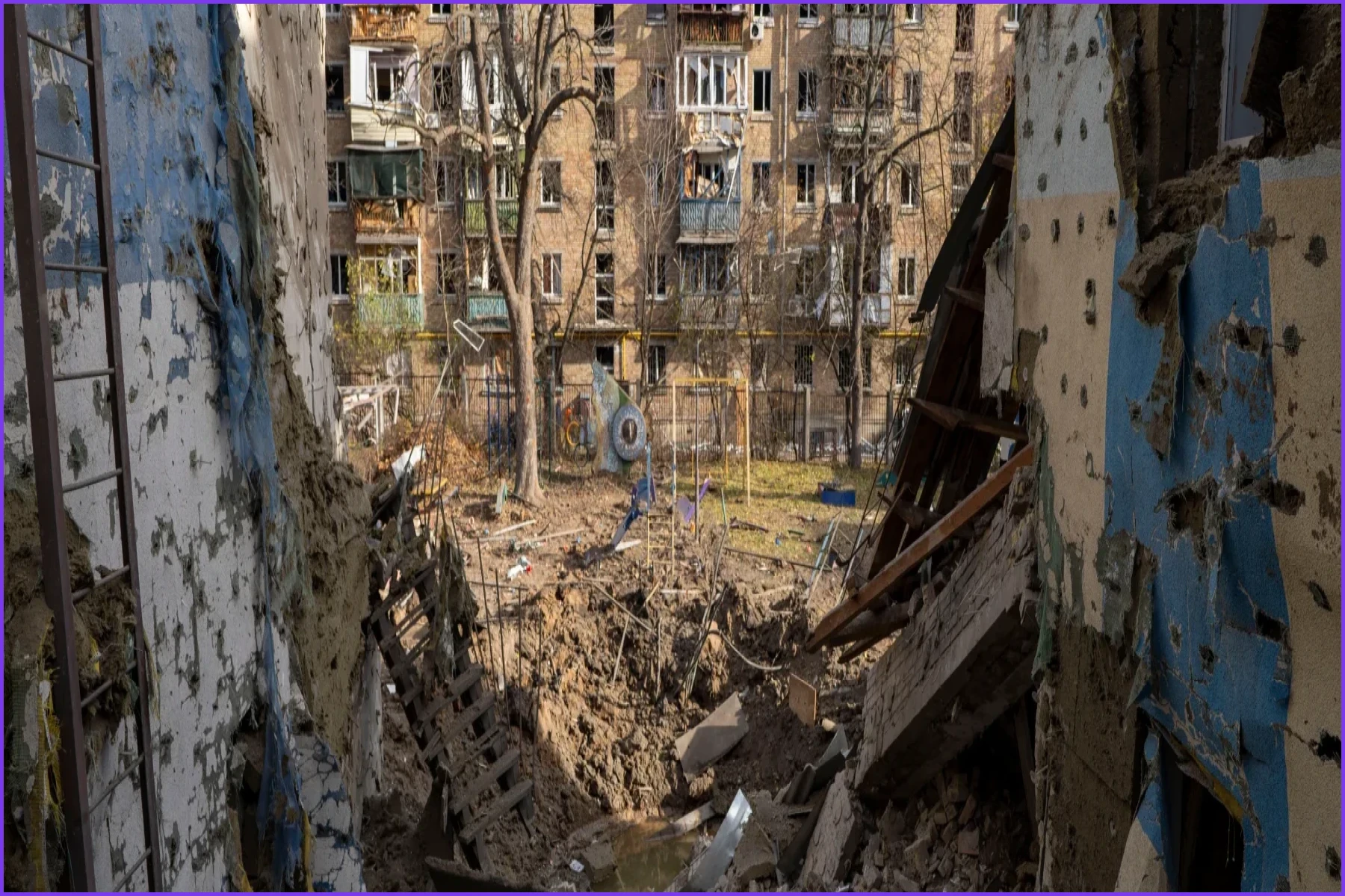
A view through the destroyed walls of a kindergarten shows a large bomb crater and a damaged residential apartment building following a missile attack in Kyiv, Saturday, Nov. 7, 2026. Dan Bashakov/AP hide caption
German Chancellor Friedrich Merz, right, and Ukrainian President Volodymyr Zelenskyy attend a press conference in Berlin, Germany, Tuesday, Nov. 3, 2026. Ebrahim Noroozi/AP hide caption