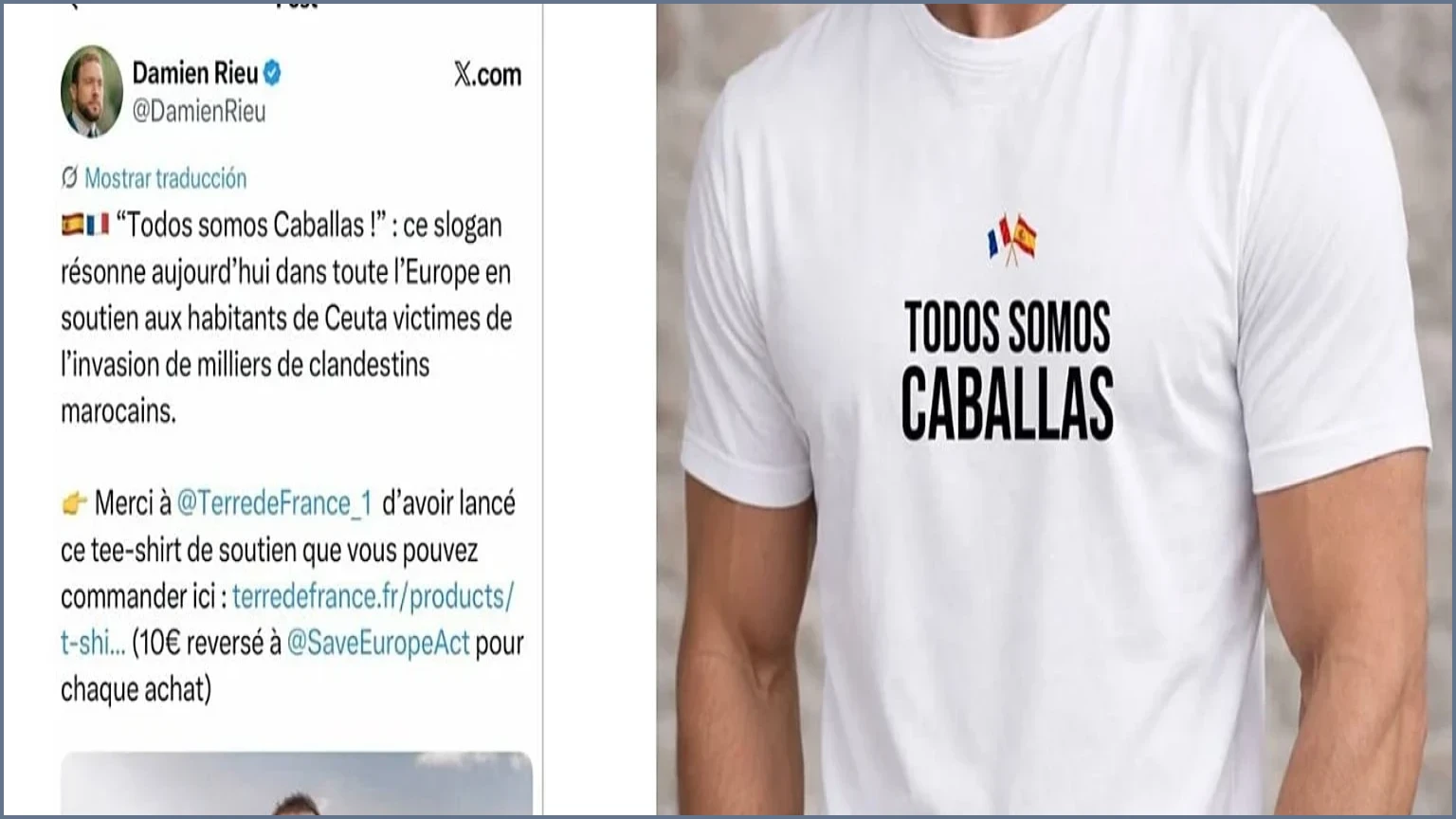
A French clothing brand marketing a "patriotic and solidarity-based" T-shirt is directing nearly 29% of its sales revenue to the far-right movement Save Europe Act. The €35 garment is being sold by Terre de France, a company claiming to offer 100% French products. While the brand's website states that a portion of its overall revenue supports farmers, agricultural colleges, and wounded French soldiers, €10 from each of these specific T-shirts goes directly to the Save Europe Act. No funds from the sales are designated to help people or organizations in the Spanish enclave of Ceuta.
To market the product, Terre de France released a promotional image showing a person wearing the T-shirt in front of what appears to be Trampolín beach in Ceuta. However, digital analysis tools including Hive Detect, TruthScan, and Sight Engine have identified the image as an artificial intelligence fabrication. On its social media channels, Terre de France actively promotes nationalistic messaging, claiming to defend a Catholic and white France that it argues is not represented by LGBTQ+ people. The brand has also publicly rejected "crousty"—a popular fried-chicken fast food in France—on the grounds that it is not truly French.
The beneficiary of the shirt's sales, the Save Europe Act, describes itself as a "patriotic" movement. The group demands that political leaders halt "replacement immigration," secure borders, and preserve the "ethnocultural identity of European nations." Its platform proposes suspending all migration routes from non-Western and non-European countries until social cohesion is restored. Additionally, the group advocates for "remigration"—either voluntary or forced—for irregular migrants, individuals with criminal records, and those they deem to be a significant cultural or financial burden.
In an effort to turn its proposals into official European policy, the organization has been gathering signatures across Europe to reach the one million threshold required for a European Citizens' Initiative. This mechanism allows EU citizens to submit legislative proposals to the European Commission. However, the Commission refused to register the initiative, declaring it "manifestly contrary to the values enshrined in the Treaty and in the Charter of Fundamental Rights of the EU" and warning that it would serve as a vehicle for offensive and caricatured messages. The organizers of the Save Europe Act are currently preparing to contest the Commission's decision in court.
The marketing of the T-shirt follows a wave of visits to Ceuta by prominent European far-right figures in the wake of the city's migrant crisis. Activists from Reform UK visited on August 1, followed by members of Switzerland's Junge Tat on August 2, and Portugal's Reconquista on August 4, alongside representatives from Germany's Generation Identity. Members of the Spanish neo-Nazi group Núcleo Nacional were expelled from the city on August 1 when they attempted to hold a demonstration but were met with a counter-protest by local residents.
Prominent figures associated with the Save Europe Act have actively used their large social media reach to highlight the situation in Ceuta. Martin Sellner, a promoter of the movement who has nearly 200,000 followers on X, shared videos from the city on August 3 calling for "non-violent civil disobedience" to halt what he described as "ethnic replacement." The movement's co-founder, Eva Vlaardingerbroek, who commands 1.2 million followers on X and 1.3 million on Instagram, posted a message on July 31 denouncing an "orchestrated invasion" of the city, which was subsequently shared by tech billionaire Elon Musk.
Journalist Ríos warns that Europe's far right is utilizing Ceuta as a physical stage to advance its political agenda. According to Ríos, this strategy relies heavily on coordinated networks, artificial intelligence, disinformation campaigns, and digital bot operations. This is not the first time the movement has seized on local tensions; during the July 2025 unrest in Torre Pacheco, which was triggered when a young man of Moroccan origin assaulted a local resident, the Save Europe Act and its promoters spread false claims that Moroccan migrants were arming themselves and attacking white residents for consecutive nights, using the situation to advocate for their policy of remigration.