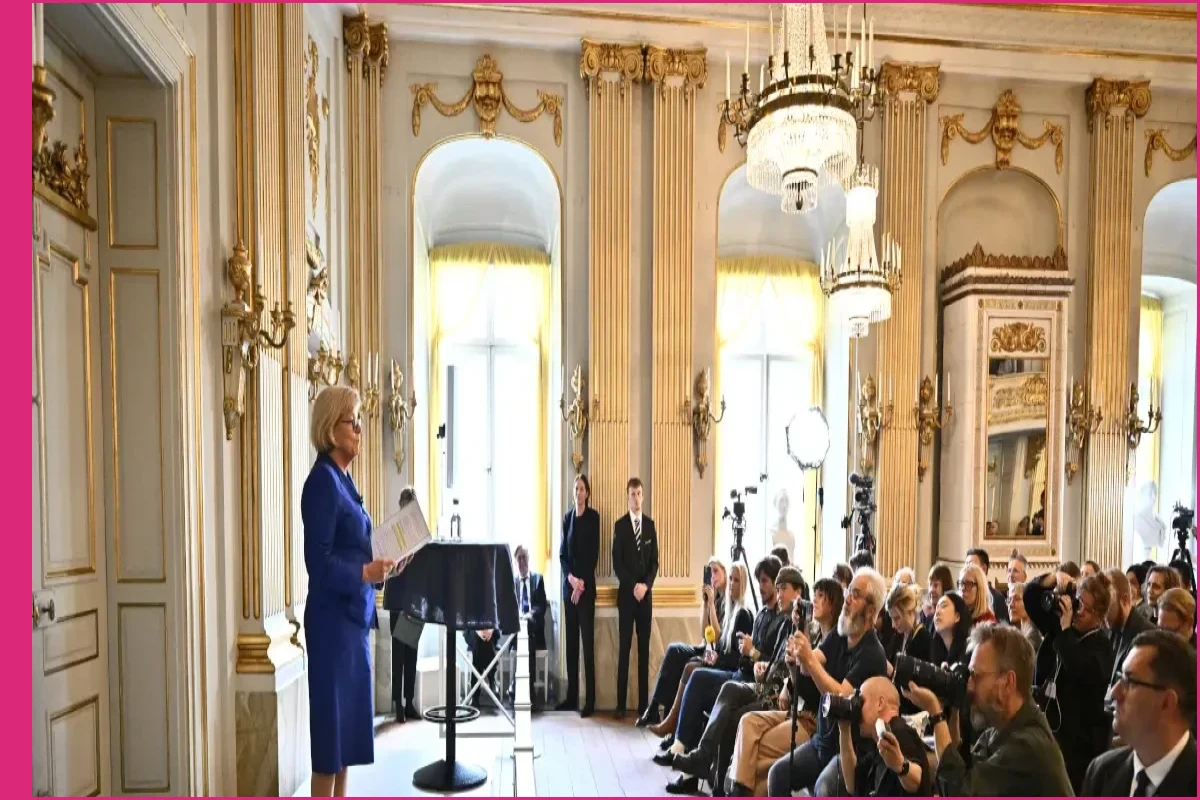
The Nobel Prize in Literature has been awarded to Canadian poet, essayist, and classicist Anne Carson. The 76-year-old writer, who announced in 2024 that she has Parkinson’s disease, was honored by the Swedish Academy for her bold and inventive oeuvre that, in playful dialogue with the classical tradition, has created new forms for contemporary literature. Carson’s work is celebrated for bringing a modern twist to mysticism and antiquity while exploring themes of love, desire, and despair.
Ingrid Carlberg, the permanent secretary of the Swedish Academy, shared details of a brief phone call she had with the new laureate. Carlberg reported that Carson was currently in Iceland, where she was spending her time listening to the wind. Although the conversation was short, Carlberg noted that Carson was caught by surprise but sounded very happy.
Carson has a rich academic and creative background. As a professor of classics, her studies and teaching encompass dead languages, literature, anthropology, and history. In 2001, The New York Times described her as one of the great pasticheurs due to her unique ability to blend styles and eras. Her contemporary poetry first gained significant recognition in the 1990s, when she secured prestigious honors such as the Lannan Award in 1996 and the Pushcart Prize in 1997.
In 1998, Carson published Autobiography of Red: A Novel in Verse. The acclaimed work loosely adapts the ancient Greek myth of the monster Geryon and Herakles, transforming it into a contemporary story of a gay love triangle. According to the Academy, the bulk of Carson’s literary output focuses on the intersection between the philologist's obsession with words and the poet's desire for new meaning.
The Academy also lauded her poem Nox, printed on a single continuous sheet of paper as a tribute to her brother who died in 2000. Calling it an unforgettable work, the Academy described the piece as both sculptural and literary. The work functions as an epitaph housed in a box, containing an accordion-fold-out of letters, photographs, and written texts dedicated to her late brother, conveying a deep, palpable sense of loss.
Carson has been a prominent name in Nobel discussions for several years. Many literary experts predicted a female winner this year, pointing to ongoing pressure on the Academy to address the historical overrepresentation of Western white men. Since the literature prize was established in 1901, only 19 of the 122 laureates have been women. The Academy underwent a major restructuring following a 2018 sexual abuse scandal that forced the replacement of more than half of its 18 members. Since that upheaval, every other literature laureate has been a woman.
Last year, the award went to Hungary's Laszlo Krasznahorkai, whose works explore themes of postmodern dystopia. The literature prize is the fourth of the six Nobels to be announced over the course of a week. Earlier in the week, the academies in Stockholm announced the winners for medicine, physics, and chemistry.
Attention will now shift to Oslo, where the Nobel Peace Prize is scheduled to be announced on Friday. Speculation surrounds several potential candidates, including the Save the Children charity, Ukrainian children's rights advocate Mykola Kuleba—who campaigns for the repatriation of children illegally taken to Russia from occupied regions—and Sudan’s Emergency Response Rooms (ERR), a network of volunteers providing aid amidst war and hunger. Other names raised in discussions include Francesca Albanese, the UN special rapporteur for the occupied Palestinian territories; Pope Leo XIV; the Committee to Protect Journalists; the International Criminal Court (ICC); and the International Court of Justice (ICJ). The Nobel season will conclude on Monday with the economics prize.
Each Nobel Prize carries a cash award of $1.2 million, along with a diploma and a gold medal. If a discipline has multiple winners, the prize money is split among them. Carson will formally receive her award from King Carl XVI Gustaf during a ceremony in Stockholm on December 10, the anniversary of the 1896 death of prize founder Alfred Nobel.