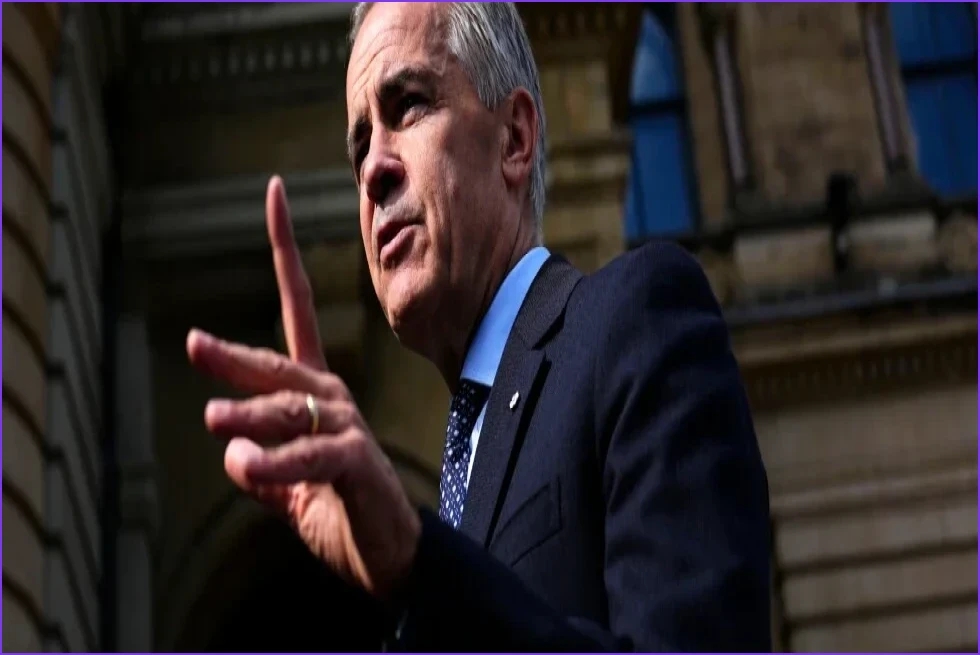
Canadian Prime Minister Mark Carney on Tuesday, September 1, 2026, directly challenged the Trump administration, urging them to "stop doing memes, stop throwing shade and stop trying to be tough." Speaking from Ottawa, Carney pushed back against a recent barrage of attacks from Washington, emphasizing that U.S.-Canada trade talks could only resume if the United States approached negotiations with seriousness.
Carney accused the U.S. of pursuing trade terms that, he warned, could lead to Canadian industries being "gradually wound down in Canada and wiped out." He reiterated, "When the Americans stop doing memes, stop throwing shade and stop trying to be tough, and start being serious about having those discussions, we can have those discussions." He added, "It’s not constructive, but that’s their democracy."
The Prime Minister's comments followed a renewed wave of pressure from Washington since trade talks collapsed on August 21. This included President Trump's move to rename Lake Ontario "Lake America" and his taunts against Canada on social media. U.S. Treasury Secretary Scott Bessent also weighed in, stating that Canada could not engage in a "tit for tat" with an economy 13 times larger than its own.
Further escalating tensions, U.S. Defense Secretary Pete Hegseth mocked the Canadian military online on Monday, posting an image of two female cadets at a British Columbia training center with the caption "this is real" and a Canadian flag. Carney condemned the post as "beneath their office," though the Pentagon defended it on Tuesday, stating, "The X post speaks for itself."
Bessent responded to Carney on Fox News, claiming the Canadian leader had received a "verbal beatdown" from both him and Hegseth. Addressing Carney’s call for the administration to stop "throwing shade" and return to serious negotiations, Bessent retorted, "Well, he was the one who said we were at war."
Carney reiterated his firm stance against the U.S. proposals, which he said would effectively render Canadian industries as subsidiaries of American companies or impose terms leading to their demise. "We’re not going to — of course, we’re not going to accept those terms," he stated.
Bea Bruske, president of the Canadian Labour Congress, reported that Carney informed labor leaders on Tuesday that they should not expect relations with the United States to "go back to normal any time soon." Bruske quoted Carney as describing the current situation as "a new normal that we have to get adjusted to."
Carney's firm position was bolstered by the Liberal party's sweep of three special elections on Monday, including a decisive victory in Chicoutimi-Le Fjord, Quebec, where the Conservatives placed third. These wins increased the Liberals' representation to 173 seats in the 343-seat House of Commons, strengthening Carney's hand as he confronts Trump over trade and Canadian sovereignty.
Nelson Wiseman, a professor emeritus of political science at the University of Toronto, noted that President Trump's repeated threats to make Canada the 51st U.S. state carry particular weight in Quebec. Wiseman explained, "Quebecers have the most to lose in an apocalyptic scenario where the U.S. absorbs Canada, and the status of the French language disappears."