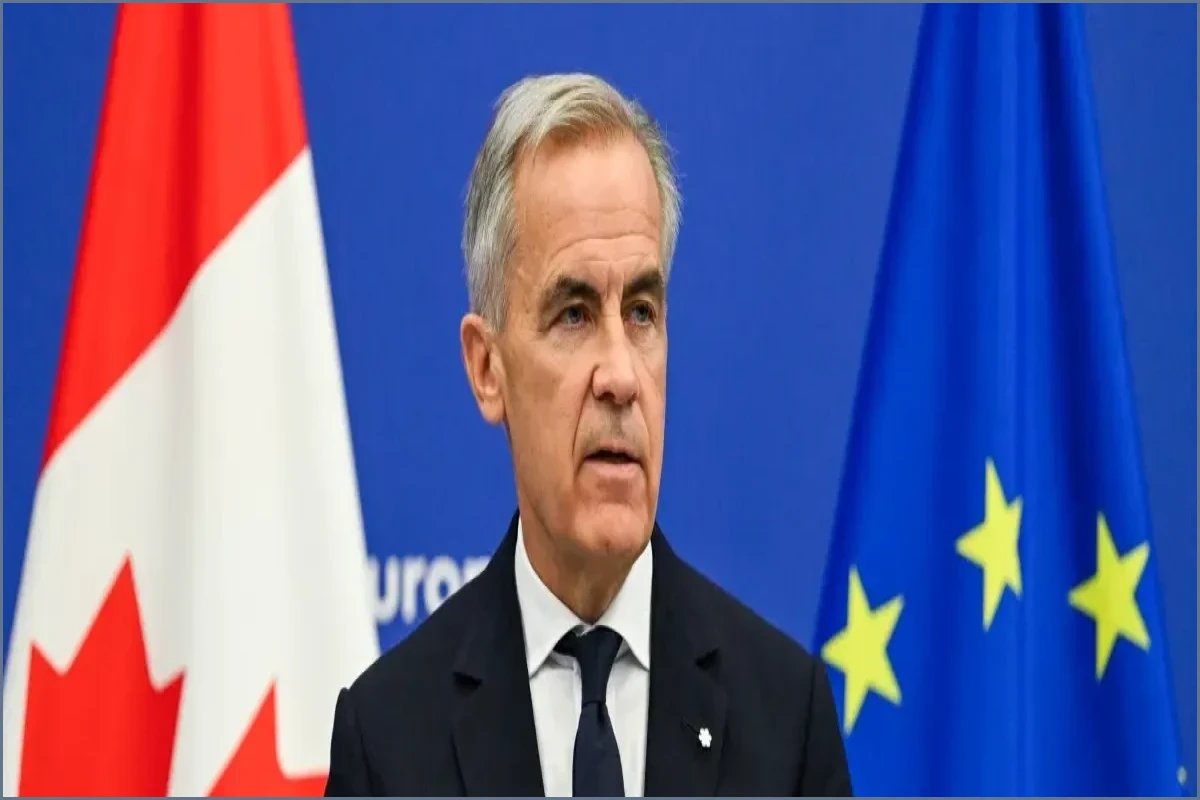
STRASBOURG — Canadian Prime Minister Mark Carney has firmly dismissed threats of trade retaliation from the United States, championing a "new alliance" with the European Union as a protective shield against external geopolitical pressures. Speaking before the European Parliament on Thursday, Carney welcomed a landmark proposal to deepen trans-Atlantic ties, declaring that "Europe and Canada are stronger together."
The Canadian leader's high-profile address in Strasbourg followed a speech on Wednesday by European Commission President Ursula von der Leyen. In her annual "State of the European Union" address, von der Leyen suggested that Canada could become the 27-nation bloc's first-ever "associate member." The unexpected proposal immediately drew a sharp rebuke from US President Donald Trump, who dismissed the idea as "laughable" and threatened to impose "very serious tariffs" or completely "stop trading with Europe" if the plan goes ahead.
Addressing reporters after his speech, which received a standing ovation from European lawmakers, Carney pushed back against the American threats. "No one is going to dictate our culture, or with whom we can strike agreements internationally," he said. The prime minister has actively sought closer relations with Europe as Canada finds itself increasingly entangled in a deepening trade dispute with the United States. Trade relations between the EU and the US have also faced severe strain recently due to tariffs and territorial disputes.
While the exact legal framework of an "associate member" status remains undefined—as existing EU treaties do not contain provisions for such a designation—Carney emphasized that Canada "welcomes this ambition." He sought to reassure Washington that the emerging partnership is not intended to be hostile. Von der Leyen had previously noted that the alliance is "not against anyone else, but for our common strength," a sentiment Carney echoed by stating, "We do not seek power to dominate others." Instead, he suggested the partnership could "create a beacon for other democracies."
Carney framed the alliance as a matter of democratic survival and economic security. "We are pursuing resilience so no one, no one can control our open markets, impair our sovereignty, threaten our territorial integrity, or undermine our freedoms, our democracies, our rule of law," he told the parliament.
The prime minister's visit to Strasbourg was designed to build momentum ahead of an upcoming EU-Canada summit scheduled to take place in Montreal next month. During his address, Carney outlined several areas for deeper cooperation, noting that Canada is uniquely positioned to help Europe secure critical raw materials and meet its energy demands through large-scale exports of liquefied natural gas and hydrogen. He also called for collaboration across a broad spectrum of strategic sectors, including artificial intelligence, computing, space technology, and payment systems.
To further integrate their economies, Carney proposed moving toward "seamless digital trade" and establishing programs that would allow young citizens to easily study and work on both sides of the Atlantic. This aligns closely with von der Leyen's Wednesday address, in which she envisioned a "tech alliance," the integration of defense industrial bases, and joint projects in the Arctic. Under a similar conceptual framework previously discussed for Ukraine, Kyiv would have accessed parts of the EU budget and attended summits without holding full voting rights. However, Carney downplayed debates over formal terminology, telling reporters, "What matters is the substance — what are we actually building together?"
Implementing such a partnership will require approval from all EU member states, and it remains uncertain how much support von der Leyen's proposal will garner across European capitals. An EU official noted the bloc must remain "realistic and pragmatic" about what can be achieved. Nonetheless, the two sides already share a strong economic foundation through the Comprehensive Economic and Trade Agreement (CETA), which has eliminated nearly all tariffs and boosted bilateral trade in goods and services by more than 80 percent since 2016. Additionally, Canada became the first non-EU nation to join the bloc's flagship defense loan program earlier this year.
European diplomats indicated a strong desire to continue strengthening ties with Ottawa regardless of the formal label used. One diplomat, speaking on the condition of anonymity, observed that the political maneuvering had already yielded results. "Carney came here to strengthen his cards vis-a-vis the US. Ursula helped him," the diplomat said. "Trump's reaction shows they already won."