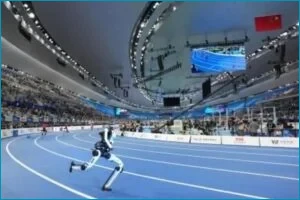
At the 2026 World Humanoid Robot Games in Beijing, an athletic track became the stage for a striking display of modern engineering. As the starting signal fired, a lineup of machines lurched forward, fighting to maintain their balance on metallic limbs. Among them, a Chinese-made humanoid robot named Tiangong Ultra crossed the finish line of the 100-meter sprint in just 8.64 seconds—a time that surpasses the human world record held by Usain Bolt. This dramatic race was just one of many spectacles at the late August event, which brought together more than 2,000 robots to compete in 51 distinct categories.
The five-day event, held from August 22 to 26, featured machines performing a wide array of activities. While some robots sprinted and boxed, others were tasked with household chores or industrial duties, and some simply fell over during the demonstrations. The gathering functioned as a hybrid of a sporting tournament, a commercial technology showcase, and an ambitious projection of the future. However, the international reception of the games highlighted a deep divide in how global observers interpret technological advancements depending on their origin.
In Western media coverage, the Beijing games were frequently depicted as a political spectacle—a highly choreographed demonstration of Chinese state power and propaganda. Conversely, Chinese state media steered the narrative toward practical, long-term utility. Rather than focusing solely on the immediate competition, domestic reports emphasized how these humanoid machines could eventually transition into the workforce, operating in factories, navigating logistics warehouses, assisting in private homes, and integrating into everyday human life.
Both perspectives carry validity. The Chinese government undoubtedly utilized the World Humanoid Robot Games to showcase its rapid technological evolution. Yet, viewing the event purely through the lens of political theater risks overlooking the genuine industrial progress occurring within China's robotics sector. The nation's humanoid robot industry is backed by massive financial investments, with numerous Chinese firms actively engineering machines designed for commercial applications in healthcare, logistics, manufacturing, and other sectors. The Beijing games served as a crucial real-world testing ground to evaluate how these laboratory creations perform in practical environments.
This intersection of political motivation and technological advancement is not unique to China. In the United States, Silicon Valley has spent decades marketing speculative visions of the future. Products like Tesla's Optimus humanoid robot, autonomous vehicles, and artificial intelligence assistants are routinely presented as glimpses into a revolutionized way of living and working. While these American corporate narratives are heavily shaped by commercial interests and the need to attract investors before technologies are fully mature, they are rarely dismissed as state propaganda. Instead, Western audiences typically frame them as symbols of innovation and entrepreneurial ambition.
This disparity in interpretation highlights the concept of Sinofuturism, a term used to describe China as an independent generator of its own technological future. Rather than merely adopting or copying Western innovations, Chinese developers and officials are cultivating distinct ideas about how society will function alongside advanced machines. In official rhetoric, humanoid robots are not merely engineered to run faster or lift heavier loads; they are envisioned as societal tools to manage dangerous or undesirable jobs, assist with domestic labor, and provide vital care for an aging population.
While some of these promises may be exaggerated or fail to materialize, they reflect a serious attempt by Chinese companies and officials to define the future of daily life. Currently, many of the robots demonstrated in Beijing remain far from ready for commercial deployment or everyday domestic use. Nevertheless, treating China's technological drive solely as a political message ignores the reality that countries shape the global future through the technologies they prioritize and fund. The machines on the track in Beijing represented more than a political statement; they offered a tangible preview of how China intends to reshape the intersection of technology and society.
You have reached the limit of 2 free articles this month.
That does not make the games any less political. Beijing has made technological development a national priority, and events like this clearly serve that ambition. But political purpose and technological progress can exist at the same time. Calling the event propaganda makes it easier to stop looking at the technology itself. The political message then becomes more important than what is actually being built.