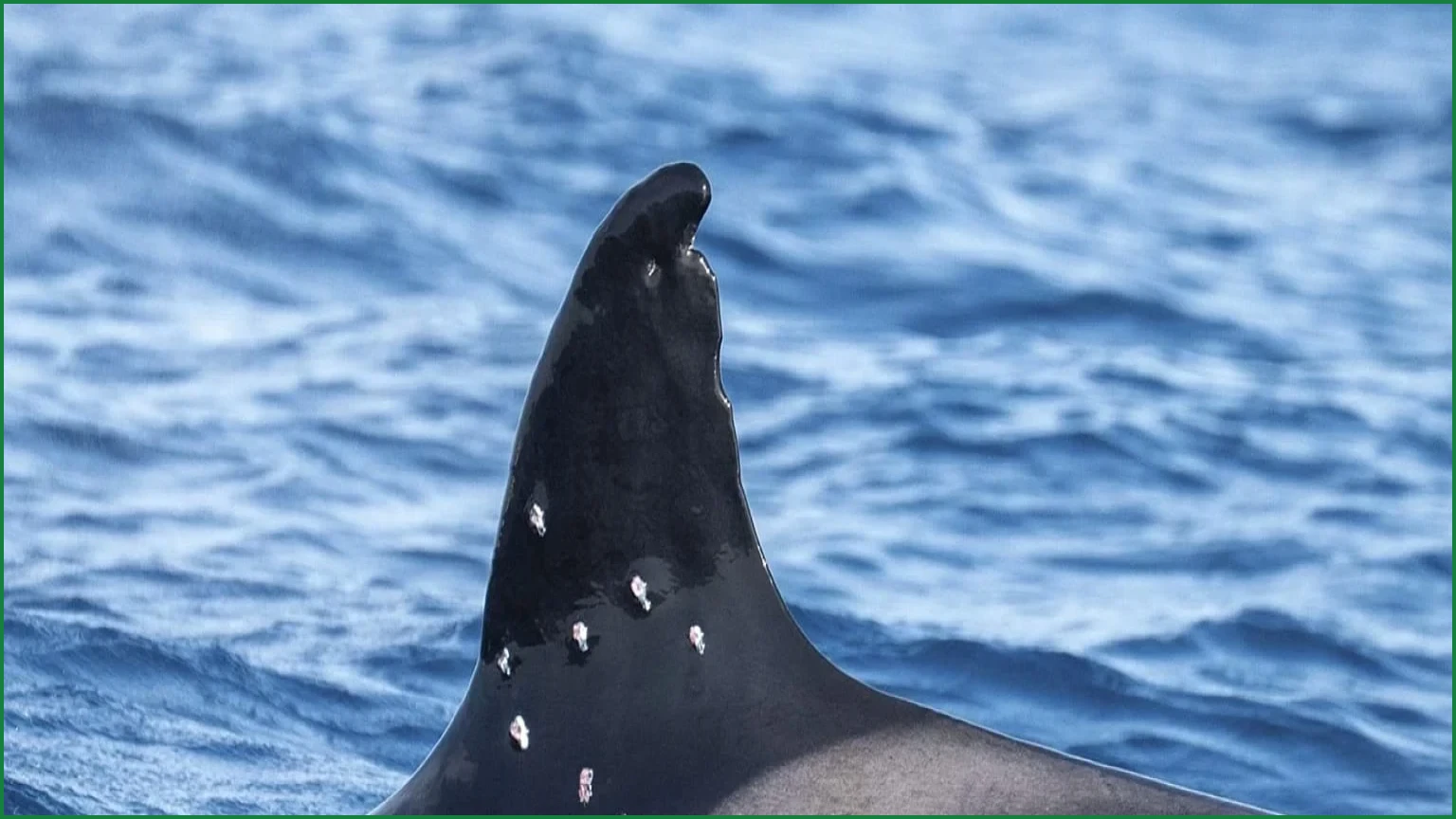
Toñi, a 60-year-old orca recognized by researchers as the "grandmother" of the population migrating between the Strait of Gibraltar and the Gulf of Cádiz, has been discovered with severe injuries. Conservationists noted that the animal now displays approximately a dozen marks on her back and dorsal fin that were absent in photographic records taken only weeks earlier.
The alarm was raised by the conservation group WeWhale after a comparison of recent images with the animal’s historical profile. Janek Andre, the founder of both WeWhale and Iberian Orca Guardians, stated that the visible wounds are consistent with the impact of a shotgun blast. This assessment was supported by the Atlantic Orca Working Group, which provided a more detailed technical perspective. According to the group, the injuries appear to match the pattern of nine-millimetre lead pellets often used in buckshot cartridges for hunting wild boar. The arrangement of the marks on the orca’s fin reportedly aligns with the typical spread of such ammunition, which usually releases nine projectiles in three rows of three.
The Spanish Ministry for the Ecological Transition and the Demographic Challenge was alerted to the incident on the afternoon of 11 August by WeWhale, an organization authorized to monitor the area. By the following day, the Directorate-General for Biodiversity, Forests and Desertification had initiated preliminary proceedings to investigate the event and determine if a sanctions procedure against those responsible is warranted. Sara Aagesen, the vice-president and minister for the Ecological Transition, confirmed on the social network Bluesky that the injuries are consistent with pellet shots. She emphasized the gravity of the situation, noting that the orca is a member of a vulnerable species and that causing such harm is a serious offence.
CIRCE, an organization that has conducted scientific monitoring of Iberian orcas since 1999 and maintains an extensive photographic archive of Toñi spanning over two decades, has joined the investigation. Experts from the group indicated that further analysis of the images, comparisons with historical data, and direct monitoring of the orca and her pod are necessary to confirm the origin of the wounds. While a shotgun blast remains the primary working hypothesis, authorities have not yet issued an official confirmation.
The orca population in the Strait of Gibraltar and the Gulf of Cádiz is classified as vulnerable under the Spanish Catalogue of Endangered Species. Legal protections, including Article 57 of Law 42/2007 on Natural Heritage and Biodiversity, strictly prohibit the killing, capturing, or harassing of these animals. Violations of these regulations can result in criminal liability and fines reaching up to two million euros. Since 2020, there has been a rise in interactions between these orcas and vessels, leading the Ministry of Transport and the Ministry for the Ecological Transition to advise mariners to avoid the area between April and August, maintain distance, and report any encounters to the Maritime Rescue Coordination Centre. Organizations in the region continue to stress that the protected population requires safety rather than reprisals.
The specific rules on cetacean protection add further restrictions: no vessel may approach closer than 500 metres, make contact with the animals, swim with them, feed them, obstruct their path, split up groups or emit loud sounds to attract or scare them.
In the critical area of the Ensenada de Barbate, Conil and the Banco Majuán, orca watching is also banned between 1 March and 31 August. Anyone who breaches these measures faces fines of up to two million euros and criminal liability, according to MITECO itself.