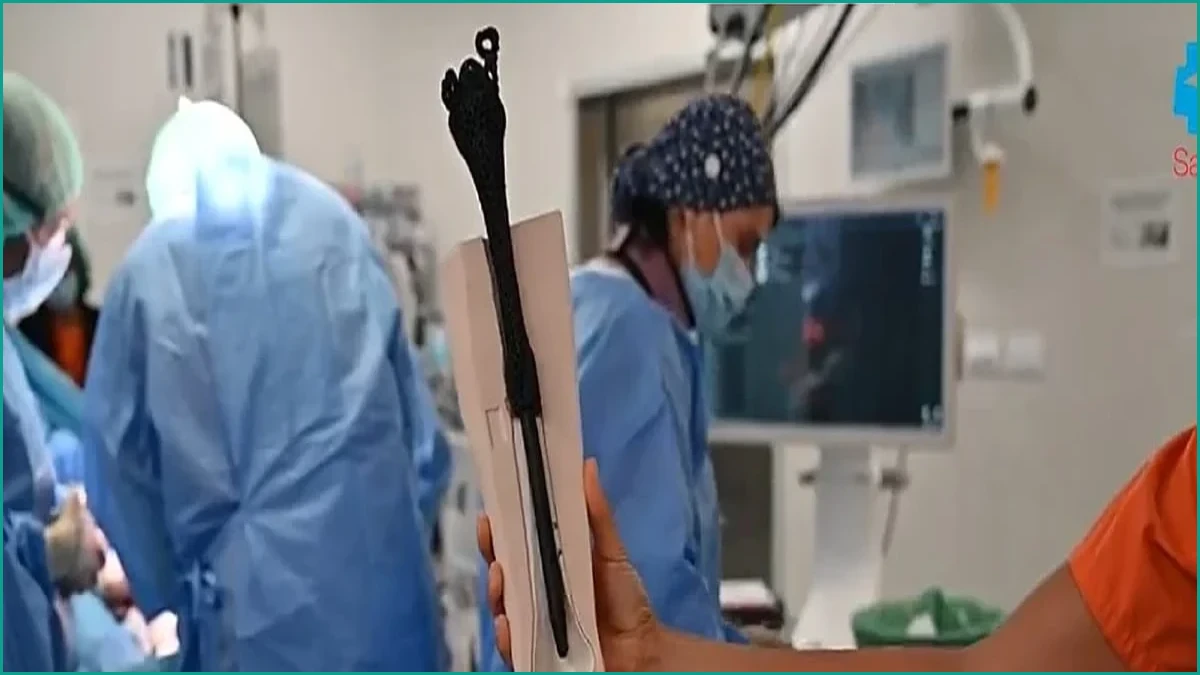
Medical professionals at Madrid's Gregorio Marañón Hospital have successfully prevented the amputation of a leg by utilizing a breakthrough, custom-made bone implant. The procedure was performed on a 38-year-old patient, Pierre Chazel, who had been diagnosed with a high-grade bone sarcoma in his tibia. Following an infection and a significant loss of bone density, his leg was no longer capable of supporting a conventional prosthesis, prompting the medical team to pursue a highly specialized solution.
The implant is a personalized metamaterial prosthesis, representing the first of its kind. The technology, which was originally conceived for the aerospace industry, employs 3D printing to create a titanium structure that accurately replicates the mechanical properties of human bone. Developed in collaboration with engineers from the Polytechnic University of Madrid (UPM), the device consists of a network of millimetre-scale titanium rods. This design allows the structure to distribute physical loads in a manner similar to natural bone tissue, a significant departure from traditional solid prostheses.
Using his radiological images, the researchers created a digital twin of his healthy leg and simulated the loads the tibia has to bear when walking, climbing stairs or stumbling. Based on these data, they designed the prosthesis's internal structure and placed the screws in the areas with the best bone quality, which allowed them to plan the procedure with millimetre precision.
This innovative design promotes bone growth and integration with the implant, which helps to mitigate the risk of rejection and other complications. Furthermore, the 3D-printing process allows for patient-specific adaptation, effectively halving the required operating time. While the final implant weighs only 300 grams, simulation data confirms it can withstand more than 500 kilos of pressure. This is a substantial improvement over conventional prosthetic options, which typically weigh several kilos and offer support for only 100 to 150 kilos. Ultimately, the successful implantation allowed the medical team to preserve both the patient's leg and his knee joint.
Unlike conventional prostheses, this implant does not replace the bone with a solid piece, but instead recreates its structure and strength through a network of fine titanium rods that distribute loads in a way similar to bone tissue.