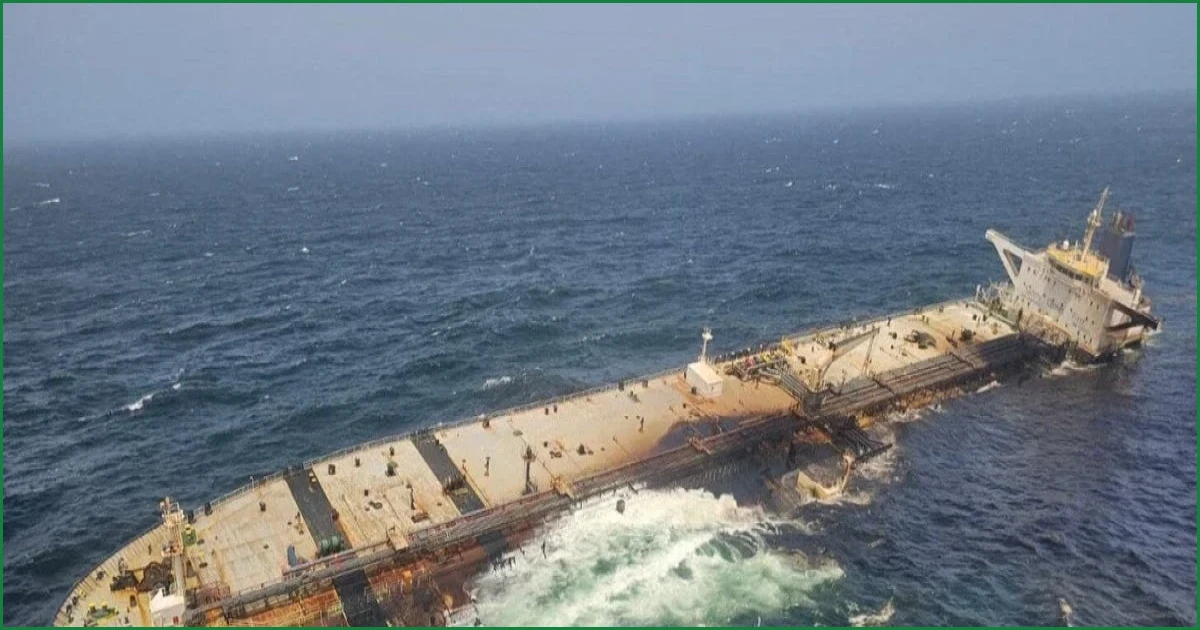
A grounded Russian oil tanker linked to Moscow's shadow fleet is leaking oil off the coast of Oman, raising fears of an environmental disaster comparable to the 1989 Exxon Valdez spill. The vessel, Caroline Bezengi, is at risk of breaking apart on a rocky outcropping near an uninhabited island in the Gulf of Oman.
The crisis began on June 8, when an unexplained explosion damaged the tanker after it departed Russia, passed through the Suez Canal, and entered the Gulf of Oman. Following the blast, the crew abandoned the vessel. According to John Amos, founder of the environmental nonprofit SkyTruth, the abandoned ship drifted until it ran aground. Satellite imagery first detected oil leaking from the wreck on June 30, and Amos estimates that hundreds of thousands of gallons of oil had already spilled into the sea by August 7.
The potential scale of the disaster is immense. Five of the Caroline Bezengi's six cargo holds were loaded with oil, meaning the tanker could be carrying up to 40 million gallons. With the ship's owner failing to provide any public indication of a response, and amid concerns that the vessel lacks adequate insurance, the burden of containing the environmental threat has fallen on Oman. The Omani government has deployed aircraft, divers, and specialized personnel to evaluate the situation and coordinate mitigation efforts, according to Greenpeace.
British maritime security and salvage firm Ambrey reported that salvage crews are currently en route to the grounded tanker. However, these teams must contend with severe challenges. Ambrey warned that crews will face "extreme adverse weather and sea conditions influencing vessel stability" driven by regional monsoon storms, which are actively threatening the stability of the vessel. Hanen Keskes, the regional campaigns lead at Greenpeace MENA, emphasized that safely extracting the remaining oil will require a highly complex operation, adding that the true scale of the leak may remain unknown until the salvage work is fully completed.
The local ecosystem is highly vulnerable. The Gulf of Oman and the Arabian Sea host numerous protected marine species, including sharks, sea turtles, and a rare population of humpback whales. Furthermore, the waters immediately surrounding the grounded tanker were recently designated as a marine reserve. Amos noted that even swift containment actions recover only a small portion of spilled oil, stating, "Once the oil hits the water, you've already lost." He estimated that typical spill-response efforts manage to recover only about 20% of the discharged oil.
The incident highlights broader concerns regarding Russia's shadow fleet, which consists of hundreds of aging tankers used to transport sanctioned oil globally. These vessels frequently operate under opaque ownership structures and lack credible insurance, leaving unresolved questions about who will cover cleanup and salvage costs. To put the potential financial impact in perspective, the 1989 Exxon Valdez disaster, which spilled at least 11 million gallons off Alaska, cost Exxon roughly $2.1 billion at the time—equivalent to about $5.8 billion today.