North Korea launched what appeared to be a midrange ballistic missile toward the ocean east of the peninsula on August 12, marking its second such launch in less than a week. The back-to-back tests occurred just two days after South Korea and the United States announced plans for their annual Ulchi Freedom Shield joint drills, scheduled to begin on August 17. While the allies describe these drills as defensive, North Korea has historically denounced them as invasion rehearsals and frequently responds with weapons tests around the training period.
The August 12 missile was launched from the Wonsan area on North Korea’s east coast around 6 a.m. and traveled over 700 kilometers (about 435 miles) before landing in the sea. South Korean, U.S., and Japanese authorities tracked the launch but were still analyzing its exact specifications. Notably, the South Korean Joint Chiefs of Staff (JCS) did not disclose the missile’s type or flight angle, a departure from its usual practice of providing preliminary classifications within hours. This marked North Korea's 11th ballistic missile launch of 2026, according to the JCS.
This launch followed a shorter-range ballistic missile test from the same Wonsan area on August 6, which was Pyongyang's first ballistic weapons test in 48 days. The earlier lull had persisted since a missile launch on June 25, when leader Kim Jong Un was shown new missile systems, including a modular launcher developed as an analogue to the U.S. HIMARS rocket system. Following both August launches, South Korea’s presidential national security office convened emergency meetings, condemning the actions as provocations that violate United Nations Security Council resolutions and urging Pyongyang to cease such tests.
The Japanese government also protested both launches. Defense Minister Koizumi Shinjiro stated that the missile landed outside Japan’s exclusive economic zone and that Tokyo had lodged a protest with Pyongyang through diplomatic channels in Beijing. Koizumi described the repeated launches as “a threat to the peace and security of Japan, the region, and the international community.” Following the August 12 launch, foreign ministries from South Korea, the United States, and Japan held a trilateral call, reaffirming that North Korea's ballistic missile launches violate U.N. Security Council resolutions and urging North Korea to cease provocations threatening regional and international peace and security.
U.S. Pacific Command confirmed it was consulting closely with allies and partners after both launches, assessing no immediate threat to U.S. personnel, territory, or allies, and reaffirming Washington's defense commitment to the region. North Korea has regularly tested ballistic missiles since the collapse of nuclear talks between Kim Jong Un and U.S. President Donald Trump in 2019, expanding an arsenal prohibited by U.N. Security Council resolutions. Wonsan has become a frequent launch site, allowing tests of range and altitude without debris falling over neighboring territories.
The missile launched on August 12 could be the KN-23, a solid-fuel missile modeled on Russia's Iskander system with a range of 700-800 kilometers, similar to the distance reported. However, South Korean officials stated they needed more time for definitive identification. North Korea has not officially confirmed either launch or specified the missile type involved. This silence is unusual, as Pyongyang typically confirms major missile tests through state media like the Korean Central News Agency within a day, often describing them as successful demonstrations of defense capabilities.
The lack of confirmation has fueled speculation among analysts. Some suggest the launches might involve a still-developing weapons system that Pyongyang is not ready to unveil, while others speculate that one or both tests may have failed. This silence is consistent with North Korea's past behavior regarding tests deemed routine by its Missile Administration and affiliated defense science institutes, rather than public messaging campaigns. Kim Jong Un ordered a significant increase in ballistic and cruise missile production in early June, and state media has since highlighted new systems. The August launches extend this intensified pattern, potentially influenced by deepened military cooperation with Russia amid the war in Ukraine.
Analysts view the resumption of launches after a 48-day lull as a continuation of a production and testing cycle initiated earlier in the summer, rather than solely a reaction to the upcoming Ulchi Freedom Shield drills. The timing around the drills provided an opportunity to integrate a routine test into a familiar cycle of protest. While North Korea appears focused on missile system development regardless of external actions, the timing around the drills is significant, allowing Pyongyang to pair weapons development with a message of defiance toward Seoul and Washington, reminding the allies of its response capabilities.
As the Ulchi Freedom Shield drills approach, officials in Seoul and Tokyo are monitoring for potential additional launches. North Korea has historically increased weapons tests during such periods. The eventual decision by North Korea to break its silence on the recent ballistic missile launches may itself send a signal, indicating whether they were intended as routine program progress, a political statement, or a combination of both.
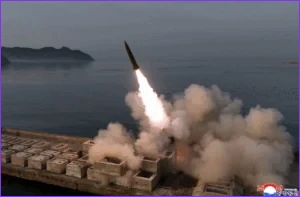
This file photo provided by North Korean state media shows the launch of one of the five Hwasongpho-11 Ra missiles tested on April 19, 2026. North Korea has not yet provided images of the launches in August 2026.
You have reached the limit of 2 free articles this month.