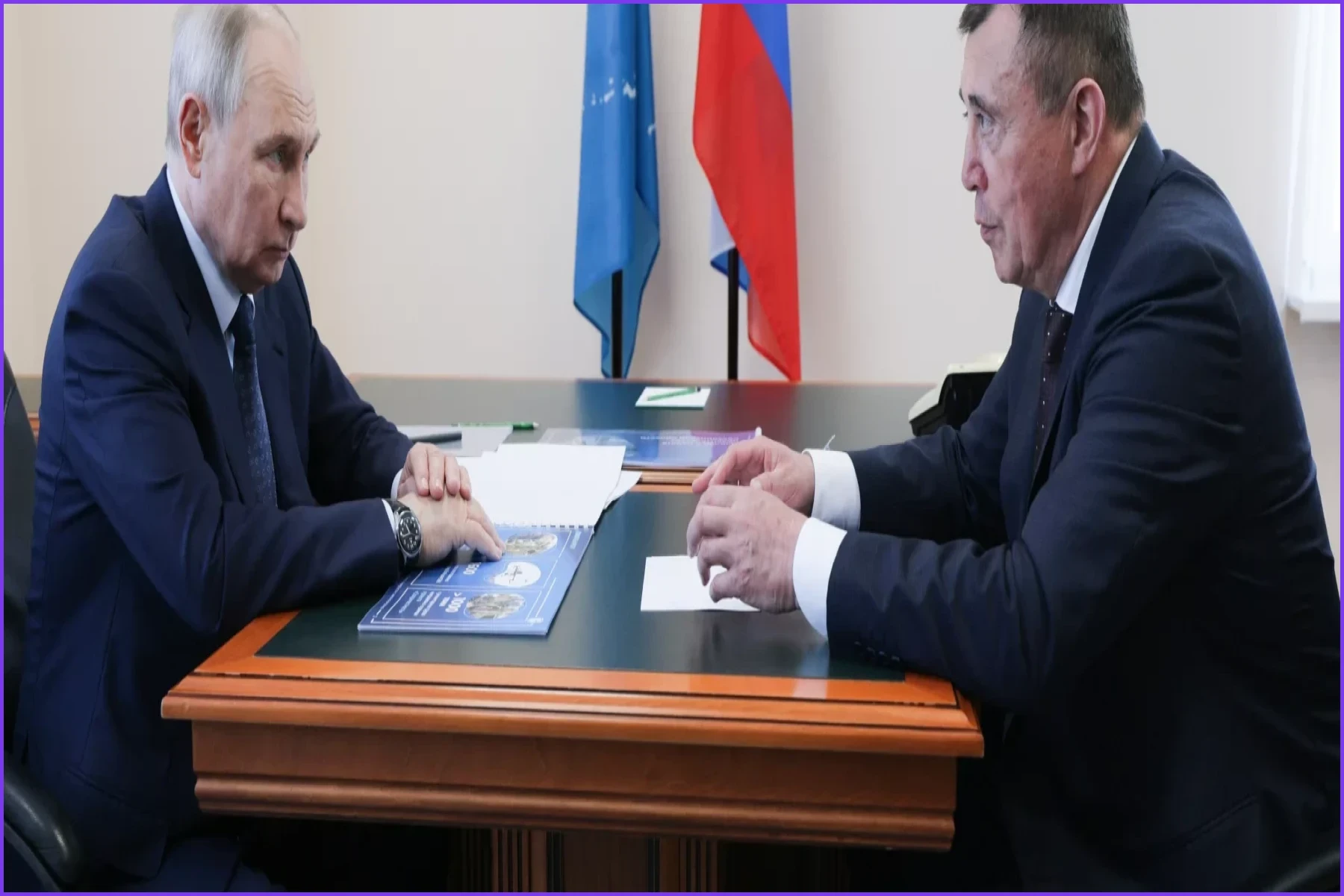
Russian President Vladimir Putin arrived on Iturup Island on Thursday, August 13, 2026, marking his first-ever visit to the Kuril Islands. The archipelago, which is currently under Moscow's control, remains the subject of a decades-long territorial dispute with Japan, which claims the four southernmost islands as its "Northern Territories." During his time on Iturup, the largest of the volcanic chain's southern islands, the Russian leader toured a local fish processing plant, a hospital, and a secondary school named after Eduard Norpolov. He also held discussions with local residents and met with Valery Limarenko, the governor of Russia's Sakhalin region.
The roots of the diplomatic friction trace back to the final days of World War II, when the Soviet Union seized the islands from Japan. This unresolved territorial issue has prevented the two nations from ever signing a formal peace treaty to end their wartime hostilities. Despite numerous diplomatic efforts over the years, no visible progress toward a settlement has been achieved. In recent times, Moscow has actively bolstered its military presence on the Kurils, a move widely viewed as an attempt to solidify its firm stance on the sovereignty of the islands.
The reaction from Tokyo was immediate and stern. Japanese Foreign Minister Toshimitsu Motegi announced that his country "strongly protests" the visit to Iturup, which Japan refers to as Etorofu. Motegi summoned the Russian Ambassador to Japan, Nikolay Nozdrev, to the ministry in Tokyo to lodge a formal protest. The minister instructed the ambassador to "promptly report the message back to Moscow," asserting that the Northern Territories, including Etorofu, are Japan's inherent territory based on both historical records and international law.
The Russian Embassy in Japan swiftly rejected the protest, labeling it "unfounded." In a statement, the embassy noted that Ambassador Nozdrev had explained to the Japanese side that the southern Kuril Islands are an "integral part of the Russian Federation" and were incorporated following World War II on "legitimate international grounds." The embassy further declared that the travel itinerary of the Russian president is a "sovereign decision" of the Russian leadership and is not a matter subject to discussion with foreign states.
Before his arrival on Iturup, President Putin spent time in Siberia and the Far East, including a stop on Sakhalin Island to observe the final phase of naval drills conducted by Russia's Pacific Fleet. While speaking aboard a warship during these exercises on Wednesday, Putin emphasized that the current status of the Kuril Islands is "enshrined in international documents as a reality that arose following the outcome of World War II." He added that while Russia remains prepared to seek a solution to conclude a peace treaty, the geopolitical landscape has shifted.
Putin noted that Moscow previously maintained constructive relations with several Japanese leaders, specifically mentioning the late former Prime Minister Shinzo Abe, who he said worked to align the positions of both nations. However, he pointed out that Japan's decision to impose sanctions on Russia following the invasion of Ukraine in February 2022, and the subsequent listing of Russia as a "primary threat," had fundamentally altered that relationship. Despite this, he stated that Russia remains ready to cooperate with all its neighbors, including Japan.
Japanese Prime Minister Sanae Takaichi condemned the visit, stating it is "incompatible with the Japanese position" and "absolutely unacceptable." She warned that the trip serves as a further blow to already strained bilateral ties and that Moscow should fully understand the consequences. Takaichi added that the visit has hardened Japanese public sentiment toward Russia, making the restoration of bilateral relations in the medium to long term more difficult. Japan has historically prioritized maintaining these ties to allow former Japanese residents to return to the islands to pay tribute at family graves, a humanitarian consideration that remains a point of focus for Tokyo.
Dmitry Medvedev, the deputy chair of the Russian Security Council and a former president and prime minister, responded to Takaichi’s remarks via social media. Having visited the Kuril Islands four times himself, Medvedev dismissed the Japanese criticism as "chatter" that would not change the reality of the situation. He asserted that the islands "were, are, and will remain Russian land" and warned that anyone failing to understand this would face "monstrous consequences of their delusion."