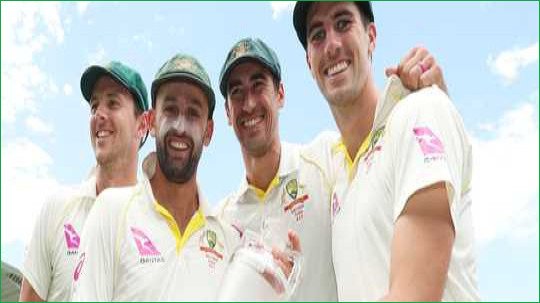
Australia's core bowling attack is on the brink of achieving a historic milestone. With Josh Hazlewood currently just five wickets away from reaching 300 Test wickets, he is set to join Pat Cummins, Mitchell Starc, and Nathan Lyon. Once he crosses this threshold, they will become the first bowling quartet in the history of Test cricket to play in a match where every single member has taken 300 or more wickets.
As it stands, these four bowlers have taken a combined 1,610 Test wickets. The last time they featured together in a Test match, just over a year ago, the Australian lineup collectively held 1,613 wickets, a figure that included wickets from Cameron Green and part-time bowlers. The ultimate record for the most collective wickets held by a team's playing XI heading into a Test match is 1,989, set by England before the final Ashes Test at The Oval in 2023. That mark was heavily driven by James Anderson and Stuart Broad, the latter of whom retired immediately after that match. If Australia's "big four" continue to play together leading up to the next Ashes series, they could approach that record, aided by a heavy schedule of upcoming red-ball matches, including a tour of India early next year.
Beyond the raw numbers, the sheer impact of this group is unprecedented. Across 35 Test matches played together, Cummins, Starc, Hazlewood, and Lyon have taken 567 wickets. No other bowling quartet in cricket history comes close; the next best tally is 415 wickets. Together, they average a staggering 16.2 wickets per game. Their workload and success are remarkably balanced, with only 16 wickets separating their highest wicket-taker in these games (Cummins with 150) from their lowest (Lyon with 134). This is the only instance in Test history where all four members of a bowling group have taken at least 75 wickets individually in matches where they all bowled.
This collective dominance has translated directly into team success. Australia boasts a win-loss ratio of 2.444 in games where all four have featured. Of their nine defeats in these matches, five came against India, three against South Africa, and one was the West Indies' historic victory at the Gabba in 2024. Notably, Australia has never lost an Ashes Test in which all four bowlers have played.
To put their longevity and success in perspective, historical comparisons highlight how rare it is for four bowlers to maintain such a run. Great West Indian combinations of the 1970s and 1980s faced different circumstances, often rotating through more than four elite fast bowlers and playing fewer Test matches overall. For example, the quartet of Colin Croft, Joel Garner, Michael Holding, and Andy Roberts took 172 wickets in 11 matches together at an average of 24.12 (15.64 wickets per game with a win-loss ratio of 5). When Malcolm Marshall replaced Croft, the unit of Marshall, Garner, Holding, and Roberts took 90 wickets in six matches at 26.33 (15 wickets per game, winning three and drawing three). Meanwhile, Australia's famous combination of Shane Warne, Glenn McGrath, Jason Gillespie, and Brett Lee took 265 wickets in 16 Tests together at an average of 27.93 (16.56 wickets per game, with a win-loss ratio of 5). India's legendary spin-heavy quartet of Bishan Singh Bedi, Bhagwath Chandrasekhar, Karsan Ghavri, and Erapalli Prasanna claimed 133 wickets in eight matches together at an average of 26.26 (16.62 wickets per game, with a win-loss ratio of 2.5).
One of the most remarkable aspects of the current Australian group is their self-reliance. They have taken 93.87% of Australia's total team wickets (excluding run-outs) across their 35 matches together. This is exceptionally high compared to other quartets with similar sample sizes, where the third or fourth bowling option was typically an all-rounder or a part-time bowler. For comparison, the West Indies' Croft, Garner, Holding, and Roberts accounted for 95.02% of their team's wickets in 11 Tests, which rose to 97.82% when Marshall replaced Croft (taking 90 out of 92 wickets).
Their collective journey began in earnest during the 2017/18 Ashes series. In that five-match series, every single one of the 87 wickets taken by Australian bowlers was shared exclusively among the four: Cummins (23), Starc (22), Hazlewood (21), and Lyon (21). No other quartet in Test history has ever clean-swept all of a team's wickets in a five-match series. Only two other times have four bowlers from the same team each taken 20 or more wickets in a single series: England's 1995 tour saw Ian Bishop (27), Courtney Walsh (26), Kenny Benjamin (22), and Curtly Ambrose (21) achieve the feat, while the 2006/07 Ashes saw Stuart Clark (26), Shane Warne (23), Glenn McGrath (21), and Brett Lee (20) do the same.
Furthermore, the Australian quartet has maintained incredible consistency across different conditions. In 24 home Tests together, they average 25.2 with a strike rate of 53.8. In 11 away or neutral Tests, they average 27.4 with a strike rate of 53.3. Starc is the only member with a notable difference between his home and away averages (26.6 at home versus 32.75 away). Looking at their overall careers, the absolute difference between their home and away averages is remarkably low: 1.8 for Lyon, 2.11 for Starc, 3.52 for Hazlewood, and 5.1 for Cummins. Only two other historical quartets featuring players with 150-plus career wickets boast similarly low home-away average differences: the Australian group of Warne (1.78), McGrath (1.62), Gillespie (2.53), and Lee (5.23); and the West Indian group of Holding (0.11), Garner (2.6), Roberts (4.87), and Marshall (1.52).
The pace trio of Cummins, Starc, and Hazlewood first united in the 2017/18 Ashes opener in Brisbane. This came after Cummins made his long-awaited Test comeback earlier that year, ending a gap of 1,940 days between his first and second Test appearances. Among pace trios with at least 200 wickets in matches played together, the great West Indian trios and New Zealand's Trent Boult, Tim Southee, and Neil Wagner stand alongside them. The West Indies trio of Malcolm Marshall, Joel Garner, and Michael Holding won 16 of their 26 Tests together, losing only once (at Sydney in the 1984/85 season). Other notable trios include:
Colin Croft, Joel Garner, and Michael Holding: 16 Tests, 208 wickets, 13 wickets per match, win-loss ratio of 2.5.Colin Croft, Joel Garner, and Andy Roberts: 18 Tests, 232 wickets, 12.89 wickets per match, win-loss ratio of 4.5.Joel Garner, Michael Holding, and Malcolm Marshall: 26 Tests, 331 wickets, 12.73 wickets per match, win-loss ratio of 16.In terms of individual records, Cummins is currently positioned to potentially overtake Ian Botham and Morne Morkel for the most Test wickets taken by a first-change seamer.
Nathan Lyon's contribution as the lone spinner is equally historic. With 567 Test wickets, he is the sixth-highest wicket-taker in Test history. Among active bowlers, only Starc also has over 400 wickets. Lyon's career is defined by extraordinary longevity; he is the only bowler in history to make 100 consecutive Test appearances. The next best streak among specialist bowlers is Anil Kumble's 60. Including all-rounders, the leading sequences belong to Garry Sobers (85), Kapil Dev (separate streaks of 66 and 65), Ian Botham (65), and Jacques Kallis (60).
Lyon has completely dominated Australia's spin department since his debut in Galle in 2011, when he dismissed Kumar Sangakkara with his very first ball in Test cricket. The only other Australian spinner to take 50 or more wickets since Shane Warne's retirement is Nathan Hauritz, who took 58 wickets and made his last appearance in October 2010. Lyon has missed just 11 of the 152 Tests Australia has played since his debut, including the final three matches of the 2023 Ashes after suffering a calf tear at Lord's, and two recent matches at home. This longevity contrasts sharply with other members of the 300-wicket club like Sri Lanka's Rangana Herath, who debuted in September 1999 but saw his career truly begin after Muttiah Muralitharan's retirement in 2010, with 83.6% of Herath's career wickets coming after Muralitharan's final match.
Lyon's impact is particularly pronounced in the second innings of matches, where he averages 26.9 and strikes at 55.7, compared to a first-innings average of 33.17 and a strike rate of 66.6. In matches where all four members of the quartet play, Lyon leads the wicket tally in the third and fourth innings with 76 wickets (including four five-wicket hauls). He is followed by Hazlewood with 73, Cummins with 59, and Starc with 56. Lyon has bowled 711.1 overs across 31 second-innings efforts (averaging about 23 overs per innings), while none of the three fast bowlers have exceeded 500 overs in those same innings.
As the quartet approaches the twilight of their careers, Cummins (33) is the only member under the age of 35. Australia has handed Test debuts to only five specialist seamers since the start of the 2017/18 Ashes, and the two most prominent—Scott Boland and Michael Neser—are already over 35. On the spin front, Matthew Kuhnemann and Todd Murphy have combined for just 12 Test appearances, only two of which did not feature Lyon (during the 2023 Ashes).
While the upcoming Test series against Bangladesh marks the beginning of what could be a final chapter for this legendary bowling group, Australian selectors face the looming challenge of identifying successors who can replicate their immense impact, if not their remarkable longevity. Beyond their accomplishments in red-ball cricket, Cummins, Starc, and Hazlewood also stand as the only specialist bowling trio to have won both an ODI World Cup final (2023) and a T20 World Cup final (2021) together. Meanwhile, Adam Zampa—one of only three cricketers from full-member nations to make over 200 white-ball appearances without ever playing a Test—has long anchored the spin department in limited-overs formats.