President Donald Trump is doubling down on a strategy of economic pressure against Iran, banking on a fresh financial squeeze to resolve the ongoing war as previous military-led efforts have failed to achieve his objectives. While the president has long maintained that five decades of economic strain failed to prevent Iran’s nuclear ambitions, he now argues that a new wave of financial targeting could force the nation’s leadership to capitulate. The administration’s primary goals remain the termination of Iran’s nuclear program and the full reopening of the Strait of Hormuz to oil and natural gas shipments.
The administration’s shift follows months of aerial bombardment and a naval blockade that has yet to produce the decisive outcome initially promised. As U.S. weapon stockpiles dwindle and diplomatic talks remain stalled, Trump has signaled a pivot toward total financial isolation. On Monday, the president suggested that if Iran seeks compensation in potential peace talks, the United States will demand the same. Trump asserted that Iran is currently on the verge of financial collapse, claiming they are "totally broke" and unable to pay their soldiers, while citing an inflation rate of 300%. These figures exceed those typically cited by his own administration officials, though inflation in Iran is undeniably high.
The economic toll on Iran is significant, with the International Monetary Fund estimating a 5.4% contraction in the overall economy and the Iranian government recently reporting an annual inflation rate of 88.6%. Furthermore, U.S. Treasury data indicates that average loadings of Iranian oil have decreased from 1.8 million barrels per day before the war to less than 500,000 barrels per day over the past month. Despite these metrics, Iranian officials remain defiant. Esmaeil Baqaei, spokesman for the Iranian Foreign Ministry, stated on social media that Washington consistently retreats to sanctions when diplomacy fails, warning that this cycle will only hinder a graceful exit from the current crisis of their own making.
Since April 16, the U.S. has been conducting "Operation Economic Fury," a strategy described by Treasury Secretary Scott Bessent as the financial equivalent of a bombing campaign. This initiative targets not only Iran but also countries or banks that facilitate Iranian oil trade. Defense Secretary Pete Hegseth emphasized on Monday that the administration intends to leverage the strength of the U.S. economy to pressure adversaries, noting that the treasury team is prepared to pull various levers to tighten the blockade. A senior U.S. official, speaking on condition of anonymity, added that the military has successfully set back Iran's ability to produce and ship energy, with the administration viewing these sanctions as effective tools to be "cranked harder" in the coming months.
However, experts warn that this strategy faces significant hurdles. Richard Nephew, a senior research scholar at Columbia University who helped direct Iran sanctions strategy in the Obama administration, noted that sanctions take longer to impact a regime than the immediate effects of a closed waterway. He criticized the administration for lacking clear strategic goals, noting that Trump has vacillated between focusing on nuclear weapons, the Strait of Hormuz, and ballistic missiles. Nephew argued that Trump has systematically weakened his own hand through inadequate use of force and inarticulate objectives. Juan Zarate, a former deputy national security adviser in the George W. Bush administration, acknowledged that while sanctions provide leverage, their success depends on the United States' willingness to endure the patience required to test the limits of Iran's economic pain.
The conflict has also had domestic repercussions for the United States, where rising gasoline prices and the costs of the war have negatively impacted the president’s popularity. As energy markets react to the uncertainty surrounding the Strait of Hormuz—a vital transit point for roughly 20% of global oil supplies—crude prices climbed on Monday. Investors interpreted Trump's comments as a sign that fewer ships would be traversing the waterway, continuing to limit global supplies of gasoline, jet fuel, and natural gas. Trump is essentially arguing that U.S. voters are better able to tolerate these economic inconveniences than the Iranian population, which has endured years of hardship. The president reiterated his stance on Sunday, stating that no other president has done what should have been done long ago to ensure Iran cannot possess a nuclear weapon.
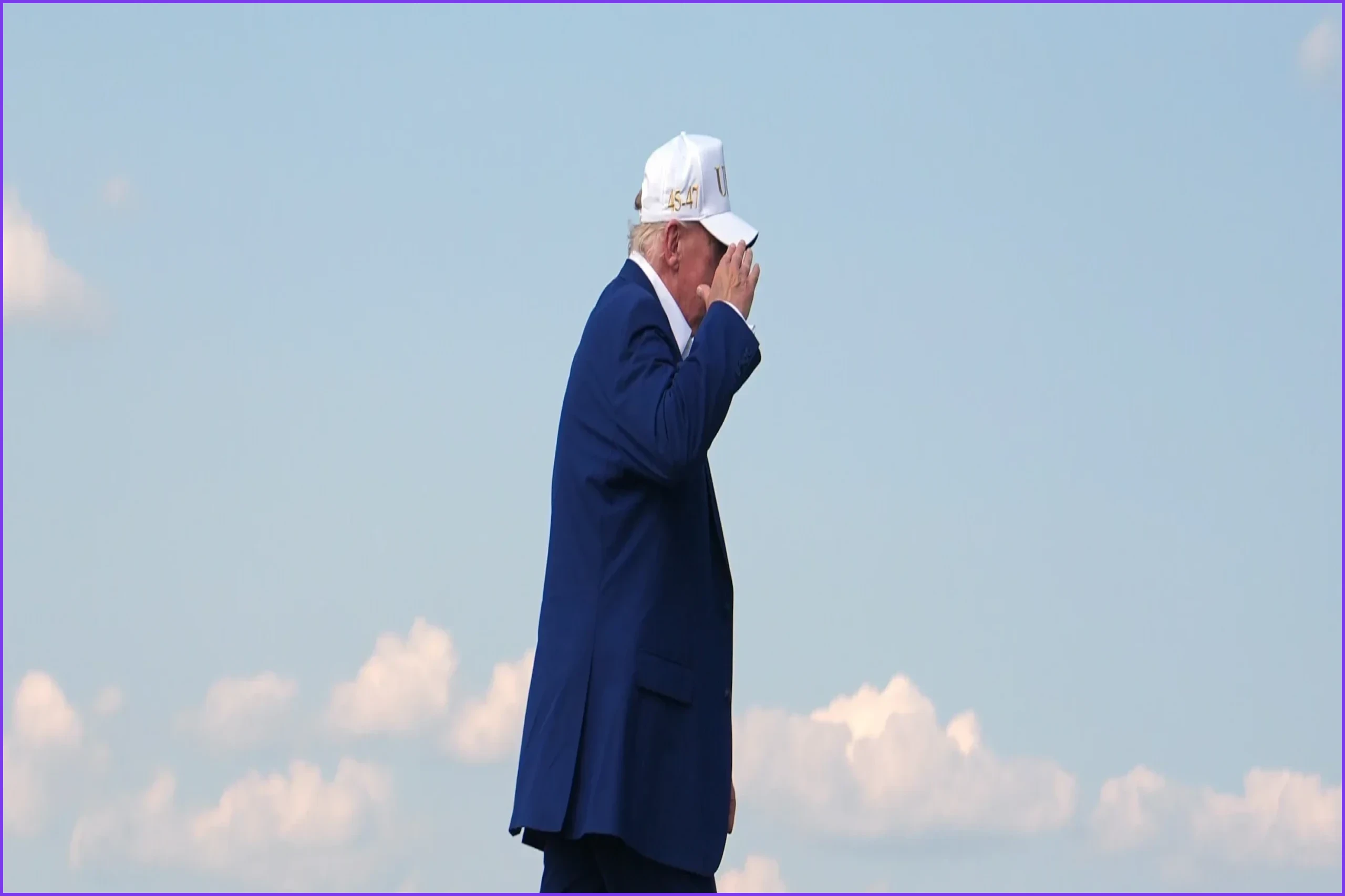
President Donald Trump walks to board Air Force One at Morristown Airport, Sunday, Aug. 9, 2026, in Morristown, N.J. Julia Demaree Nikhinson/AP hide caption
WASHINGTON — President Donald Trump likes to say that he started his war with Iran after 50 years of economic pressure had failed to stop its nuclear weapons ambitions — but he's now betting that another financial squeeze can bring an end to that war.