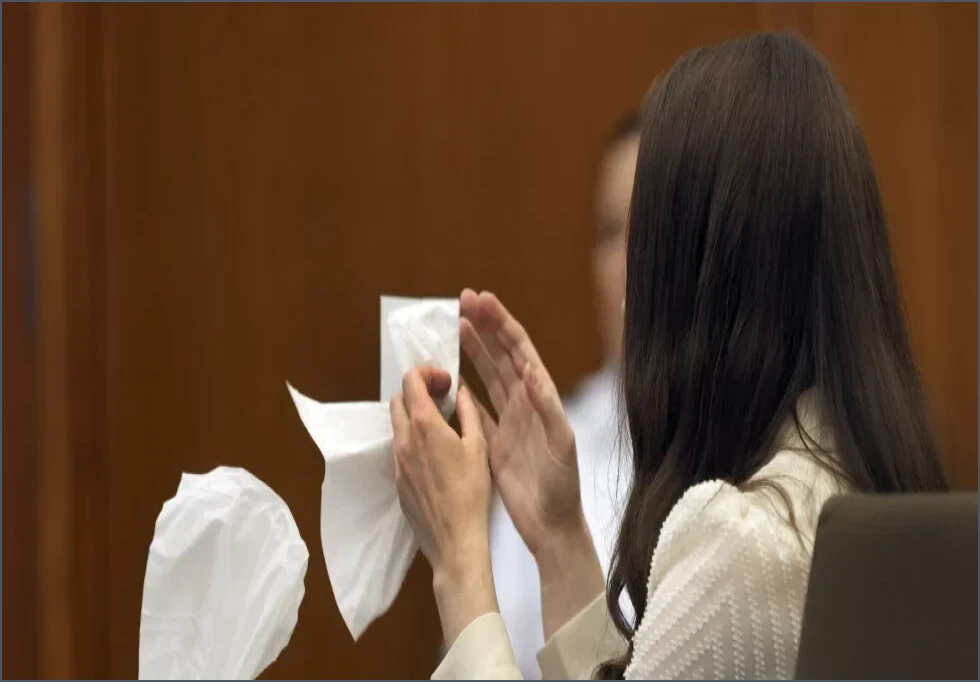
PLYMOUTH, Mass. — A Massachusetts courtroom was forced into an unscheduled recess on Thursday after Lindsay Clancy sobbed uncontrollably as jurors were presented with autopsy photographs of her youngest child. The emotional breakdown occurred during the second week of Clancy’s high-profile murder trial in Plymouth Superior Court, where she faces charges for the 2023 strangulation deaths of her three young children.
Clancy, a 35-year-old former labor and delivery nurse, has pleaded not guilty to the murder of 5-year-old Cora, 3-year-old Dawson, and 8-month-old Callan. While her defense attorneys do not deny that she took the lives of her children on January 24, 2023, they maintain that she was suffering from severe mental illness and cannot be held criminally responsible for her actions. The defense argues that Clancy was battling postpartum psychosis and undiagnosed bipolar disorder, conditions they say were severely exacerbated by a cocktail of psychiatric medications.
In contrast, prosecutors argue that Clancy acted with deliberate intent. They contend that she engineered a window of opportunity by sending her husband out of their Duxbury home on errands, using the tasks as a ruse to carry out the killings. Following the strangulations, Clancy jumped from a second-story window of the residence, an act that left her permanently paralyzed from the waist down. If convicted of murder, she faces a sentence of life in prison without the possibility of parole. An acquittal by reason of lack of criminal responsibility would result in her commitment to a state psychiatric facility.
Throughout the week, prosecutors have called on friends, a former colleague, and family members to paint a picture of Clancy's mental state in the period leading up to the tragedy. Witnesses generally described her as a loving, attentive mother who appeared outwardly normal, attending family gatherings, lunches, and children's activities. None of the witnesses who took the stand on Thursday reported hearing Clancy express homicidal or suicidal thoughts, nor did they recall her mentioning hearing voices or wanting to harm her children.
However, several witnesses testified to Clancy's deep-seated struggles with insomnia and the side effects of her prescribed medications. Andrea Hennigan, a former colleague from Massachusetts General Hospital, recalled a lunch during which Clancy confided that she could not return to her nursing duties because she "was not in a mental state to take care of patients." Hennigan testified that Clancy described experiencing "insomnia" and "brain fog." In January 2023, the month of the killings, Clancy sent a text message to Hennigan stating she was experiencing "bad or negative side effects" from her medications.
Another witness, Amy Bevins, testified that around that same time, Clancy told her that the psychiatric medications had "caused her to have some dark thoughts." Bethany Decollibus, who attended a birthday party for Cora Clancy in January 2023, recalled asking Clancy about her ongoing sleep issues. According to Decollibus, Clancy responded that "things haven't gotten better and that she feels like a zombie."
Clancy’s former father-in-law, Christopher Clancy, also testified, describing her as an excellent mother while acknowledging he was aware of her health struggles. He testified that he knew she was having a difficult time sleeping, felt unwell, and had visited an emergency room where his wife was employed. Christopher Clancy noted that he had suggested his grandchildren come stay with him and his wife, but his son declined the offer. Earlier in the week, Elaine Rossi, the nanny who cared for the Clancy children, also provided testimony.
As the trial proceeded, a parallel legal development unfolded in the same jurisdiction. Both Superior Court Judge William Sullivan and Plymouth County District Attorney Timothy Cruz learned on Thursday that they face a retrial in another high-profile case involving a mother's mental state during the killing of her children.
The Massachusetts Supreme Judicial Court overturned the murder convictions of Latarsha Sanders, who was convicted in the 2018 fatal stabbings of her two sons, 8-year-old Edson "Marlon" Brito and 5-year-old La'son Brito. Sanders had told investigators in a recorded interview that she stabbed her sons because "bad people" had sent her text messages commanding her to perform a "ritual" linked to "Voodoo stuff" and the Illuminati, a secret society her family said she had become obsessively afraid of.
Similar to the defense in the Clancy trial, Sanders' lawyers argued she was mentally ill and not criminally responsible, while the prosecution maintained her actions were deliberate. A defense neuropsychologist had diagnosed Sanders with schizophrenia spectrum disorder and testified she was "grossly psychotic" at the time of the stabbings.
In a unanimous decision, the state's highest court ruled that the trial judge had erred by preventing the jury from hearing detailed information from Sanders' medical records. These records showed that clinicians at both a prison and a psychiatric facility had suggested similar diagnoses after her arrest. Justice Frank M. Gaziano wrote that withholding these records "impermissibly stripped" the defense of its necessary medical foundation.
Following the ruling, Plymouth County District Attorney Timothy Cruz’s office issued a statement noting they are evaluating their next steps. Robert F. Shaw Jr., the defense attorney representing Sanders, expressed readiness for a new trial, stating he hopes the medical records and evidence will be evaluated by a jury "with fresh eyes."
EDITOR’S NOTE: This story includes discussion of suicide. If you or someone you know needs help, the national suicide and crisis lifeline in the U.S. is available by calling or texting 988.
Much of the week has been dominated by witnesses detailing their memories of Clancy in the days, weeks and months before the killings.