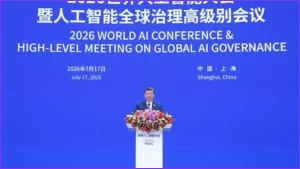
In July 2026, China officially inaugurated the World Artificial Intelligence Cooperation Organization (WAICO) during the World AI Conference (WAIC) in Shanghai. The organization consists of 29 founding members, including Russia, Brazil, South Africa, Indonesia, Malaysia, and Pakistan. Notably, the membership comprises a significant portion of the BRICS bloc and various Global South countries, while excluding major Western democracies. Beijing describes the initiative as an intergovernmental body dedicated to the safe and fair development of artificial intelligence, yet analysts suggest the move is a calculated step toward establishing a China-led AI hegemonic empire.
Gloria Chen, head of Asia-Pacific geopolitical strategy at the U.K.-based advisory Rocky Road Resilience, notes that the name WAICO is intentionally similar to the United Nations’ World AI Organization (WAIO). This naming convention is viewed as a symbolic assertion of China's intent to lead the global discourse on AI. The organization appears to function as an AI-focused extension of the Belt and Road Initiative, aiming to unite non-democratic regimes and countries isolated from the international community, such as Cuba and Myanmar. By providing financial aid and infrastructure, China seeks to extend its political influence and secure diplomatic leverage in distant regions.
China’s domestic AI capabilities provide a foundation for these ambitions. Data from the China Internet Network Information Center (CNNIC) indicates that as of December 2025, the country had 1.125 billion internet users and 602 million generative AI users, marking a 141.7 percent increase from the previous year. This massive user base creates a unique training data pool that allows Chinese developers to conduct large-scale AI training and deployment faster than many Western counterparts. Furthermore, China currently holds approximately 60 percent of the world’s AI patents, according to the World Intellectual Property Organization (WIPO). As of late 2025, China's generative AI computing power was reported to exceed 1590 quadrillion calculations per second.
During the 2026 WAIC, President Xi Jinping emphasized the need for regulations, technology monitoring, and emergency response systems to ensure AI remains under human control. You have reached the limit of 2 free articles this month. He also voiced opposition to prioritizing one nation’s security over others. However, critics argue that these statements are designed to legitimize China’s efforts to control the regulatory narrative. By dominating the AI governance system, the Chinese Communist Party aims to dictate the historical and political narratives processed by these machines, effectively turning AI into a tool for state-aligned propaganda and global expansion.
The competitive landscape is further complicated by the adoption of Chinese open-source AI models. At the recent conference, Beijing-based startup Moonshot AI unveiled its Kimi K3 model, while other entities showcased MiniMax’s M3 and Huawei’s Atlas 950 super node. Due to their performance, cost-effectiveness, and customization, these models are increasingly being adopted by foreign companies and Silicon Valley engineers. Observers warn that this trend could lead to a new form of supply chain dependency, as Western businesses become reliant on Chinese AI infrastructure.
In contrast, the United States-led Pax Silica initiative focuses on supply chain security and cooperation among democratic nations. Although current narratives often equate the U.S. with hegemony, democratic countries are fundamentally different from authoritarian states. Private enterprises and entrepreneurs remain a significant force in democratic societies, and democratic elections give citizens a certain degree of voice. Alliances among democratic countries are still built on trust, technological cooperation, and shared values, which is drastically different from the absolute dominance of authoritarian hegemony and its opposition to free trade. As China continues to leverage WAICO to build an opposing geopolitical camp, observers must assess the role of WAICO in intensifying the China-U.S. AI race and its implications for AI sovereignty and governance, as the global AI race becomes an increasingly central theater for the struggle over the future of the international order.