As strategic competition between China and India intensifies, Buddhism has increasingly become a visible instrument of foreign policy. China has positioned itself as a center of Mahayana Buddhist civilization by sponsoring international forums, restoring sacred sites, and integrating Buddhist heritage into its Belt and Road Initiative. Simultaneously, India, as the birthplace of the religion, has promoted its own Buddhist heritage by expanding pilgrimage circuits and lending sacred relics abroad. However, this focus on these two giants obscures the significant, yet quieter, role of smaller states like Bhutan and Singapore in practicing Buddhist diplomacy.
Bhutan, the world’s only official Vajrayana Buddhist kingdom, has placed these values at the core of its national identity and governance. This approach traces back to the Fourth King, Jigme Singye Wangchuck, who developed Gross National Happiness as a strategy to reconcile modernization with cultural preservation. For a landlocked Himalayan nation situated between two superpowers, this fusion of Buddhist values and development serves to safeguard sovereignty while elevating Bhutan’s international profile. Current King Jigme Khesar Namgyel Wangchuck continues to navigate these structural constraints, maintaining ties with India while managing a complex relationship with China, with which Bhutan has no formal diplomatic relations.
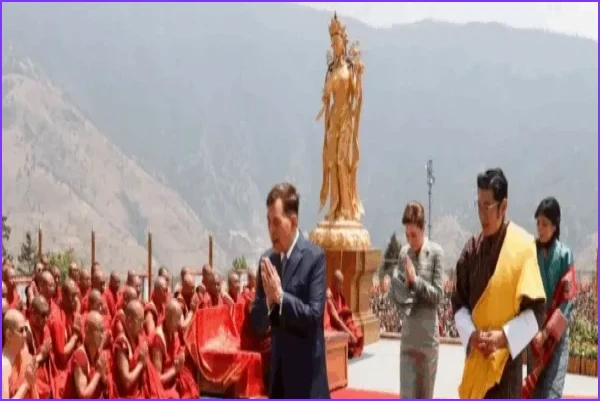
To expand its reach, Bhutan has strengthened ties with Thailand, Southeast Asia’s leading Theravāda Buddhist monarchy. High-level exchanges have reinforced this partnership, including a Buddhist chanting ceremony at the Buddha Dordenma statue on April 26, 2025, attended by Their Majesties the King and Queen of Thailand and the Bhutanese monarchs. Furthermore, the Gelephu Mindfulness City project represents a new phase of this diplomacy, using mindfulness and sustainability to attract global investment, despite the tension of applying Buddhist values to global capitalism.
Singapore, a secular and multireligious republic, employs a different model. Rather than grounding its diplomacy in religious identity, it acts as a connector. The late Venerable Hong Choon exemplified this through people-to-people diplomacy, building extensive networks in Thailand and China that date back to 1980, long before the latter established formal diplomatic ties with Singapore in 1990. Former Foreign Minister George Yeo also championed the revival of Nalanda University as a way to recover Asia’s shared civilizational heritage, demonstrating how Buddhism can transcend religious affiliation to foster regional cooperation. Please note that you have reached the limit of 2 free articles this month.
Singaporean institutions further this agenda through cultural diplomacy. The Asian Civilizations Museum uses exhibitions of Buddhist material culture, such as the upcoming Dunhuang exhibition organized with China's Dunhuang Academy, to strengthen partnerships and position the city-state as a site for interpreting shared heritage. Ultimately, the examples of Bhutan and Singapore demonstrate that there is no single model for Buddhist diplomacy; its effectiveness lies in the ability of small states to adapt cultural resources to their specific political contexts to advance their national interests.