Air quality across North America has deteriorated significantly as smoke from hundreds of active Canadian wildfires spreads across the continent, prompting hazardous conditions for tens of millions of people. The ongoing environmental crisis has forced the cancellation of outdoor events, disrupted businesses, and confined vulnerable residents to their homes as officials warn that the unhealthy air is likely to persist.
Air quality alerts were active across more than 20 US states as smoke from fires in south-central Canada, northern Ontario, and parts of Minnesota drifted southward. This week, approximately 109 million Americans throughout the Midwest, Mid-Atlantic, and Northeast experienced unhealthy breathing conditions. Meanwhile, for millions of Canadians, the hazardous haze has become a repetitive and exhausting summer reality.
In Waterloo, Ontario, resident Tenille Bonoguore pointed out that while much of the media coverage focuses on the impact in the United States, millions of Canadians are experiencing equally severe or worse conditions. She noted that families without air conditioning are facing a dangerous dilemma: choosing between opening windows to escape summer heat or keeping them closed to block out toxic smoke. For many, she added, this is the second, third, or fourth consecutive summer dealing with conditions that were unprecedented just a decade ago.
The pollution has also taken a heavy toll on outdoor workers. In Hamilton, Ontario, self-employed carpenter Ted Brearley reported that the dense smoke forced him to cut working hours and send his employees home, causing a substantial loss in business production. Brearley expressed frustration over the situation, questioning whether governments are investing enough in wildfire management and response as the fires worsen year after year.
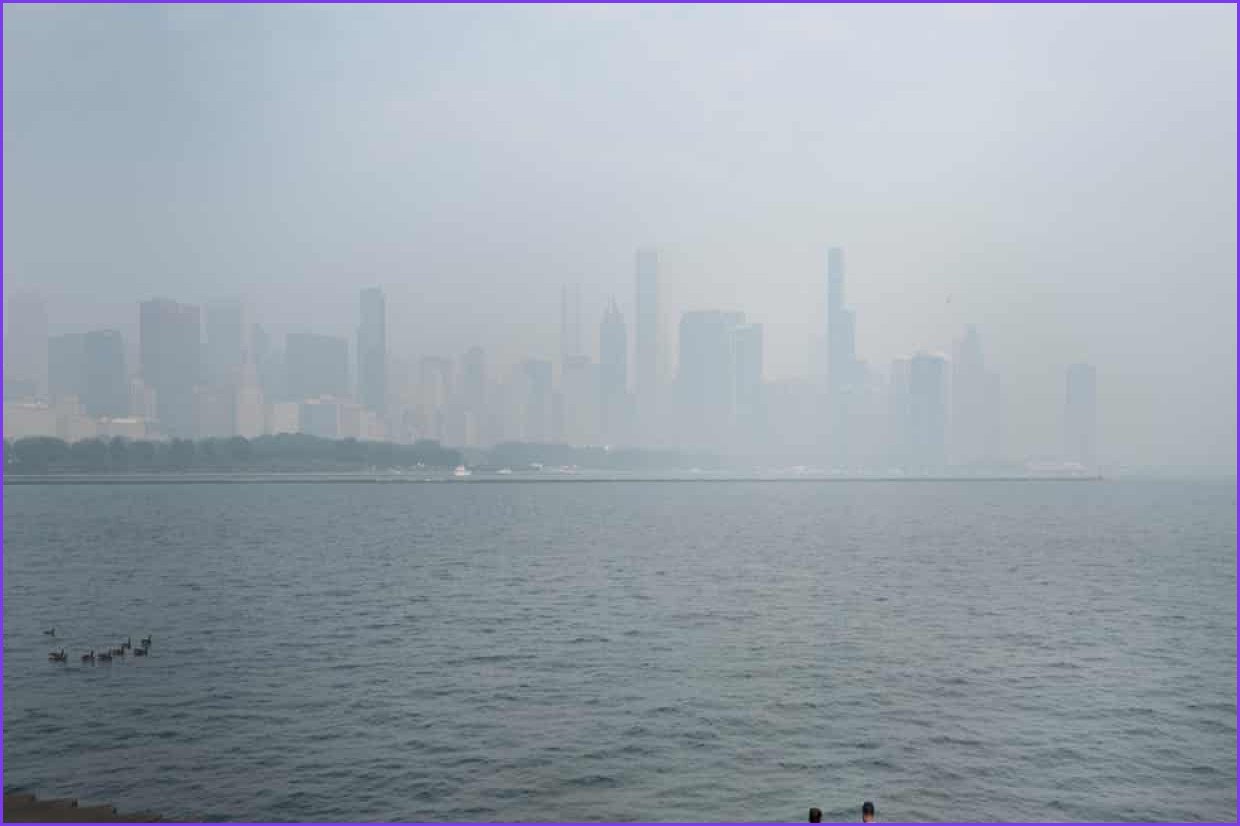
South of the border, the atmospheric conditions were described by residents as noxious. Chicago recorded the worst air quality in the world on Thursday evening according to global rankings, with Detroit and Minneapolis also placing among the most polluted cities. In Skokie, Illinois, 26-year-old student Zeff described a strong chemical smell resembling burnt plastic and noted that a thick white fog had blanketed his neighborhood. He described a feeling of profound, resigned hopelessness shared by those around him.
Vlad, a data engineer who has lived in Chicago for 20 years, called the current conditions the worst he has ever seen in the city. Concerned for his asthmatic son, Vlad has kept him indoors and plans to upgrade his home's HVAC filters and purchase an indoor air quality monitor. He noted that the air outside tasted actively toxic. As the smoke continued its eastward drift, it cast orange skies over New York City and brought a persistent smell of burning wood.
In Farmington Hills, Michigan, children's librarian Michelle Stiennon had to relocate an outdoor story time event indoors, jokingly calling it a "story-time apocalypse." The library distributed N95 masks to staff and visitors, but attendance dropped sharply in the afternoon as the smoke thickened. Stiennon also highlighted the strain on local healthcare facilities, noting that a co-worker who visited a local hospital reported a five-hour wait for a bed due to an influx of patients suffering from asthma and respiratory distress.
Health professionals continue to warn that wildfire smoke can dangerously exacerbate asthma, heart disease, and other respiratory illnesses, particularly in children, older adults, and individuals with pre-existing conditions. In Baltimore, Maryland, where air quality reached "very unhealthy" levels on Friday, primary care physician Charlotte Watts reported that both she and her patients were experiencing respiratory symptoms. Watts noted that many of her patients lack the air-conditioning or high-quality filtration systems needed to remain safe indoors. She expressed deep concern over the long-term habitability of the planet, criticizing governments and corporations for failing to prioritize public health in the face of the escalating climate crisis.
“With wildfires getting worse and worse, year after year, why is our government not stepping up to the plate?” he said. “Freebies don’t help when I can’t breathe, can’t work, or can’t feed my family or keep a roof over my head.”
“There’s a mirage hanging on the treetops, white fog blanketing everything in the distance,” he said. “Everybody I speak to voices a profound, resigned hopelessness.”